Bitcoin — along with 10 other select crypto tokens
—
now looks like a coiled spring. Why? Because
they all
have the same powerful ingredient:




I’ll explain exactly what I mean by that, and how it works…
But if the four-year Bitcoin cycle plays out again, as I believe it will…
And the global ‘big print’ of all fiat currencies begins in earnest…
It could trigger a rush into the hardest, scarcest asset ever created.
I will show you how, if nurtured correctly, that seed could not only 10x in the years ahead…
It could also SUPERCHARGE your purchasing power while everyone else loses theirs.
Now, that sounds like an enormous claim. I get it.
So, let me give you the background straight away.
And then I’ll explain how I can — in my power as publisher — leave an extra $3,000 in your pocket to start this journey...if you are convinced.
Hi, James Woodburn here. Publisher and CEO of Fat Tail Investment Research.
And my story today starts with a man you may have come across before.
His name is James Altucher.
He’s a former hedge fund manager, venture capital investor and bestselling author.
One of the most-widely read financial writers in America, and an OG podcaster.
And — in April 2013 — he was one of Bitcoin’s loudest critics.
Back then, when readers asked him about this strange new ‘internet money’, his answers were blunt.
‘Bitcoin is a fad,’ he told one. To another: ‘a bitcoin is worth $0.’
Then something happened.
James sat down with his friend Naval Ravikant — the founder of AngelList, and one of Silicon Valley’s sharpest minds.
Naval walked him through what Bitcoin actually was: a form of money with a hard, mathematical limit built into its code.
Only 21 million would ever exist…
No central bank could print more…
No government could inflate it away.
For a man who’d spent years watching the Federal Reserve conjure trillions out of thin air…that changed everything.
Within weeks, James didn’t just change his mind.
He staked his name on it.
In May 2013, he released his new book, Choose Yourself — and for the first month, before it hit Amazon, you could only buy it with Bitcoin.
It’s recognised as the first book ever sold for Bitcoin.
The mainstream press thought it was a publicity stunt. CNBC invited him on live TV to explain himself.
Here’s what he told them, with Bitcoin trading at around US$114:
‘It’s what I call a “Choose Yourself” currency. It doesn’t depend on any other institution to approve its use…the philosophy behind these digital currencies — and Bitcoin’s the leader — is very interesting, and will ultimately succeed.’
In fact, watch it yourself:
Today — even after the latest ‘crypto winter’ bear market — which took it from US$126,000 down to around US$58,000 in early July — it trades around US$86,000.
I’m telling you this for two reasons.
First: James earned his conviction the hard way — by starting out as a sceptic.
Which may be exactly where you’re sitting right now.
Second: I’ve watched him do it again.
In 2017, I began publishing James’s research here in Australia.
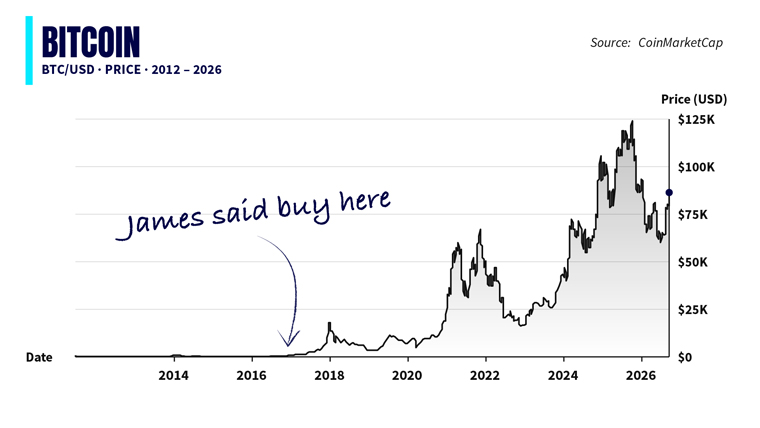
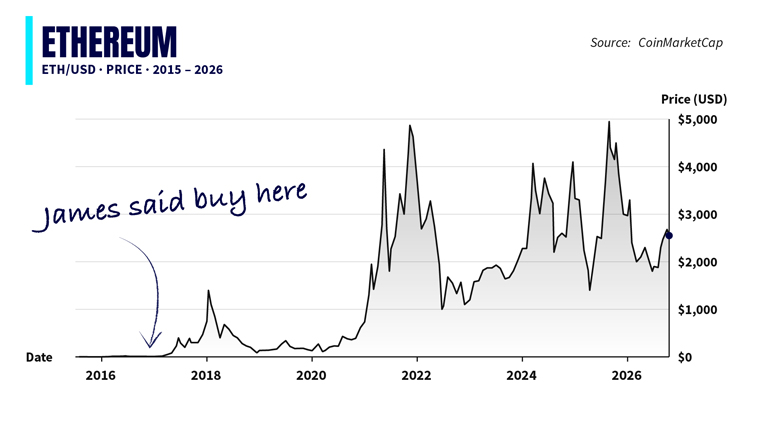
And I vividly remember the reaction when he told our readers to buy Bitcoin and Ethereum.
Plenty thought it was mad. Bitcoin was a few thousand dollars. Ethereum was a few hundred.
Those calls looked wild then. They don’t now:
Source: CoinMarketCap
Source: CoinMarketCap
Now, I’m not telling you James gets everything right.
Nobody does — and anyone who claims otherwise is selling you something worse than nothing.
What I am telling you is this: when James sees the same forces lining up that turned him from sceptic to believer in 2013…I pay attention.
And right now, he believes those forces are assembling again — on a scale that dwarfs anything we saw back then.
To understand why, you need to see three numbers the mainstream press has barely mentioned…
Three numbers that
explain everything
- Number one: US$23.3 trillion.
That’s America’s M2 money supply — roughly speaking, every US dollar sitting in circulation, cheque accounts, savings accounts and money market funds.
In August, it hit another all-time record, according to the Federal Reserve’s own data.
Let that sink in.
All the Covid stimulus, all the ‘emergency’ printing…was never unwound.
It’s now the baseline. And the pile has started growing again.
- Number two: ¥356.7 trillion.
That’s China’s M2 — which hit its own all-time record in June this year, according to the People’s Bank of China.
In US dollar terms, that’s roughly US$50 trillion. More than double America’s.
The world’s two largest economies, printing to record levels, at the same time.
- Number three: US$150 trillion.
That’s the total global stock of broad money as of June — another all-time record.
It grew by US$10.7 trillion in a single year. And the pace has been accelerating since April last year.
This is what I meant at the top of this letter by the global ‘big print’.
It’s not a forecast. And it’s not a theory.
It’s already on the central banks’ own ledgers.
And here’s the thing: I don’t believe they can stop.
Washington is now borrowing around US$2 trillion a year just to keep the lights on.
In the first 11 months of fiscal 2026 alone, the US government’s interest bill hit US$1.27 trillion…
More than America spends on its entire military.
When a government reaches that point, history says there’s only one politically survivable way out: print, inflate and debase.
Not once. Continuously.
A Federal Reserve official once admitted as much on 60 Minutes — ‘there’s an infinite amount of cash at the Federal Reserve.’
Check it out for yourself:
He meant it as reassurance.
But I’d take it as a warning.
And now the bond market has started taking it as a warning too...
The 10-year US Treasury yield recently pushed to levels not seen since 2002.
Bond prices are now falling while yields are rising.
Forget all the technical economic terms and jargon around it...
That basically means the bond market is repricing its trust in government issued paper currency, in real time.
And watch what’s happened as that trust erodes...
The rush into hard assets
has already begun
Gold — the oldest hard asset of all — set record after record, peaking in January.
Central banks themselves have been buying it by the tonne.
But something newer is happening alongside it.
Between July and early October, Bitcoin climbed by almost half — from around US$58,000 to around US$86,000…
While bond yields were rising.
That isn’t meant to happen.
For most of its life, Bitcoin traded like a tech stock — when yields rose, it fell along with other ‘risk on’ assets.
But this time it rose with gold instead, behaving like what its believers always said it was:
A hard, scarce monetary asset...a pressure release valve for the big print.
I want to be straight with you: a few months of trading doesn’t prove a permanent regime change.
Crypto remains volatile and speculative, and it will test your stomach again.
But put the pieces side by side.
Record money printing on one side of the scale.
And a small set of assets nobody can print on the other.
When one side can expand without limit…the pressure builds under the other.
Which brings me back to those four letters: L.S.L.D.
Here’s what that stands for...
Limited Supply.
Limitless Demand.
L.S.L.D.
It’s the oldest force in economics.
Take the supply side first...
You’ve just seen what’s happening to the supply of dollars and yuan: record after record, with no brake in sight.
It’s the same with Aussie dollars, pounds, the euro...all fiat currencies.
Now compare Bitcoin.
Bitcoin’s supply is capped at 21 million coins.
Not by policy. And not by promise.
But by code.
Enforced by a global network of computers that would all have to agree to change it.
They never have and there’s no sign they ever will.
Around 95% of every Bitcoin that will ever exist has already been created.
And every four years, the flow of new coins is cut in half.
It’s happened on schedule, every time, since 2009. Most recently in April 2024.
So run the comparison...
The world’s stock of money grew 7.7% in the past year.
Gold miners dig up roughly 1–2% more gold every year.
Bitcoin’s supply is growing at less than 1% a year — and that rate gets cut in half again in 2028.
It is now the hardest monetary asset humans have ever created.
Harder, even, than gold.
That’s the ‘Limited Supply’.
Now the second half of the equation...and let me be precise about what I mean by this.
‘Limitless demand’ doesn’t mean demand is guaranteed to rise forever.
Nothing works like that.
It means there’s no preset ceiling on who can buy — and the gates are swinging open, one after another.
Remember that Fed official on 60 Minutes, and his ‘infinite amount of cash’?
If the supply of dollars has no ceiling, neither does the pool of dollars that could one day go looking for something scarce.
And more of those dollars now move on blockchains, as stablecoins and tokenised funds.
That puts them a few clicks away from 21 million Bitcoin.
Now...think back to 2017, when James first told our Australian readers to buy Bitcoin.
Who could actually act on that advice?
Individuals willing to open an account on a crypto exchange.
That was the entire market.
Now look at the buyers who’ve arrived since — buyers who literally could not exist two years ago:
- The ETF money...
Since 2024, anyone with a broking account — or a financial adviser, or a retirement fund — can hold Bitcoin through funds run by the largest asset managers on the planet.
BlackRock’s Larry Fink, who once called Bitcoin ‘an index of money laundering’, now runs one of the biggest of them.
- The stablecoin loop...
Digital US dollars — stablecoins — have become one of the fastest-growing corners of finance, and under new US law their issuers must back them with high-quality reserves such as US Treasuries.
The US Treasury Secretary has pointed to projections of that market growing from around US$300 billion beyond US$2 trillion in the next few years.
Washington now has a financial interest in crypto’s plumbing succeeding.
- The Wall Street build-out...
Visa is settling payments across public blockchains.
The company that clears and settles almost every share trade in America is expanding onto one of them.
The world’s biggest banks are tokenising bonds, funds and deposits — on infrastructure that runs on a handful of specific tokens.
- The regulators...
The SEC has approved generic listing standards for crypto funds — meaning qualifying coins can now be wrapped in an ETF without years of case-by-case fighting.
Each approval opens the next pool of capital that was previously locked out.
- Even Ray Dalio...
Founder of the world’s largest hedge fund, and a gold man through and through, now says a portfolio should hold hard assets…and includes “a bit of Bitcoin” alongside his gold.
Point is, one by one, the people who couldn’t buy, wouldn’t buy, or weren’t allowed to buy…are becoming buyers.
That’s the ‘Limitless Demand’.
And there is no preset ceiling...
The coiled spring
Now put the two halves together, and you’ll see why I call this a coiled spring.
On one side: demand channels multiplying, with trillions in institutional money behind them.
On the other: an asset whose supply cannot expand to meet them. Not slowly. Not at all.
When demand surges into a normal market, producers make more of the thing, and the price settles.
More copper gets mined...more houses get built...more dollars get printed.
But when demand surges into a market where supply is fixed by code…
Price is the only thing that can move.
But look, a hard cap alone in and of itself makes nothing valuable.
There are thousands of capped tokens out there that are worthless today and will still be worthless in a decade.
Scarcity only matters when genuine, growing demand is pressing against it.
But here’s the thing — you’ve just watched both halves of that test lock into place.
The hard caps are real...written in code...and verified.
And the demand isn’t hypothetical either.
The ETFs are live. The stablecoin law is passed. Wall Street is building out the infrastructure rails and adopting digital assets.
There’s no question the gates are open, and institutional money is walking through them.
To me, the equation is clear: supply that can’t grow…is meeting demand that’s growing as we speak.
Which leaves just one question: if the spring really is wound this tight…
What could it be worth if it lets go?
Now, the bold part…
Everything you’ve read so far is the setup.
Here’s the potential payoff...
Earlier this week, I jumped on a call with Dr Lachlann Tierney — ‘Lachy’ to his friends — who heads up James Altucher’s crypto research advisory, Early-Stage Crypto Investor, here in Australia. (You’ll be hearing a lot more from him shortly.)
And I asked him straight: if this L.S.L.D. setup is real…what could it actually be worth? Put a number on it...
Interestingly, his starting point wasn’t crypto at all.
It was gold.
All the gold ever mined is worth around US$29 trillion right now.
And that figure hit a record in January, as central banks and investors crowded into the oldest debasement hedge there is.
Bitcoin — the hardest monetary asset ever created, as you’ve just seen — is worth around US$1.7 trillion.
Now run the scenario forward…
If the big print unfolds the way we believe it will…
And if Bitcoin captures even just HALF of gold’s role as the world’s hedge against money printing…
Measured against half of gold’s value today, the maths says Bitcoin’s market cap would be around US$14.5 trillion.
What does that mean in terms of price?
That’s roughly eight times what it trades today.
Per bitcoin, you’re talking north of US$700,000.
Leave out the millions of coins analysts believe are lost forever, and it’s closer to 10 times.
Let me be clear about what that is...
It’s a scenario, not a forecast. Nobody can promise you that outcome — and anyone who does is lying to you.
But notice what the scenario asks.
It doesn’t ask Bitcoin to conquer the world.
It only asks Bitcoin to do half the job gold already does.
And we’re far from the only ones running this kind of maths…
Late last year, analysts at JPMorgan — nobody’s idea of crypto cheerleaders — published research framing Bitcoin as a direct challenger to the roughly US$6 trillion private investors hold in gold. Their volatility-adjusted model puts the next staging post at roughly US$170,000.
Standard Chartered — the British bank founded back in 1853 — has mapped a staircase for Bitcoin: around US$100,000 by the end of 2026…climbing to US$500,000 by 2030.
Now, notice what they did during the crash. Twice, they pushed the early targets back. But the US$500,000 expectation stayed.
Cathie Wood’s ARK Invest goes further still: its latest outlook has Bitcoin worth around US$16 trillion by 2030, or roughly US$760,000 a coin.
VanEck, the Wall Street fund manager, has published a base case of US$2.9 million per Bitcoin by 2050.
US$170,000…US$500,000…US$760,000…US$2.9 million.
Different firms, with different models and different timeframes.
But all pointing the same way.
Now, take any long-range number with a pinch of salt. None of these outcomes are guaranteed.
But notice who’s publishing them now.
This is no longer simply ‘cypherpunks’...
This is the world’s global elite investment institutions.
And that’s just Bitcoin.
Here’s where it gets interesting for the other 10 cryptos I want to introduce you to today…
The leverage effect
Think about how gold mining stocks trade...
A small move in the gold price can mean a much bigger move in a miner’s profit margin.
So, the shares can amplify the metal, in both directions.
In 2016, a fund of gold mining shares (ticker: GDX) returned about 53%. A fund holding gold itself (ticker: GLD) returned about 8%.
In 2013 it ran the other way. The miners fell about 54%, against gold’s 28% fall.
There’s no fixed multiplier, but they’re a leveraged bet on the same metal.
Crypto has its own version of that pattern.
When Bitcoin runs, the smaller coins tend to follow.
Traders even have a name for the phenomenon: ‘altcoin season’.
Part of it is mechanical.
In crypto, Bitcoin is widely used as collateral — it’s what many traders post to fund their positions in everything else.
When it rises, buying power across the whole market expands with it.
And historically, the right smaller coins have moved much further than Bitcoin itself…
In both directions!
I’ll say that again: in BOTH directions.
Amplified gains in the good times. Amplified losses in the bad.
Which is exactly why you need to be very selective about which altcoins you go into.
You don’t simply want ‘a basket of altcoins’.
You want to make sure that the handful you are thinking about holding are where real, verifiable demand is building against a hard limit on supply.
Now, of the 22 recommendations in the Early-Stage Crypto Investor portfolio right now, 10 smaller coins pass that test and share Bitcoin’s defining characteristic of hard-capped and limited supply.
I can’t hand you the full list — that wouldn’t be fair to paying members.
But let me show you three, so you can see the calibre of what’s inside…
Three of the 10, up close
The first, I’ll simply give you. It’s the biggest of the 10, and we’ve named it publicly before: Chainlink (ticker: LINK).
If Wall Street is moving onto blockchains, something has to connect those chains to each other — and to the real world’s data.
That’s Chainlink.
Swift, the messaging network that connects more than 11,000 banks, has worked with it on moving value across blockchains.
And its supply?
Capped at one billion tokens.
Every single one already minted — about two-thirds out in circulation, the rest sitting in the project’s reserve. And under its current rules, not one more can ever be created.
The second, I’ll describe but not name.
It takes US Treasuries — the very IOUs Washington has to keep selling — and puts them on the blockchain, where institutions and stablecoin issuers can hold them.
It’s one of the first projects of its kind with the regulatory standing to do it.
Remember the stablecoin loop from earlier?
This project is its on-ramp.
If Treasuries move on-chain the way Washington now needs them to, it sits at the toll gate.
And its maximum supply is fixed: 10 billion tokens.
No mechanism exists to mint more under its current rules.
The third is James’s personal favourite in the entire portfolio.
It runs a decentralised marketplace for AI computing power — an AI economy that no tech giant controls.
Think of it as the anti-Big-Tech bet on artificial intelligence.
And here’s the kicker: its creators modelled its supply rules directly on Bitcoin’s.
A hard cap of 21 million tokens. The same number. Even the same four-yearly halving rhythm.
Bitcoin’s scarcity…pointed at the AI boom.
And deeper in the portfolio sit a couple of L.S.L.D. micro-caps almost nobody is watching.
Tiny, highly speculative projects I won’t describe here at all — they belong behind the members’ wall, with full risk warnings attached.
Every one of them — Bitcoin, the 10, and another 11 recommendations besides — is covered inside the service you’re about to see.
Which brings me to the timing.
And why this specific window…
Crypto has just been through a bear market that nearly halved Bitcoin.
So, why step in now?
Three big reasons...
Number one...
- The next four-year cycle could be dawning...
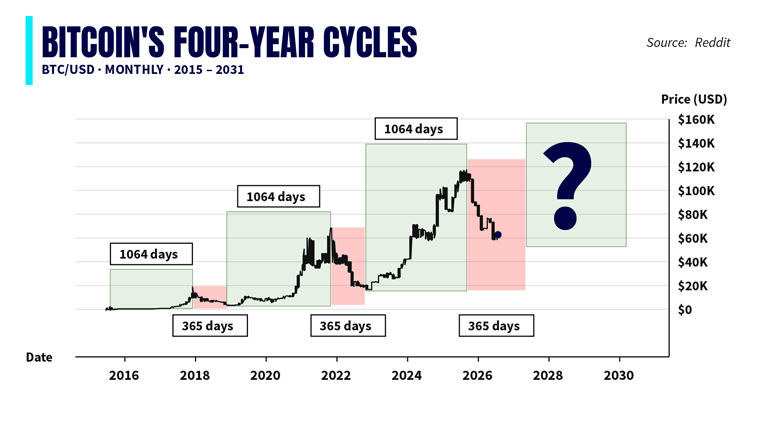
Since 2009, Bitcoin has moved in a rough four-year rhythm, anchored to those halvings — the moments its new supply gets cut in half.
Run-up…peak…crash…recovery.
2013...2017...2021...2025.
Peak after peak, crash after crash...each cycle topping out higher than the last.
Why four years?
Each halving cuts the flow of new coins, and that squeeze takes time to bite.
When it does, prices have tended to run hard and overshoot.
Then a crash clears out the borrowed money and the short-term crowd, ready for the next squeeze.
Bitcoin’s four-year cycles. Source: Reddit.
And here’s the part that matters for you today:
After the last three major bear markets — 2015, 2018, 2022 — the stretch that followed turned out to be the best entry window of the entire cycle.
We’ve just lived through the fourth such fall.
US$126,000 down to around US$58,000.
Now, I won’t pretend four cycles make a law of nature. They don’t.
The pattern could break this time. Standard Chartered’s head of digital assets research, for one, argues ETF flows now matter more than the halvings.
Maybe he’s right.
But as of now, there’s no evidence to suggest the four-year cycle is broken.
James Altucher certainly believes the rhythm remains intact — and that what we’ve just been through was the washout, not the ending.
- There are some key catalysts coming in 2027...
This isn’t vague ‘adoption is coming’ talk.
Lachy’s research has a calendar for 2027:
- On 18 January, the GENIUS Act — America’s new stablecoin law — takes effect…channelling stablecoin reserves into high-quality assets such as US Treasuries, and Washington’s interest into crypto’s success...
- In February, South Korea begins its tokenisation rollout...
- In the first half of the year, the plumbing of the US share market is scheduled to bring tokenised assets onto one of the blockchains in our 10...
- And the SEC’s new listing standards mean more coins being wrapped into regulated funds, one after another, all year long.
But perhaps the most compelling reason for you as an investor...
- The price of being early
It’s a cliché, but it’s also true...
Nobody rings a bell at the bottom.
I can’t tell you crypto has bottomed — nobody can, and you should run from anyone who claims otherwise.
What I can tell you is this: Bitcoin sits roughly a third below its old high.
The smaller coins sit further below theirs.
And the demand machinery you’ve just read about is being bolted into place either way.
Buying after the crash, before the catalysts…that’s the uncomfortable window.
It never feels good.
It didn’t feel good when James backed it at US$114, either!
That’s why I picked this moment.
And it’s why the next four days exist…
Like I’ve said, the research service James and Lachy run together is called:
James Altucher’s
Early-Stage Crypto Investor
It’s our premium crypto advisory — the only place James’s early-stage crypto recommendations are published for Australian investors, with Lachy working the Australian angles alongside him.
Here’s what membership gives you
- The live model portfolio — all 22 current recommendations, including every one of the 10 L.S.L.D. coins, with guidance on which to buy at today’s prices.
- New recommendations as James and the team find them, with the reasoning laid out in full.
- Buy and sell alerts — so you’re never left guessing when the picture changes.
- Regular briefings on the portfolio and the market, through the week and through the cycle.
- And the members’ archive — years of guides and research, including step-by-step walkthroughs on buying and storing crypto safely, built for people doing this for the first time.
But the first thing to read is the newest thing…
The moment you join, you’ll get Lachy’s brand-new report:
2027: Crypto’s
New Rules and
22 Coins
for the Next Cycle
 It’s a serious piece of work.
Lachy’s ‘debt hyper-complex’, and why it makes the big print so hard to stop.
The five new rules reshaping crypto.
The full 2027 catalyst calendar.
All 22 recommendations, grouped by risk — the core holdings, the contenders, the long shots.
And every one of the 10 L.S.L.D. coins, named, with the reasoning behind each.
Lachy’s advice: grab a coffee before you open it. You’ll need the full cup!
Now, about that $3,000...
At the top of this letter, I promised to explain how I can — in my power as publisher — leave an extra $3,000 in your pocket if any of this interests you.
Here it is, straight up...
The publisher’s price for a year of Early-Stage Crypto Investor is $3,999.
Until 11:59pm this Monday night — 19 October — you can join for $999.
Same service. Same portfolio. Same reports, same alerts, same everything.
But $3,000 less.
I’m not handing you cash, and nobody’s funding an account for you.
It’s simpler than that: if you were ever going to join this service, joining before Monday night leaves $3,000 in your pocket that joining later wouldn’t.
What you do with that $3,000 is entirely your call.
But here’s the thought I couldn’t shake — and what I built this whole invitation around…
$3,000 happens to be a meaningful seed at a moment when I believe the spring is coiled.
Let’s run the hypothetical (and be clear, that’s what this is — a hypothetical, not a promise)...
If the scenario Lachy sketched earlier plays out — Bitcoin capturing half of gold’s role over the coming years, a move in the region of 8x to 10x — then $3,000 positioned in Bitcoin alone becomes something like $24,000 to $30,000.
And if the right smaller L.S.L.D. coins amplify that move the way smaller coins have amplified Bitcoin in past cycles…that’s where the 10x I flagged at the top of this letter stops sounding outrageous.
Could it fail to play out? Absolutely.
Crypto could crash again instead — it’s done it before and it will test you.
That’s why the seed should only ever be money you can genuinely afford to put at risk.
And if the thesis is wrong?
Then you’ve joined a world-class research service for $999 instead of $3,999 — with a guarantee at your back.
Which brings me to the last thing…
The guarantee —
and your decision
 Your membership comes with a 30-day money-back guarantee of any subscription fee you pay.
So, you can join, read Lachy’s report, open the portfolio, dig through our extensive archive of reports and videos.
If you decide it’s not for you, contact our Melbourne-based member services team within 30 days and we’ll refund your membership fee in full.
And let me say the plain thing one final time, without any gloss on it: crypto is speculative.
These assets can halve, as you’ve seen in this letter.
Some can go to zero.
Never invest money you can’t afford to lose and never borrow to speculate.
So, here’s the decision, laid out:
James Altucher’s Early-Stage Crypto Investor.
Twelve months of research, recommendations and guidance.
Lachy’s 2027 report the moment you join.
The full ten-coin L.S.L.D. list, named.
$999 until 11:59pm Monday 19 October, AEDT.
$3,999 after that.

Join Early-Stage
Crypto Investor here
Your window closes Monday night.
Sincerely,

James Woodburn,
Publisher & CEO, Fat Tail Investment Research
P.S. If you skipped to the end, here’s the letter in five lines...
Governments are printing money at record levels — the figures are on the central banks’ own ledgers.
Ten of the 22 cryptos in our Early-Stage Crypto Investor buy-list share Bitcoin’s defining trait: a hard limit on supply, written into its rules.
James Altucher — who defended Bitcoin on CNBC at US$114 — believes the same forces that made him a believer in 2013 are assembling again, bigger.
Until 11:59pm Monday 19 October you can join for $999 instead of $3,999…and the $3,000 you don’t spend is yours to deploy however you choose.
Seed money, if you want it to be.