



DRAWN UP AT THE G7 SUMMIT IN EVIAN
In June, the world’s most powerful leaders gathered at a French palace overlooking Lake Geneva.
They were there to discuss a problem most people never think about.
Rare earth magnets.
Tiny components with extraordinary power that turn electricity into motion — and make many modern technologies work.
You’ll find them buried inside your phone. Your television. Your washing machine.
They’re inside cars, fighter jets and military communication systems.
Almost anything with a screen, speaker or electric motor depends on them.
So what’s the problem?
China produces more than 90% of these components.
Around US$6.5 trillion of global production depends on China playing ball.
And if it suddenly stops…
The AI buildout grinds to a halt.
Nvidia, Microsoft, Google, Amazon and Meta stocks would fall — hard.
You’d feel the hit to your portfolio—everyone would.
Here at home, our economy would cop it.
Wind and solar installations would come to a standstill. The grid upgrade would seize up. And without replacement drill rig and truck parts, mines would slow right down.
And that’s before we even get to the housing market.
For decades, Western governments have allowed this dependence to grow — because we all benefited from it.
But Trump is a different kettle of fish.
At the G7 summit on Lake Geneva, America told its allies: enough.
The minerals underpinning the US economy — and national defence — can no longer be left in Beijing’s hands.
So, they’re investing in an entirely new supply chain.
And that’s opening up a new
opportunity for Australian
investors like you
Since October 2025, Western governments have committed AU$135 billion to projects designed to mine, process and manufacture critical minerals outside of China.
We’re talking new mines…
New processing plants…
New refineries…
And new manufacturing capacity that simply doesn’t exist today.
Now, why should you care?
History tells us that when hundreds of billions of dollars in infrastructure capital suddenly starts flowing in one direction…fortunes can be made by the companies standing in its path.
And guess where some of that capital is headed?
You guessed it.
About 150 kilometres south of Perth, construction is underway on a new gallium facility. The US and Australian governments have committed US$400 million to help get it built.
Now, gallium is fast becoming the new silicon. It’s used in specialist heat-resistant chips for data centres, satellites and EVs.
And at full capacity, this site could produce 100 tonnes of gallium a year. Around 10% of global demand.
Now drive 300 kilometres northwest of Melbourne and you’ll reach the Donald Project. Here an American company is helping to turn a vast mineral deposit into a working rare earths mine.
Energy Fuels has already put roughly AU$85 million into the project. And their total investment could reach AU$183 million as the mine moves into production.
And if you head across the border into New South Wales, you’ll find another example.
Around 110 kilometres northwest of Mildura lies the Copi Project. A titanium and rare earth deposit so significant that four governments — the US, Japan, India and Australia — have thrown their support behind it.
At full capacity, the Copi Project will produce around 400,000 tonnes a year of the titanium feedstock, something geologists call zircon.
This is what’s happening across Australia right now. And it’s just a taste of what’s to come.
Deposits that sat untouched for years are finally getting the financial backing to become mines.
Processing plants are breaking ground.
And new supply chains are taking shape.
Piece by piece, Australia is building the West’s alternative to China.
This is the kind of setup investors wait a lifetime for.
And right now, you’re one of the few who know about it.
Today, you’ll learn how to take advantage of this situation long before most other investors realise its significance.
In the next few minutes, you’ll hear about four ASX companies I’ve been watching closely.
They’re standing in the path of capital set free by Trump’s New Trade Map.
You’ll see why I believe their share prices could soon re-rate. Potentially dramatically.
And you’ll learn why it’s important you position yourself before 1 January 2027.
The people closest to this shift know how rare — and potentially lucrative — this development could be.
Arafura CEO Darryl Cuzzubbo has spent 35 years in the Australian resources industry. He says:
I’ve never seen this level of alignment and cooperation at the highest levels of two governments.’
Treasurer Jim Chalmers calls it…
An absolutely golden opportunity for our country.’
But perhaps Resources Minister Madeleine King put it best:
We are now part of a broader reconfiguration of a global trading order.’
Think about what that means.
We’re not talking about another rotation of the mining cycle here.
Governments are deliberately rebuilding a global supply chain.
This has only happened three times in the last 50 years.
China in the early 2000s. Japan in the 1980s. Britain in the 1970s.
And each time, those who positioned themselves early had the chance to multiply their investment many times over.
You may remember the last time global supply chains were re-drawn…
It started back on 11 December 2001, when China joined the World Trade Organisation.
That single political decision helped turn China into the world’s factory.
Suddenly, Beijing needed staggering quantities of iron ore, coal, copper and aluminium.
And Australia happened to be sitting on mountains of the stuff.
Money began flooding into Australian mines, ports, railways and processing facilities.
What followed has become the stuff of investing folklore…
Some mining companies didn’t merely rise.
They turned modest investments into some very sizable sums.
Take Mount Gibson Iron.
At the beginning of 2003, it was a speculative little company trying to break into an iron-ore industry dominated by BHP and Rio Tinto.
You could have bought its shares for around 7 cents.
Five years later, those same shares were trading for $2.80.
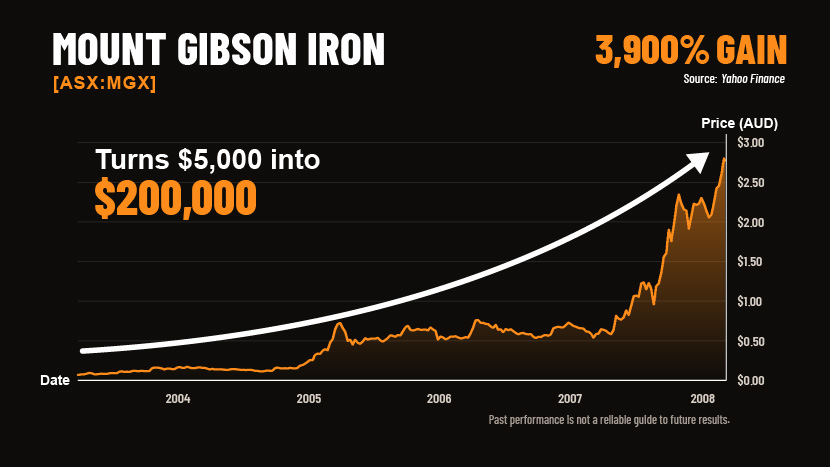
Meaning every $5,000 invested would have grown to $195,000.
And that wasn’t an isolated opportunity.
In 2005, you could have bought another little Pilbara hopeful called Atlas Iron for less than 30 cents a share.
At its peak, Atlas traded above $4.
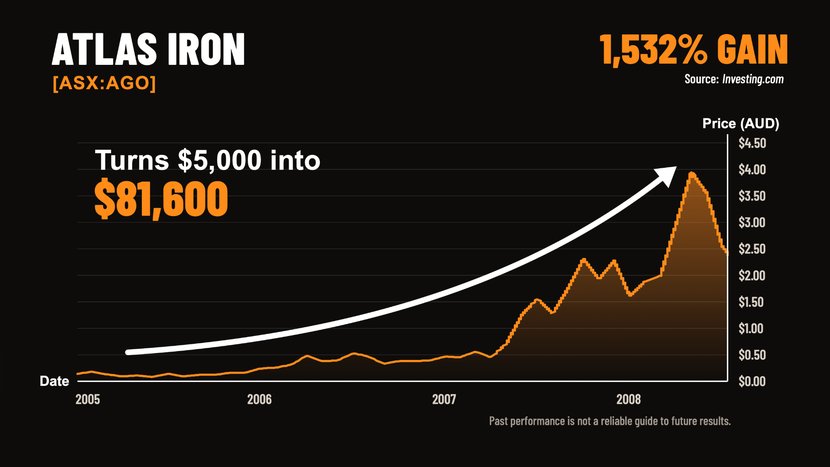
Turning a $5,000 investment into more than $81,000.
But the opportunity most Australians would come to regret missing was Fortescue.
Today, everyone knows the name.
Back then, it was a tiny explorer with no mines, no railway and no port.
In October 2003, you could have bought its shares for around 2 cents.
Think about that — $5,000 would have bought you 250,000 shares.
Five years later, with Fortescue trading above $12, that holding would have been worth more than $3 million.
And if you’d held on until Fortescue reached almost $29 in 2024, those same shares would have been worth more than $7 million.
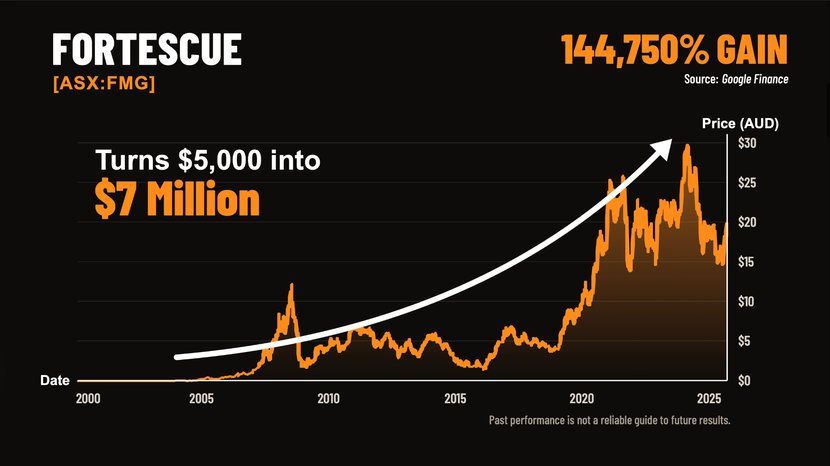
It sounds unbelievable — but
it actually happened
Of course, not all mining companies performed like these. Fortescue was certainly an outlier, unlikely to be repeated.
But the fact remains that regular Australians had the chance to buy these companies before China’s rise became obvious to everyone else.
Most didn’t.
They watched the boom unfold on the evening news. They read about soaring commodity prices. They saw mining billionaires get richer.
And by the time the opportunity felt safe, the biggest gains had already been made.
I believe Australia is facing a similar breakthrough opportunity today.
Because Trump is redrawing the world’s trade map again.
Only this time, the objective isn’t to build China’s supply chain.
It’s to build one outside of China.
And Australia could — again — be one of the biggest beneficiaries.
Which means the decisions you make right now could determine whether this becomes another historic boom you merely read about…
Or the opportunity that changes when you can retire, how you can live, and what you leave to your family.
That’s what I want to show you today.
I’ll walk you through exactly what Trump’s New Trade Map could mean for your investment portfolio, and for your family’s financial future.
I’ll reveal four companies I believe are best placed to capture this flood of spending.
And show you four things you can do right now to put yourself on the right side of this historic shift.
But before we get into any of that…
I should properly introduce myself

James Cooper
My name is James Cooper.
I’m a resource market analyst and former exploration geologist.
For the past 15 years, I’ve watched geopolitics shift commodity prices — and make or break fortunes in a heartbeat.
Back in 2011, I was on the ground in Zambia, hunting copper for a small Aussie explorer called Equinox Minerals.
Copper was in high demand from China.
And the world’s biggest gold miner — Barrick Gold — took a big bet on copper, buying Equinox for $7.6 billion in cash.
After the takeover, I helped lead what became Africa’s biggest drill-out.
For a moment, it felt like we were part of something unstoppable.
Then Beijing shifted its economic direction.
Virtually overnight, the world had a copper glut. Prices tumbled. Barrick panicked. Hundreds were laid off.
Barrick wrote down its Zambia portfolio from $7.6 billion to just $1 billion.
Brutal doesn’t even begin to describe it.
But here’s what stuck with me…
The rocks didn’t change. Politics did. So if you want to make real money in mining, you can’t just chase drill results.
You’ve got to understand what’s driving the market — where demand’s really heading.
That’s why I study global trends before a single drill result.
It’s how I find the big movers early…before the crowd even knows what’s coming.
In 2023, some of the biggest names in global finance — Citi Group, Goldman Sachs and S&P Global — were all bearish on copper.
I didn’t see it that way.
I could see that Russia’s invasion of Ukraine would shake up more than just oil and gas.
Sure enough, in April 2024, the US and UK stopped buying Russian aluminium, copper and nickel.
My readers were well positioned for the move.
One copper explorer is up over 300% — and it’s still climbing.
In our copper producer, we’ve already taken part profits after it ran up 141%.
Last year, when Trump slapped new tariffs on China, Beijing hit back with export controls on the high-tech permanent magnets I mentioned earlier.
I recommended a company with both a rare earths mine and a processing facility — outside China.
In just five months, it climbed 149%.
And three months before the Iran war, I told my readers…
I believe we’re in the midst of a significant transition in the global energy markets.’
You know what happened next. Oil prices almost doubled. My recommendation jumped 43% in just four months.
Now, not every stock I recommend goes up like these. Sometimes I’ve been early — and sometimes wrong.
I don’t believe I’m wrong this time, though.
Because — without exaggeration — I think we’re looking at the biggest shift in global trade in 25 years.
It’s a financial story that every investor in the world will soon be talking about. Many will wish they had the intel that could soon be in your hands.
Because on 1 January 2027, a deadline passes that could push this story onto the front pages.
I want to give you the chance to get in front of it.
Before I show you how, you need to know…
How Donald Trump is changing the
economics of the mining industry
In June, Donald Trump, former UK Prime Minister Keir Starmer, France’s President Emmanuel Macron and other G7 leaders agreed to break China’s grip on critical minerals.
That decision is changing — in real time — which mining projects get green-lit.
For years, those decisions were left to the market.
And that typically means the lowest-cost producer wins.
For 25 years, that meant Australian ore and Chinese processing.
Now, that era is ending.
In its place is a new model.
Where Western governments pick the winners.
And they’re moving the market in three new and remarkable ways.
The first is by taking direct stakes in mining companies.
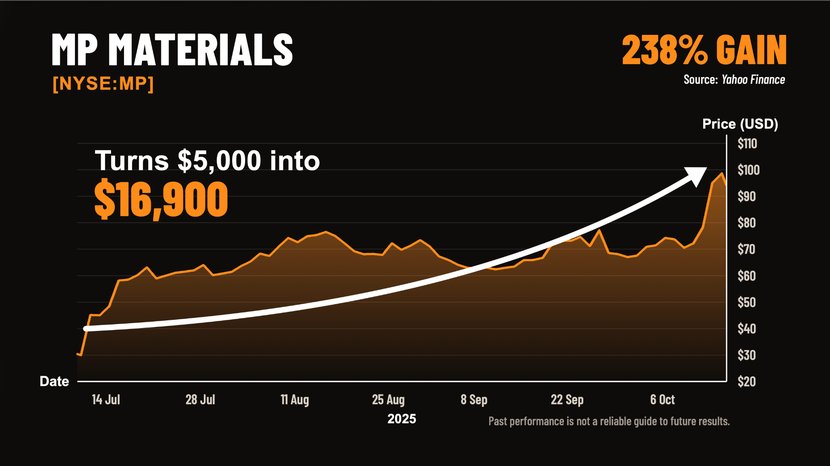
Last year the Pentagon bought 400,000 shares of US rare earths producer MP Materials for US$400 million.
It also secured a 10-year warrant allowing it to buy another 11 million shares — at the same price.
That means the US government is thinking — and acting — like an investor.
Because if the share price takes off — it can buy another 11 million shares at a deep discount.
So, what happened after the Pentagon’s big move?
The stock jumped 62% in a single day.
In a month, it was up 164%...
And the share price kept moving higher…
Soaring 238% in just three months.
We saw the same thing with Trilogy Metals.
This time, a proposed US government investment sent the stock ripping over 400% in a week.
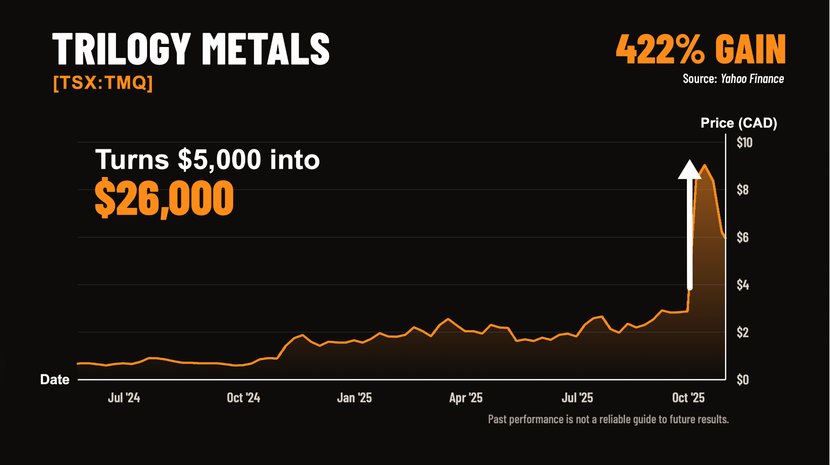
The government is proposing to buy 8.2 million shares for US$17.8 million.
With a 10-year warrant that could more than double their upside.
Now, the deal hasn’t yet closed.
But we’ve seen the market impact of the rumour.
We saw the same story play out when the US Department of Energy took a 5% stake in Lithium Americas.
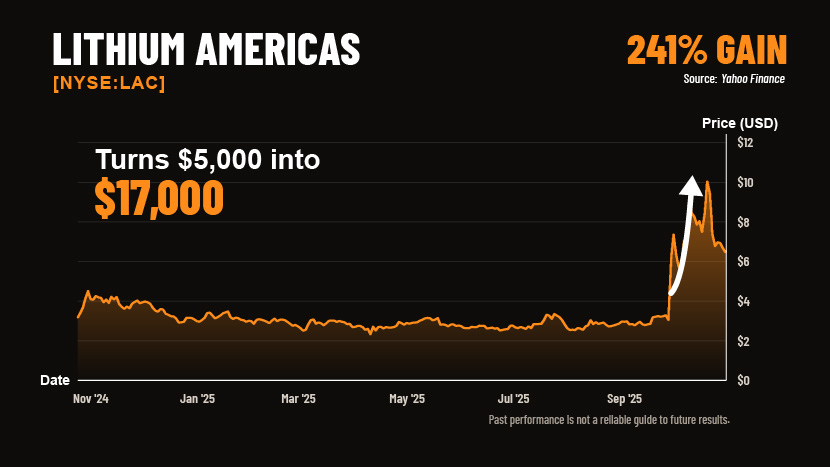
The share price ran up from $2.96 to over $10 in less than a month.
A 241% move in just three weeks.
Point is, Western governments are no longer just watching commodity markets. They’re moving them.
And investors who understand what’s happening could see years of gains compressed into months — or even weeks.
But direct investment is only the first way governments are helping these projects get off the ground.
The second?
They’re putting floors under prices.
In simple terms, governments are saying:
If the market won’t pay enough to make these projects economic, we will.
That gives miners something they’ve rarely had before — greater certainty over what they’ll be paid.
And that certainty makes it much easier to justify spending billions on new mines and processing plants.
Just look at Lynas Rare Earths.
Its average selling price is now 70% higher than a year ago.
And, since the start of last year, its share price is up as much as 261%.
It has since given back some of those gains — giving investors another chance to buy at what I believe is an attractive price.
But there’s a third way governments are tipping the scales.
They’re becoming customers.
Through long-term offtake agreements, governments can effectively say:
Build the project, produce the minerals, and we’ll buy them.
That removes one of the biggest risks facing any new mine.
Governments suddenly have a very good reason to become buyers.
They’re building enormous stockpiles of critical minerals for economic and national security.
Australia is committing AU$1.2 billion to its strategic reserve.
America has launched the US$12 billion Project Vault to stockpile critical minerals for US industry.
And this isn’t theoretical. The money is already moving.
Take Arafura Rare Earths.
In May 2026, Canberra made a non-binding commitment to purchase up to 500 tonnes of rare earths per year for the next five years.
That commitment gave Arafura something enormously important.
The confidence to commit to building its Nolans rare earth processing facility.
Think about that...
A plant that might otherwise have struggled to get built suddenly had the Australian government standing behind it as a future customer.
The government changed the economics of the project.
When you step back and add all these interventions together: the investments…the price support…the guaranteed buyers…the stockpiles…and the alliances being built around them…
You can see the scale of what’s starting to happen.
Western governments have already put roughly AU$135 billion behind the creation of a new ‘China-free’ critical-minerals supply chain.
Now, $135 billion is one of those numbers that’s almost too big to mean anything.
So let me put it another way.
After World War II, America launched the Marshall Plan to help rebuild Western Europe.
It became one of the biggest and most consequential government investment programs in modern history.
It cost roughly AU$260 billion in today’s money.
Which means…
America and its allies have already committed around HALF that amount to rebuild the critical minerals supply chain.
Think about that.
The money on the table is over half the cost of rebuilding an entire continent.
And it’s being directed towards one simple goal:
Breaking China’s grip on critical minerals.
As an investor, you need to pay close attention to where this money goes next.
Because governments can announce billions in new funding virtually overnight.
They can sign agreements.
They can offer loans, tax breaks and price floors.
All of which can move markets.
But none of those things break China’s grip by themselves.
These financial commitments still have to become new mines, processing plants, storage depots, power infrastructure, and manufacturing facilities.
That’s why I believe the mining boom taking shape today is unprecedented and could look very different from the ones most Australians remember.
Here’s what I mean...
The old model was simple: Dig it up. Ship it out.
Australia produced enormous quantities of iron ore, coal, lithium and other raw materials.
Most of it got shipped to China for processing and manufacturing.
Now, Trump wants a new supply chain built outside China.
For Australia, that increasingly means:
Dig it up. Process it here. Stockpile it here. Manufacture it here. Then sell those metals to American, Japanese and European buyers.
Sounds perfect. But it dramatically increases the amount of infrastructure required for every tonne of material Australia produces.
Because in this future, we don’t just need more mines.
We need more power, more refineries, more chemical plants, processing facilities and advanced manufacturing.
Someone has to build those facilities. Someone has to maintain the machinery. And someone has to supply the enormous quantities of energy required to keep them running.
That could create a wave of industrial spending that stretches far beyond the companies digging critical minerals out of the ground.
You can already see this taking
shape across Australia
If you drive 135 kilometres north of Alice Springs, along the Stuart Highway towards Darwin, you enter cattle country.
Red earth. Low scrub. Long stretches of road disappearing towards the horizon.
Near the tiny settlement of Aileron, Australia is preparing to build one of the world’s most important rare earth operations.
It’s called the Nolans Project.
And once it reaches full production, it will mine and process 4,400 tonnes of neodymium-praseodymium oxide every year.
Now, that name probably means very little to you.
But what it does is much easier to understand.
It’s used to make some of the strongest permanent magnets on Earth.
Put those magnets inside an electric motor, and they help turn electricity into movement.
They propel electric cars. Move the arms of industrial robots. Spin the rotors inside drones. And drive the tiny mechanism vibrating inside speakers and headphones.
In other words, they help move much of the modern world.
And Nolans could eventually produce enough rare earths to power around 4.5 million EVs per year.
To put that into perspective, Tesla sold 1.6 million cars in 2025.
So this single project in the cattle country north of Alice Springs could produce enough rare earths for almost three times Tesla’s annual production.
But the most important part of the story isn’t simply how much Nolans could produce.
It’s what happens to the materials before they leave Australia.
The rare earth ore will be mined here. Processed here. And separated into magnet-ready oxides here.
The industry will be transformed.
You can see it happening in Western Australia, too.
Around 500 kilometres east of Perth lies the Mount Holland mine.
This is remote Goldfields country.
Low bushland. Long, empty roads. And an enormous open pit where miners once searched for gold.
Today, they’re digging up something the modern world needs even more. Lithium.
The ore is hauled from the pit, crushed and processed into a lithium-rich concentrate known as spodumene.
In the past, that’s where Australia’s role in the supply chain ended.
The concentrate would have been loaded onto a ship and sent to China, where someone else would turn it into the high-value chemical needed to make batteries.
But that isn’t what happens at Mount Holland.
Instead, the concentrate begins another journey.
It travels west, from the remote bush to the industrial coastline south of Perth.
There, at Covalent’s new refinery in Kwinana, it passes through a series of furnaces, tanks and chemical processes.
The grey rock that came out of the ground hundreds of kilometres away eventually emerges as a fine, white powder.
That’s the material battery manufacturers use to produce the cells that power electric vehicles.
In July 2025, the refinery produced its first battery-grade lithium.
Once it reaches full capacity, Kwinana could produce around 50,000 tonnes per year. Enough for roughly one million EVs.
In Queensland, you can see what the finished version of this new industrial model looks like...
The journey begins near Weipa, on the western edge of Cape York.
Here, beneath the tropical bushland and red soil, lies one of the world’s great deposits of bauxite — the reddish-brown rock from which aluminium is made.
The ore is dug from the ground and carried by rail to the coast. There it’s loaded into the holds of enormous bulk carriers and begins a journey of more than 2,000 kilometres down the Queensland coast.
The ships carry the bauxite south to Gladstone, where it’s unloaded at one of the largest alumina refineries in the world.
Inside the refinery, the rough red ore is crushed into fine particles and mixed with a hot solution of caustic soda.
The unwanted minerals fall away as red mud.
What remains passes through vast tanks before being heated to more than 1,000 degrees Celsius.
By the end of that process, the red rock that left Cape York has become something almost unrecognisable: a fine, white powder called alumina.
But it still isn’t aluminium.
To complete the transformation, that powder travels along a conveyor belt to the Boyne Island smelter next door.
There, the alumina is fed into enormous smelting pots and hit with an immense electrical current.
Now you’ve got the metal that can end up in Coke cans, smartphones, cars and planes.
Queensland produces more than 500,000 tonnes of it every year at Boyne Island alone.
It’s a fully integrated supply chain.
And it’s one of only a handful in the Western world.
Trump wants us to replicate that model across lithium, rare earths and other strategic minerals.
And that’s going to create the kind
of investment opportunities
we haven’t seen for
20 years or more
And not just in mining companies themselves.
Every one of those supply chains must first be built.
The mines must be dug. The processing plants must be constructed. The refineries, roads, railways and ports must be expanded.
And once they’re up and running, they’ll consume enormous amounts of energy.
No matter which critical mineral attracts the most money. No matter which project receives approval first. And no matter which commodity rises fastest — two things have to happen.
Someone has to build this new supply chain. And someone has to power it.
That means the biggest investment opportunity may not depend on correctly predicting whether lithium, copper, uranium or rare earths become the standout commodity of the next decade...
...but on owning the companies that get paid to build, maintain and service all of them.
I’m talking mine development. Production. Processing. Refining. Manufacturing and more.
The more Australia spends building these new supply chains, the more work should flow to these companies.
And unlike speculative explorers, these are established, profitable businesses.
In fact, some of these stocks are already on the move.
Take the company that repairs diggers, trucks and crushers. Its shares are up over 300% in the last five years.
Then there’s the business that helps keep refineries and processing plants running. Its shares have climbed 193% over the same period.
My point?
If you wait until this construction
boom is obvious to everyone, you
may have missed the best
buying opportunities
History shows us why.
On 6 October 1973, while Israelis observed the holy day of Yom Kippur, Egyptian and Syrian forces launched a surprise attack.
The fighting lasted just 19 days.
But it set in motion an economic shock whose consequences are still with us today.
Arab oil producers punished America and its allies for supporting Israel.
They cut production. Raised prices. And imposed an oil embargo on the United States and several other countries.
Within months, the price of oil had almost quadrupled.
Petrol stations ran short. Inflation surged. The global economy tipped into recession. And Western governments were forced to confront an uncomfortable truth:
Their economies ran on oil that OPEC could simply turn off.
Almost overnight, energy security became a national priority.
America launched Project Independence, created the Strategic Petroleum Reserve and pushed ahead with the Trans-Alaska Pipeline.
Britain didn’t waste time either. It looked beneath the freezing waters of the North Sea.
And that’s where this story gets interesting for investors.
Because Britain already knew there was oil down there.
BP had discovered the giant Forties field in 1970.
But extracting oil from beneath the storm-lashed North Sea was difficult, dangerous and expensive.
Then came the embargo.
Suddenly, North Sea oil didn’t look quite so difficult.
And something that had been sitting beneath the seabed for millions of years became an economic lifeline.
But Britain couldn’t simply turn a tap and bring the oil ashore.
It had to build an entire new supply chain.
It needed drilling platforms strong enough to withstand enormous waves.
Pipelines stretching for hundreds of kilometres beneath the sea.
Terminals, supply vessels, helicopters and specialised equipment.
Most importantly, it needed companies with the expertise to make everything work.
What followed was one of the greatest industrial building programs in modern British history.
Thousands of wells were drilled. Hundreds of offshore installations were constructed. And more than 10,000 kilometres of pipeline were laid across the seabed.
BP later described Forties as a turning point for Britain.
That almost understates it.
By 1980, Britain had become self-sufficient in oil.
A year later, it was a net exporter.
And by the middle of the decade, North Sea oil was delivering 10% of all Treasury revenue.
It transformed Britain — and created fortunes for investors.
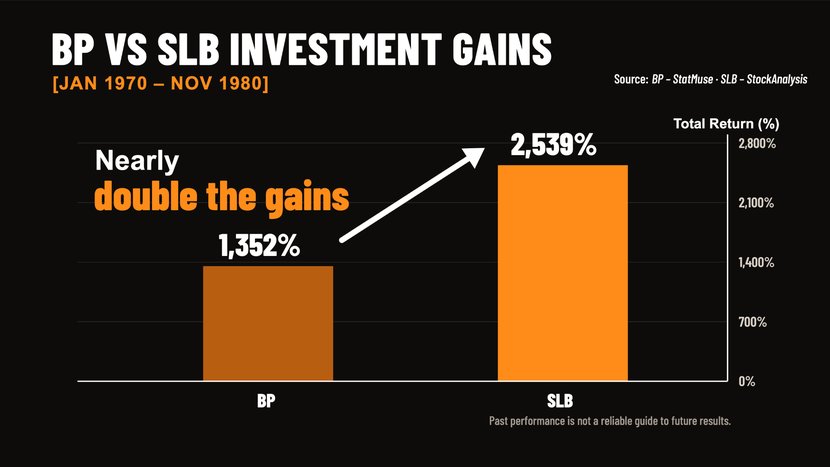
If you’d invested in BP at the beginning of 1970, your money would have increased more than thirteenfold by 1980.
A $5,000 investment would have grown to approximately $72,000.
That’s an extraordinary return.
But BP wasn’t the biggest winner.
The company that made substantially more money for its investors didn’t own the Forties field.
It didn’t discover the oil.
And it didn’t have to gamble billions getting it out of the ground.
Instead, it supplied something every major oil producer suddenly needed:
The expertise and technology required to drill difficult wells and keep the oil flowing.
That company was Schlumberger — known today as SLB.
It was founded almost 50 years earlier by two French brothers who pioneered the use of electrical measurements to understand what lay beneath the ground.
When oil majors began pouring billions into the North Sea, SLB was ready.
It didn’t matter whether BP, Shell or Exxon struck oil.
Every new well required drilling technology, specialist equipment and technical expertise.
And SLB got paid to provide it.
In the decade between 1970 and 1980, its shares climbed 2,539%.
That’s nearly double BP’s return.
A $5,000 investment would have grown to almost $132,000.
And the 1970s were only the beginning.
By 2014, that original investment would have been worth more than $700,000.
That’s why The Wall Street Journal calls SLB:
The Nvidia of the 1970s.’
It supplied the technology behind an industry-wide boom.
And that reveals one of the most powerful — and frequently overlooked — lessons in investing…
When geopolitics forces the world to build a new supply chain, you don’t necessarily make the greatest fortune by owning the resource.
Sometimes, the bigger return is in the companies everyone must hire to find it, build it, and keep it running.
That’s exactly what happened in the North Sea.
And when China’s rise redrew the world trade map three decades later, we watched the same investment secret play out here in Australia.
As Chinese factories began feeding the world. Tiny fishing villages turned into giant cities. New railways, power stations and airports spread across the country.
And China needed almost unimaginable quantities of iron ore, copper, coal and aluminium to build them all.
Australia had these resources.
But getting them to China created an enormous challenge.
Miners had to build new mines, processing plants and railways across some of the most remote terrain on earth.
And that created an extraordinary opportunity for a little-known Australian company called Monadelphous.
The company behind
BHP’s 20-million-
tonne expansion
In the early 2000s, BHP wanted to export another 20 million tonnes of iron ore every year. But it couldn’t simply dig faster. Getting the ore out of the ground was only the beginning.
It had to be crushed, screened and blended. Loaded onto trains. Carried hundreds of kilometres across the Pilbara. Unloaded at Port Hedland. Swept along a network of conveyor belts. And finally poured into the holds of enormous ships bound for China.
Every extra tonne had to pass through that chain.
So BHP launched Rapid Growth Project 3 — a huge mine-to-port expansion designed to increase production across its Pilbara operations.
And when it needed help building the port infrastructure that would carry all that extra iron ore onto ships, it turned to Monadelphous.
This was precisely the kind of job it had spent decades preparing for.
Monadelphous had the workers, equipment and engineering expertise required to turn BHP’s expansion plans into steel, machinery and moving ore.
More importantly, Monadelphous wasn’t dependent on one successful mine.
It worked for BHP, Rio Tinto, Woodside, Alcoa, Fortescue and other major resource companies.
Every time one of them approved another mine, processing plant, railway or port expansion — Monadelphous had another chance to win work.
And as billions of dollars flowed into Australia’s resources sector, Monadelphous began winning contract after contract.
In 2007 alone, its revenue climbed 81%, and its profit more than doubled.
Investors who recognised what was happening early made a fortune.
Between 2002 and 2013, Monadelphous shares climbed 4,750%.
Turning a AU$5,000 investment into AU$242,000.
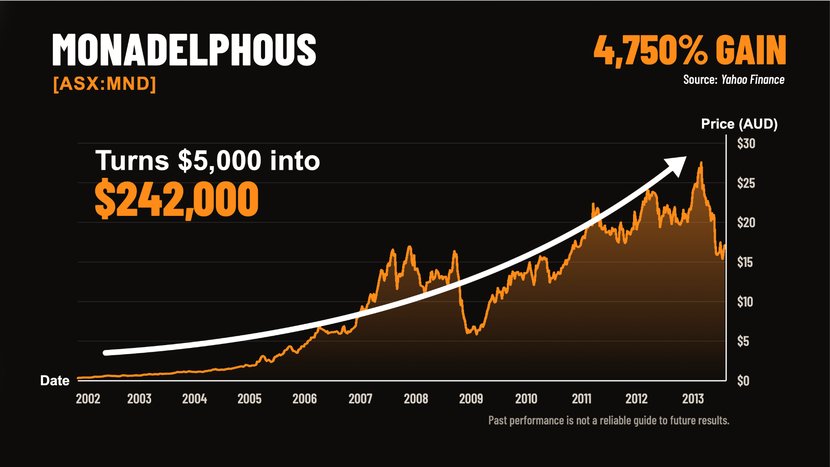
But Monadelphous also paid a steadily rising dividend.
Reinvest those payments along the way, and your AU$5,000 could have grown to approximately AU$435,000.
Now, here’s where the story becomes really interesting.
Because you could have invested your AU$5,000 directly in BHP instead.
After all, BHP owned the mines. It produced the iron ore. And it was one of the biggest beneficiaries of China’s extraordinary appetite for raw materials.
BHP shares performed well. Between 2002 and 2013, they climbed 259%.
That would have turned AU$5,000 into roughly AU$18,000 before dividends — or AU$23,000 if you reinvested them.
A very respectable return.
But it’s AU$400,000 less than you could have made from the far less famous company BHP hired to help build the boom.
And Monadelphous wasn’t an isolated example.
A few years later, Andrew Forrest set out to break BHP and Rio Tinto’s grip on Australian iron ore.
He had an enormous mineral deposit in the Pilbara.
He had ambition.
And he had customers in China desperate to buy what he planned to produce.
But none of that could carry a single tonne of iron ore to market.
Before Forrest could sell the ore, he needed to turn a remote stretch of red dirt into a mining network.
He needed a mine. A processing facility. A 280-kilometre heavy-haul railway across the Pilbara. And a new export terminal at Port Hedland.
So Fortescue turned to WorleyParsons.
Worley first helped determine whether the Cloudbreak mine could work.
Then Fortescue handed them the engineering contract to help turn its export plans into physical infrastructure.
Once again, the miner owned the resource.
But a services company supplied the expertise needed to bring it to market.
And just like Monadelphous, Worley wasn’t making a one-mine bet.
It worked across the mining industry — earning fees whenever another company approved a major project and needed someone to help build it.
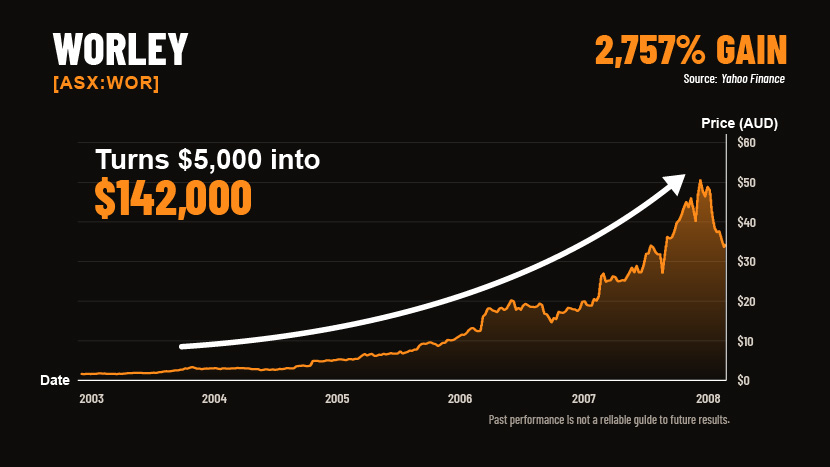
Between 2003 and 2007, Worley shares climbed 2,757%.
Turning a AU$5,000 investment into more than AU$142,000 in just four years.
Different companies. Different projects. But the same pattern keeps showing up.
When geopolitics redraws the world’s supply chains, you don’t have to own the resources to make a fortune.
You can own the overlooked businesses miners can’t live without.
The ones they need to get those resources out of the ground and into the hands of buyers.
And right now, for a completely
different geopolitical reason,
it’s happening again
Because Trump wants Australia to build a new critical minerals supply chain.
That means new mines. New processing plants. New roads, railways, ports and power infrastructure.
And all of it has to be built and maintained by someone.
If Australia builds 20 mines, these companies can win work from every one of them.
If lithium wins, they get work. If copper wins, they get work. If rare earths win…you get the idea.
So, you don’t have to predict which miner becomes the next Fortescue.
You just need to identify the company everyone has to call when they start building.
And I believe three little-known Aussie companies could be the biggest contenders.
 I’ve put their names, ticker symbols and the full investment case inside my new report: America’s New Trade Map: Four stocks standing directly in the path of a AU$135 billion spending plan.
Before I show you how to claim your free copy, I should also mention that mining companies are typically high-risk, volatile investments. Prices can fall just as quickly as they can rip higher. So you should never invest more than you’re prepared to lose.
Now, there’s one more part of this story.
And I think you’ll love it.
Every new rare earths mine needs more equipment and people to keep it running.
It also needs power. Lots of it.
That means every new mine also becomes a major new customer for the companies supplying the energy.
Just look at the Nolans Project. It’s much more than a mine. It has three separate processing plants.
The first crushes and grinds the rock. The second uses acids and other chemicals to extract the rare earths. The third separates them into individual products ready for sale.
Put simply, they’re digging up rocks and turning them into the ingredients for permanent magnets.
And all that extra processing needs energy.
Nolans is expected to use as much electricity as 50,000 Australian homes.
That’s just one site. One project in Trump’s new critical minerals supply chain.
And as more projects come online, Australia’s energy demand will take off.
In Western Australia, the energy market operator — AEMO — expects consumption to rise by more than 50% in the next decade.
BHP CEO Ross McEwan believes the electricity surge will be much more severe. He says…
Power requirements in Western Australia are expected to increase three to four times the current [level because of] electrified mining equipment.’
For Australia to build a new critical minerals supply chain, it first needs to build a new energy backbone.
Western Australia is already building huge new wind and solar farms, with natural gas playing the critical backup role.
And here’s the thing most investors miss…
The renewables boom could actually make natural gas more valuable.
Because gas becomes the insurance policy under a much larger electricity system.
And that insurance policy is already in short supply.
Australia’s energy market operator is already warning Western Australia could face a gas shortage from 2031. That’s only five years away.
And listen to why.
Its Executive General Manager, Kate Ryan, says…
The expected supply shortfalls are underpinned by declining production and the [increased] use of gas for industrial processing and electricity generation.’
Think about what she’s saying.
Gas supply is falling…just as Australia needs more of it.
And natural gas does something else that’s easy to miss.
It doesn’t just generate electricity. It also helps turn rocks into metals.
Think back to Rio’s aluminium operation in Queensland.
Bauxite begins as red rock dug out of the ground at Weipa. It’s then shipped more than 2,000 kilometres down the coast to Gladstone, where gas-fired heat helps transform it into fine white alumina.
Turning that alumina into aluminium requires another enormous supply of energy — this time in the form of electricity.
Every step Australia takes beyond mining — into processing, refining and manufacturing — demands more energy.
And the scale of what’s coming is enormous. Australia has more than 120 critical minerals projects in the pipeline — including mines and processing facilities.
Rare earths won’t simply be dug up.
They’ll be crushed, concentrated, leached and separated into magnet-ready oxides.
Lithium won’t simply leave the country as ore.
It will be converted into battery-grade chemicals.
And that’s the part of this new mining boom almost nobody is talking about.
The bigger Australia’s critical minerals supply chain gets — the more energy it consumes.
More electricity. More industrial heat. And — at least with today’s technology — more natural gas.
And one ASX company could be the standout winner. I’ll tell you all about it in my new report: America’s New Trade Map: Four stocks standing directly in the path of a AU$135 billion spending plan.
Inside, you’ll see my complete investment thesis for each position, the key risks, price targets, and the specific catalysts I’m watching today. Everything you need to make a smart investment decision.
And I’d like to send you a free copy. All I ask is that you take a 12-month subscription to my research service Diggers and Drillers.
My aim in this advisory is simple:
To get you into the right mining
companies…at discounted
prices… before everyone else
And right now, I’m watching something I’ve never seen in my 15 years in this business.
Australia is building an entire new supply chain for critical minerals — from mines to processing plants to manufacturing facilities…
And America is picking up much of the tab.
It’s happening right in front of you.
World leaders are telling us exactly where the capital’s going.
The G7 handed us the map. All we have to do is follow it.
The only question is: are you positioned in front of all this capital, or behind it?
Because that money is already moving the market.
Companies like Arafura, Lynas, Iluka Resources, Alpha HPA, NexGen Energy...and more.
One by one, these chokepoint stocks of the new critical minerals supply chain are moving up.
Reader, I believe we’re only at the beginning of what’s coming.
As government funding turns into construction contracts, supply agreements and new production, I believe the companies at the heart of this build-out could become some of the best recommendations of my career.
And that shift from promises to projects is happening faster than most people realise.
Because America’s defence industry is running towards a deadline.
On 1 January 2027, the Pentagon’s restrictions on rare earth magnets extend from the mine to the finished product.
That means it won’t be enough to make magnets outside of China. The materials that go into them, and the steps used to produce them, will matter too.
America has set the date. But the replacement supply chain is still being built.
So every new funding deal, supply agreement and construction contract between now and then could draw more attention to the companies building it.
And investors who get positioned before the deadline could do very, very well.
That’s why I’ve put together a new research briefing on the four companies I believe are best placed to benefit.
Of course, when billions of dollars are flowing into an industry, plenty of companies will claim they’re in line for a share. The hard part is working out which ones could actually benefit — and spotting them early enough for it to matter.
That’s what I’ve done repeatedly for my subscribers over the years. Identifying the moments a shift in the global economy begins redirecting capital, then finding the companies in its path.
In 2023, Citi Group, Goldman Sachs and S&P Global were all bearish on copper.
I didn’t see it that way. To me, the setup was clear — we were on the edge of a major turnaround.
So I recommended NGEx Minerals at just $7 a share. Today it’s over $26 — a 263% move.
Bloomberg Intelligence was saying ‘gold would lose its lustre, as the Fed tames inflation’.
I told my followers:
With gold fever about to strike…now could be the ideal time to add to this explorer.’
For the next two years, gold ran straight up. Take a look…
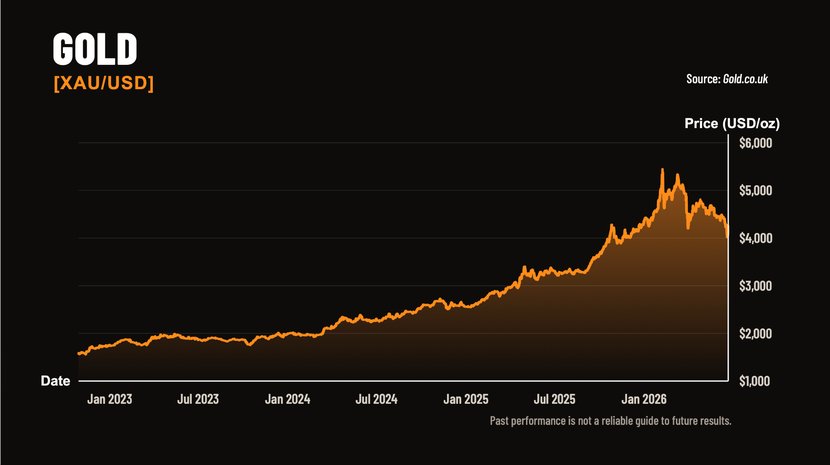
Anyone who followed my advice is sitting on gains of 230% in Snowline Gold and 266% in Capricorn Metals.
Of course, not every recommendation has worked out as well as these. Sometimes my timing has been off. Other times, I’ve simply got it wrong.
And that’s something I keep in mind with every new recommendation.
So I’ve spent months digging into which companies stand to benefit the most as AU$135 billion moves from government agreements into real projects.
I’ve narrowed it down to four.
And I’ll give you all the details on them in my new report: America’s New Trade Map: Four stocks standing directly in the path of a AU$135 billion spending plan.
Inside you’ll learn about the four publicly listed companies that I believe could be the biggest winners from Australia’s new mining boom.
I’ve christened the first stock: The Bloomberg of Mining.
Bloomberg takes raw financial information and turns it into market insights the world’s biggest investors trust with billion-dollar decisions.
This company does the same for miners by precisely analysing drill samples for traces of copper, gold, lithium or rare earths.
This allows geologists to see the deposit’s size and grade — and whether it might justify spending another billion dollars developing it.
When that much money rests on the answer, you need to trust the company producing the numbers.
That’s where this business stands apart.
It began as a small Brisbane lab in 1976. Over 50 years, it became one of the world’s leading mineral-testing businesses. And it gets paid whether a drilling campaign strikes gold or comes up empty.
Now imagine what happens as governments help fund more exploration, more mines and more processing here in Australia.
More drilling means more samples to test. We can already see the impact on its share price — up more than 100% in three years. And I believe the biggest opportunity still lies ahead.
The second stock I call: Mining’s Global Pit Crew.
When a haul truck breaks down hundreds of kilometres from the nearest town, this is the company miners call.
Its specialist mechanics can fly into remote sites and repair everything from drilling rigs and excavators to the equipment inside processing plants.
That matters because a mine only earns money while its machines are digging, hauling and processing rock. When they stop, production slows — and the pressure to get them moving again is immediate.
What started with one mechanic and a ute in Western Australia has grown into a global operation with more than 4,500 employees, serving miners across Australia, Asia, Africa and the Americas.
Now think about what a new mining boom brings: more mines, more machines and more hours worked by each fleet.
Every one of those machines will need servicing. And when something breaks, miners will want someone who can get there and fix it fast.
That’s the opportunity I see in this company.
The third company I call: The Invisible Backbone of Australia’s Mining Boom.
Remember the aluminium supply chain in Queensland?
Rock comes out of the ground at Cape York, becomes alumina in Gladstone, then becomes aluminium at Boyne Island.
None of that happens without the infrastructure that keeps material moving from one stage to the next.
This company helps build and maintain that infrastructure. It has already worked inside a major Gladstone alumina refinery, supplying specialist labour and materials for upgrades.
And that work could explode as more than 120 new critical minerals projects come online.
We’ll soon see new processing plants, power connections, rail links and port capacity — all of which will need maintaining long after the construction crews leave.
This company can get paid to help build that new supply chain — and then keep getting paid to maintain it.
Our fourth and final company supplies what every part of Australia’s new supply chain needs: energy.
Getting minerals out of the ground takes power. Crushing, refining and turning them into metals takes even more.
Think back to Rio’s operation in Queensland. The journey from bauxite to aluminium depends on industrial plants that need reliable electricity and intense heat. They can’t pause production when energy runs short.
That’s why we need a lot more natural gas. And this company is in the strongest position.
It’s Australia’s largest natural gas producer, with the infrastructure to supply energy at home and overseas.
And I believe this company could help power Australia’s mining boom for decades.
You’ll get the full investment case for all four companies in America’s New Trade Map: Four stocks standing directly in the path of a AU$135 billion spending plan.
I’ll send you a copy when you subscribe to Diggers and Drillers today.
Here’s what happens when you join
Within minutes, a welcome email will arrive in your inbox with access to your report.
You can read the full investment case for each company, plus get the names, tickers and buy-up-to prices. Everything you need to decide whether you want to act when the market next opens.
But that report is only the beginning.
Every week I’ll send you my honest, unfiltered read on the economy and explain what it could mean for commodity prices.
I show you the sectors heating up long before they’re on anyone’s radar. And warn you when there’s reason for caution.
You’ll get immediate access to the Diggers and Drillers portfolio. It currently has 16 open positions, four of which show gains of more than 100%, with the largest at 266%.
You’ll be able to see every stock and its current status, including which are still in their buy zones.
Every month, I’ll send a new research report. Inside, I reveal the very best opportunity in the commodity market. The kind that puts you in front of the biggest moves long before they hit a headline.
Right now, the biggest opportunity standing in front of us is the one you learned about here today: Trump’s New Trade Map.
But geopolitics — especially right now — is moving fast and creating new opportunities.
And they could come from anywhere: oil and gas, copper, rare earths, gold or silver.
Wherever it is, I’ll find it early. And put you in front of it.
Each briefing puts one company in front of you. And I give you everything.
The name. The ticker. The risks. The potential upside. The maximum price to pay.
I recommend when to get in. When to take profits. And when to cut your losses. No guesswork. No confusion. I make it that simple.
All you have to do is follow along.
As subscriber Keith put it:
James gives precise buy-sell-hold details as well as a risk profile with all recommendations. Priceless advice!’
John agrees, saying:
I like the conversational style, spelling out the analysis of situations and recommendations. The performance of the recommendations I have invested in has mostly been good.’
From time to time, you’ll also receive a more in-depth special report, along with access to our archive.
When a major agreement, funding commitment or policy change deserves more than a quick update, I’ll take the time to show you how the pieces fit together.
That’s what I want Diggers and Drillers to give you: a clear view of the changes reshaping the resources market, and research you can use to position yourself to potentially profit.
I’d love for you to take a look inside
Diggers and Drillers for yourself
That’s why I’ve organised a limited-time introductory deal for you.
A year’s subscription normally costs $299.
And frankly, it’s a bargain at that price.
We’re talking less than a buck a day for access to the kind of analysis and insight that could help you get positioned at the start of Australia’s next great mining boom.
BUT…I want to make this as easy as possible for you.
So, for a limited time, you can get started with Diggers and Drillers for just $99 for a full year.
That’s less than $2 a week. And you’ll get my America’s New Trade Map report as soon as you join, along with a full year of research, recommendations and portfolio updates.
Just click the button below. You’ll be taken to a secure order form where you can review the offer before you decide.
And you’ll have 30 days to see whether Diggers and Drillers is right for you.
Take a look with my 30-day
money-back guarantee
 Read the report. Look through the portfolio. Follow my updates.
If you don’t think the research is worth what you paid — or you simply change your mind — let me know within 30 days and I’ll refund your $99 in full.
No questions asked. No hard feelings. And you can keep my America’s New Trade Map report as my way of saying thanks for giving Diggers and Drillers a go today.
I’m making this offer because I want you to see the scale of the mining boom happening across Australia as we speak…and to help you get positioned before the crowd.
America and its allies are putting hundreds of billions of dollars behind a new critical minerals supply chain. Those funding commitments now have to become mines, processing plants, and the infrastructure that keeps minerals moving.
The four companies in my report are positioned to do that work. They don’t need one particular mine or mineral to succeed. They stand to benefit as the wider supply chain takes shape.
I’ll send you their names, tickers and my full analysis the moment you join.
You have three choices.
The first? You can do nothing.
Close this video, go about your day. Forget about Trump’s AU$135 billion spending plan.
You can ignore the new mines, new processing plants and new manufacturing facilities that are popping up across Australia right now.
And you’ll see how that works out for you.
Your second choice? You can do all this research yourself. You can research the G7 decision.
You can track the US-Australia Critical Minerals Framework.
You can investigate Australia’s Critical Minerals Strategic Reserve and America’s Project Vault.
You can see for yourself how the FORGE Alliance gives Aussie miners the price guarantees they need to build the supply chains the West desperately needs.
You can spend a lot of time doing that. Maybe months.
Of course, I’ve already done all of that. But you can absolutely try. And by the time you’ve done the research, the best entry points may already be gone.
The third option is to let me do all the heavy lifting for you.
I’ve already done it.
Every company, every price target, every risk, every catalyst has already been assembled into a single briefing you can read today and act on right away.
It’s all inside America’s New Trade Map.
And I’ll send it to you today when you join Diggers and Drillers.
All you’ll pay is $99.
You’re covered by my 30-day guarantee.
And you get to keep everything — even if you decide my service isn’t for you.

All you have to do is click the button below.
Thanks for watching, and I’ll see you inside.
Sincerely,

James Cooper,
Diggers and Drillers