Dear Reader,

Hi, Lachlann Tierney here.

The best money I’ve ever seen made in the stock market was made when nobody was watching.

Right now, your average punter here in Australia has close to zero interest in small-caps.

You might feel the same.

And fair play. I get it.

But let me tell you the harsh reality of small-caps.

When it goes quiet — you need to go on the attack.

Here are just some of the reasons you might think it’s ‘quiet’ right now for small-caps…

We’ve seen a deluge of negative headlines about the war.

The federal government just launched a torpedo at risk capital with its latest tax changes in the Budget.

Inflation is bleeding us out and the RBA is following the US Fed and RAISING rates.

That kind of toxic cocktail annihilates retail investors’ punting capital.

No disposable income, no luxury purchases of speccy stocks — simple, right?

Think again!

I’ve seen two full ‘round-trip’ small-cap cycles play out.

And this exact kind of fallow period is where the best small-cap harvests can be found.

Not in booms. Not in manias. But in that quiet period before the crowd shows up.

Eight years covering ASX small-caps has taught me this lesson above all others.

And I haven’t learned it from behind a desk.

I’ve consulted for a privately held lithium company sitting on one of the largest known deposits of its kind.

I’ve been on the ground at a US lithium summit in Arkansas…

I’ve talked with French financiers who bankroll mines…

And I’ve sat across boardroom tables from the people running the companies I cover, looking them in the eye.

Back in 2018, I published an essay predicting AI would explode by about 2023 — I’ve got the receipts — because I had access to a private AI engineer forum and could see where the technology was heading, long before ChatGPT made it obvious to everyone else.

That’s the job as I see it: get to the information before it becomes news.

And I’ve watched, up close, what that edge can do…

I’ve watched it hand my old boss a mansion in Armadale, Victoria.

He got into Vulcan Energy Resources at 26 cents and watched it climb to over $18 when people finally cared about lithium again.

I’ve watched it put my own dad into Tesla at $16 (today those shares change hands for around $350).

And it’s exactly what 64-year-old General Motors public relations officer Paul Garrett understood all the way back in 1956…

The greatest ‘nobody was

watching’ trade ever made?

At the time, he was facing mandatory retirement.

Most men in his position wound down.

But Garrett decided his last years would be his best years.

And he was open about how he intended to do it, too: he wanted to build serious wealth, fast enough that it would count.

He judged there was only one realistic way for an ordinary investor to do that.

Not blue chips. Not bonds. Not property.

But tiny, fast-growing companies…bought before anyone else was looking.

Garrett had four criteria. The stock…

  1. Must be small
  2. Must be relatively unknown
  3. Must have a unique product or service
  4. Must have strong, progressive, research-minded management

He worked his contacts for names of good companies that professional money liked…but couldn’t buy, because the companies were simply too small to absorb institutional capital.

That narrowed 50,000 listed stocks down to about 50.

He studied the financials and cut the list to three. He visited each one and met the men running them.

Then he settled on one: a little outfit called Haloid.

You know it today as Xerox.

Garrett put in $133,000 between 1955 and 1959…more than 63,000 shares, at around a dollar each.

By 1971 those shares traded above $125. His stake had grown to over $14 MILLION. More than 100 times his money.

Now…that is not an everyday outcome. It might be a once-in-a-generation outcome. I’m not promising you a Xerox.

But notice when Garrett acted.

He didn’t buy Haloid when it was screaming past $100 and everyone knew the story.

He positioned himself when it was a dollar, when nobody cared.

That’s the entire game in small stocks.

Garrett’s story survives because of one book: Thomas W. Phelps’s 100 to 1 in the Stock Market — a study of the rare stocks that turned every dollar invested into 100.

Phelps found those stocks shared a profile: small, ignored, operationally sound…and bought when nobody cared, and held.

And in fact, this book gave this presentation its internal codename around our office, too. We’ve been calling it ‘Project 100-to-1’.

Not because I’m promising you 100-to-1 returns. Phelps’s whole point is that such outcomes are extremely rare and take years of patience.

It’s because that profile — small, ignored, but operationally sound — describes EXACTLY what I hunt for.

And right now, the ASX has more stocks fitting that profile, at better prices, than at any time in years.

It’s why you’re receiving this invitation now, and not later…

The strangest
divergence on the ASX

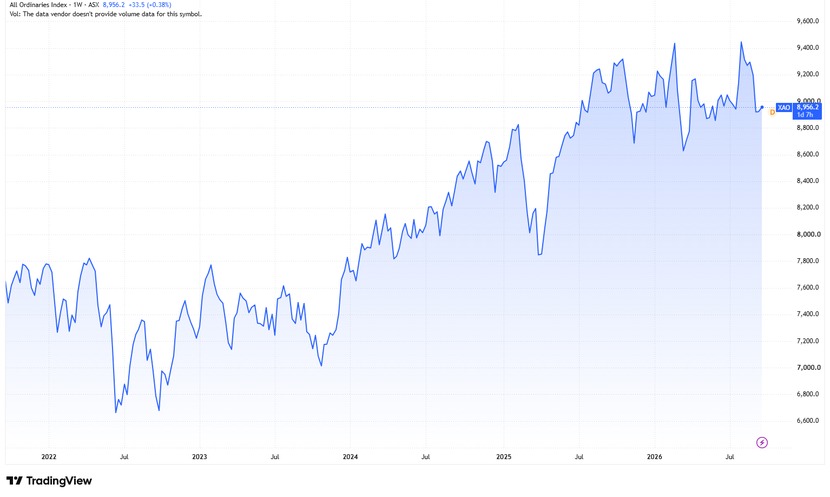
Right now, the ASX All Ordinaries sits near all-time highs:

...

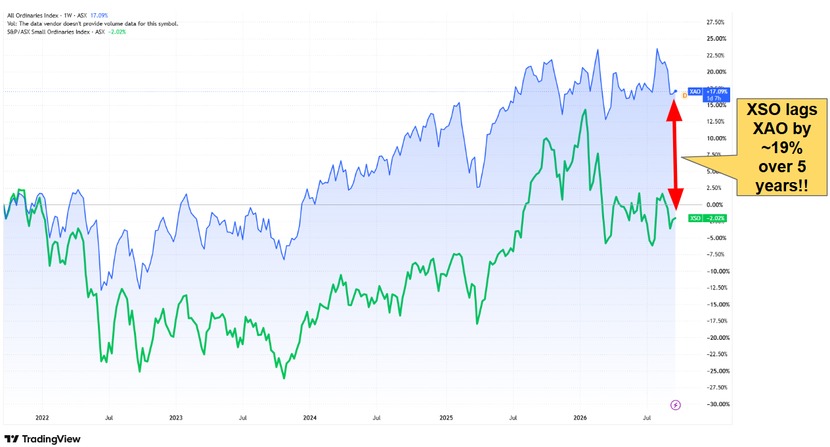
Meanwhile, the smaller end of the market, the ASX Small Ordinaries (XSO)…still trails roughly 18% behind over the last five years:

...

In fact, while the larger caps have risen this year, the smaller end has actually fallen since January.

It isn’t a bloodbath, though. And the small end certainly isn’t broken.

It’s simply lagging…grinding along while the index above it sets record after record.

And here’s the thing: it’s not that Australians have lost the appetite for a punt, either.

It’s that the punting money is chasing what’s already moving — the big end, the momentum trades, the stuff on the front page.

But down at the smaller end, where nothing is truly ‘hot’ yet, real operational progress is still sitting there…unpriced.

That’s not a crisis.

That’s your window.

And when the speccy money comes back down the market-cap curve — and on the ASX, it always does — it moves fast, and it doesn’t wait for anyone.

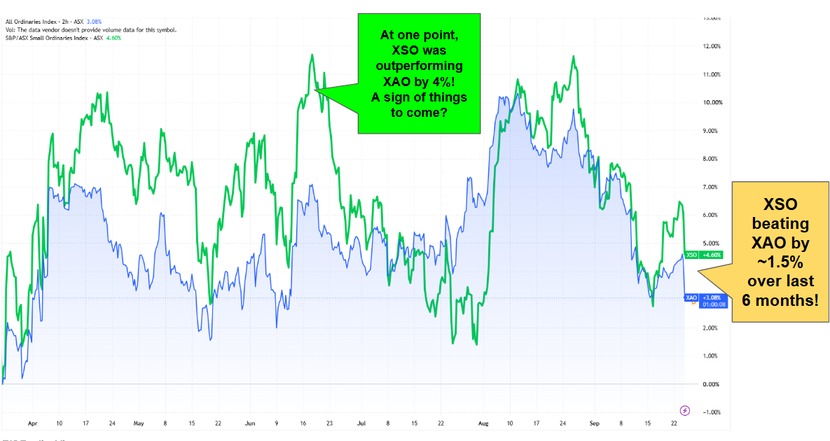
In fact, look at what this part of the market did in June alone, suddenly ripping off the floor:

...

Source: Trading View

Right now, the ASX Small Ordinaries is remarkably around 1.5% higher than the ASX All Ordinaries (which is heavily weighted towards the top end of the index).

Maybe that’s the start of the turn. Or maybe it fades.

Either way, just remember nobody rings a bell at the bottom. By the time you’re certain, the prices are gone.

In my opinion, you don’t want to find out from the sidelines.

(This is also part of the reason that key date, 10 January, is so important. More on that shortly.)

There’s a line from history that captures this moment perfectly for me...

In 1914, at the First Battle of the Marne, the French general Ferdinand Foch sent back a message that soldiers have repeated for a century:

‘My centre is giving way.

My right is retreating.

Situation: excellent.
I attack.
’

Well, that’s the small-cap market in 2026 in a nutshell.

Sentiment squeezed. Attention elsewhere. Prices ignoring progress.

But our situation: EXCELLENT.

And if you want to be in with a genuine chance of some big gains in the 12–18 months ahead…now is the time to attack.

Because the broader small-cap universe may be lagging, but the businesses are not…

And I have THREE such businesses to share with you right now.

But before I do…

Remember this date:

10 January 2027

I’m going to explain the significance of this shortly.

But first, I simply need you to write it down.

Remember any way you can.

Understand this much: it’s a hard, real-world deadline, set at the highest levels of Beijing and Washington…with direct implications to the stocks you’re about to learn about.

And it’s the single biggest reason this invitation is in front of you today, and not in three months’ time.

Again: keep that date in the back of your mind as I give you a glimpse of the kind of opportunities I’m seeing on the ground.

All three of the ideas below connect to a single global story:

The tiny handful of rare raw materials that the coming wave of humanoid robots, AI hardware and space infrastructure cannot be built without.

Now, you already know the man driving that wave…

Elon Musk has landed two ‘moonshots’ in his lifetime — bets so ambitious that most people wrote them off at the start.

First electric cars. Then reusable rockets.

Both changed the world…and made fortunes for many of the early backers in their orbit.

His third is robots.

Optimus — Tesla’s own walking, working humanoid, built to do the physical jobs we currently pay people to do.

Musk reckons that by 2040, humanoid robots could outnumber humans.

Now, take his timelines with a grain of salt. He misses them routinely.

But on his two moonshots so far, the record reads: wrong on the date, right on the destination. Both times.

And there’s a catch to moonshot three — one he can’t out-engineer.

It isn’t software.

Take a humanoid robot apart, joint by joint…and every joint needs a motor. Every motor needs a magnet. And the magnets strong enough for the job are built from a small cluster of rare earth elements.

Musk flagged the ‘magnet issue’ to his own shareholders on an earnings call: Optimus production held back…because China now requires an export licence for exactly these materials.

By Chinese industry estimates, one humanoid robot needs around three and a half kilos of finished magnet material — roughly double what goes into an electric car.

China controls most of the world’s supply of them — and the fragile truce holding back its harshest export controls is now due to expire on 10 January 2027.

Remember, that’s the date I told you to keep in the back of your mind — and the full details are coming, as promised.

One thing to keep in mind, though: this opportunity is not a bet on Musk’s calendar.

These three companies would qualify for my buy list with or without him.

He’s the accelerant — the reason the crowd could come back to this corner of the market sooner than anyone expects.

For now, just notice what these three companies have in common: real assets, real progress…and almost nobody watching.

And finally, to give you a real idea of just how FAST this story is moving…

On 11 September, I recommended my readers get in on Meteoric Resources at 18 cents per share…

It’s a rare earths small cap sitting on a big Brazilian deposit of dysprosium and terbium — the two rare earths that stop a high-performance magnet cooking itself inside a hot motor.

It was the most advanced pick of the bunch…

Feasibility study done. Production costs around US$11 a kilo…for a class of magnet metal Washington has already guaranteed at US$110 a kilo, under a 10-year Department of Defense price floor.

And just three weeks later…

Meteoric was acquired by Lynas Rare Earths for $672 million…

Sending the share price soaring 51% in less than an hour.

As you can see, these companies are moving quickly and paying top dollar to secure assets.

And today, I’m going to give you three that could be next.

Idea #1: The Brazilian
deposit
Gina Rinehart paid
$42.5
million to get into

Your first play is a small ASX-listed explorer sitting on a rare earths deposit in Brazil.

Before I tell you what’s in the ground here, write down these two words…

Because between them, they’re most of the reason Musk’s robot ambition can — or can’t — be built.

The first: neodymium-praseodymium. NdPr, in the trade.

NdPr is the magnetic muscle inside those permanent magnets. Every humanoid robot needs a web of powerful motors…arms, hands, hips, knees, ankles…and every one of those motors needs an NdPr magnet. No NdPr, no robot. It’s that direct.

The second word is: niobium.

A robot joint only needs a trace of this element. But niobium also goes into rocket engine nozzles and spacecraft thrusters.

And it’s one of the scarcest items on the entire shopping list.

More than 80% of the world’s supply comes from a single producer in Brazil.

Now, here’s why that geography is important….

This little explorer’s ground sits right next door to that same niobium giant…the same district, just a few kilometres down the road. And the confirmed portion of its own NdPr now stands at more than half a million tonnes.

For scale: its total rare earth count sits near four million tonnes of rare earth oxide.

For comparison, Aussie giant Lynas Rare Earths holds about 4.4 million at WA’s Mount Weld…and Lynas is worth roughly 30 times more than this little company.

There’s no feasibility study yet. There’s no reserve. And no Tesla deal yet.

And that gap is exactly why the stock is still cheap.

But a US alloy group has already agreed in principle to take up to 40% of whatever the project eventually produces.

And Gina Rinehart — who does not throw money at speculative ASX names for fun — has steadily built a stake of roughly $42.5 million, at 10 cents a share, for about a tenth of the entire company.

And here’s the connection few have connected the dots to: Gina and Elon Musk are mates.

In June, she put roughly $1.4 billion of her own money into Musk’s SpaceX listing, calling him ‘exceptional, rare, sensible and hardworking’.

Forbes has described the relationship as ‘increasingly cosy’.

Months before that billion-dollar headline hit the papers, she was already quietly building her position in this tiny Brazilian stock.

I can’t tell you what she knows. But once you connect those dots, it stops looking like a punt on one company…and starts looking like someone positioning early around something much bigger.

Last I checked: it’s still under 15 cents, with the whole company valued around $400 million.

If there’s one small-cap ‘moonshot’ to consider right now, it’s this one.

Then there’s…

Idea #2: The biggest known
stash of one of Earth’s
rarest metals

Your second play jumps to Québec.

This is the one where a single hole in the ground gives you four separate shots at the same story.

The foundation is a large, already-proven lithium deposit.

That alone would be a solid buy-case…

Lithium is the metal that went vertical on the back of Musk’s last big push, and it minted a generation of ASX winners.

The man running this one has done it before, too.

He’s already turned one small stock into a large-cap, and he’s exactly the kind of bloke you want steering a ship this end of the market.

But the lithium isn’t why it’s on this list.

Sitting right on top of that lithium is the single biggest known deposit of a metal called caesium — anywhere on the planet.

Caesium is one of the rarest industrial metals in existence.

Almost nobody holds meaningful supply, and you can’t simply order more when you run short.

This single project holds the most of it, full stop.

Then two more strategic metals — gallium and tantalum — ride along underneath, essentially for free.

Tantalum sits inside the capacitors that go into satellites and planes. Gallium’s earlier-stage.

So, like I said: one hole in the ground…four strategic metals. That doesn’t happen often.

The government has already given the project its environmental green light — a real step, not paperwork gathering dust — and new numbers are due by the end of the year.

Last I checked: around 50 cents.

Last but not least…

Idea #3: The Nevada project
backed by a near-billion-
dollar US federal loan

And finally, a permitted boron project in the Nevada desert — one of only a handful of deposits like it in the world…

It’s big enough to run for most of a century and owned outright. And it’s 100% owned by one Aussie company. There’s no partner to split it with.

Now, boron is likely another resource on the list you may never have heard of.

It touches the magnets, the space hardware and the defence side all at once.

In June, the US Army signed a lease on a real site in Utah for a defence-grade boron facility — on top of the near-billion-dollar federal loan already backing construction.

The company is targeting a final go-ahead on the whole project before the end of 2026.

Not five years out.

NOW.

Pretty much every broker covering it rates it a buy, with price targets running three to four times where it trades.

That’s the market’s own read, not mine.

It’s still pre-revenue. And about 12 cents a share, last I looked.

Now, look. These are three real businesses. Executing real projects. Hitting real milestones.

Every price I’ve quoted is a snapshot. Stocks this small jump around, so treat those numbers as a guide, not a quote.

And behind these three sits my full live buy list — 18 open positions, every one vetted the same way.

All are doing everything right.

And the market has barely noticed…because right now, almost nobody is watching this end of the ASX.

Why I can’t print the names

here — and why now

Let me be completely straight with you…

These tiny stocks typically trade very few shares per day.

If I released a stock recommendation to too many people…the stock would go absolutely bonkers.

The price would almost certainly go up artificially if enough people jumped in.

That’s why the names, tickers and buy-up-to prices only ever go to members, by private email — and why every member agrees to keep them confidential.

It keeps the field fair for the people who’ve paid for the research. And it stops a public page like this one moving the very prices you’d want to buy at.

So, no…I can’t print the three names here. Not because of some artificial velvet rope.

Because it wouldn’t be fair to paying members…and because stocks this small punish careless broadcasting.

Now…the second thing you need to understand: the timing.

And look, we could easily sit on this whole campaign until the small-cap market is booming again.

And honestly? That would be the far easier sell! When the charts go vertical, the interest takes care of itself.

But from an investment perspective, that’s precisely the wrong time to be buying small-caps.

The right time…if you’re this way inclined…is when the market’s down, and the runway is still ahead of you. Not behind you.

Putting this invitation in front of you now is us doing the best we can by you: helping get you onto these ideas while that runway is (hopefully) still in front of us all.

By the time a small-cap boom is obvious, the prices that made it possible are usually gone, too.

My rule of thumb:

By the time your neighbour starts telling you about a penny stock he heard about yesterday — trust me, the TOP IS IN.

The 20th century’s
greatest fortune
was
made exactly in this way

Sir John Templeton built one of the great investment fortunes of the last century on this single idea: buy at what he called the point of maximum pessimism.

When war broke out in Europe in 1939 and investors fled, he did something extraordinary…

He bought $100 worth of stock in every New York Stock Exchange listed share that was trading for less than $1.

We’re talking mainly about small, super volatile companies, and a few very large ones with nationwide businesses that had been virtually sold to death by every other investor.

Big, household companies selling for less than a buck.

There were 104 companies in all with 37 of them in bankruptcy.

As it turned out, only a handful went to zero.

The rest made him rich.

But notice how Templeton hunted.

He didn’t buy ‘the market’.

He used a filter — one hard, mechanical rule (under a dollar) — to cut thousands of stocks down to a target list he could actually work through.

Garrett did the same thing with his four criteria.

Which raises the question: there are hundreds of genuine small-caps on the ASX by my count, and I watch this end of the market daily.

How do you whittle that down to the handful worth owning?

The information gap

My answer is the discipline I’ve built a career on: hunt the information gap.

Think about how mainstream finance coverage actually works.

Commercial TV and the newspaper business pages are advertiser-funded, built for a mass audience, covering stocks big and liquid enough for millions of casual viewers to trade at once.

A fund sitting on billions can’t even take a real position in the companies I’ve just described.

So, the coverage simply…stops.

Not because anyone’s hiding these companies. They’re just too small for that machine to bother with.

That gap — between what a small company has actually achieved and what the wider market knows about it — is where the mispricing lives.

It’s the one corner of the market where an ordinary investor can still genuinely get ahead of professional money.

But you don’t find it from a desk. I do the airmiles and the legwork.

You saw the receipts at the top of this letter — the consulting, the summits, the boardrooms.

An idea that can’t survive that kind of scrutiny doesn’t get recommended. Simple as that.

My point is, I think Australian small-caps are at, or near, their own point of maximum pessimism.

At least as far as retail sentiment goes…

Hardened professional
small-cap investors tell
me they’re loading up!

And funds are still committing large sums of capital to select small-caps that are kicking goals.

The gap between retail and professional investor sentiment is about as wide as I’ve ever seen.

And that’s the discipline I use to whittle the hundreds of small-caps on the ASX down to what I believe are the best opportunities available.

This is your chance to look at what the masses are ignoring.

The kind of stocks that could move quickly when lots of eyeballs suddenly appreciate results that were years in the making.

I don’t believe we’ll have long to wait for the crowd to show up, either.

As I said, I’ve seen fund managers who live in this space position in select stocks while retail money sits it out.

You’ve already seen the biggest clue of all: Australia’s richest woman building a $42.5 million stake in the first company on my list — at 10 cents a share, across two raises, while almost nobody was paying attention.

Gina Rinehart is not a woman who throws money at speculative ASX names for fun.

When she moves, she moves for a reason.

Clues like that tell you what a genuine entry point looks like.

So, I’m sounding the horn now — not later, when a boom makes it easy.

I fully understand we’ll likely get fewer takers than we would in a boom.

But I’m cool with that.

Because the members who join at this point in the cycle are the ones who’ll be positioned to get the most out of it.

I’ve written all three companies up in a single dossier — names, tickers, the full case for each, what to pay, and when I’d get in and out.

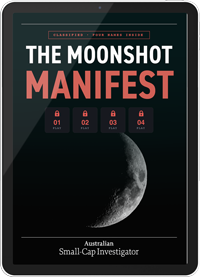
I’ve called it The Moonshot Manifest.

The name’s deliberate.

A manifest is a cargo list — everything a ship or a rocket carries, itemised before launch.

And these three companies are sitting on the cargo Musk’s third moonshot can’t leave the pad without.

Here’s what you get the moment you join…

Australian Small-
Cap Investigator


FULL MEMBERSHIP

  • The Moonshot Manifest — naming all three companies above, with buy-up-to prices for each. In your inbox immediately.
  • The complete open portfolio — every live recommendation, fully vetted, with current guidance on each.
  • A brand-new investigation every month — a full special report into something new, almost always with a fresh recommendation attached.
  • My full research on every idea — what the company does, why it qualifies, and what would prove me wrong (risks in plain English).
  • Clear instructions on every trade — name, ticker, buy-up-to price, stop loss and risks…then continual health-check updates, and sell alerts the moment the story changes.
  • A Getting Started kit — so day one isn’t spent guessing where to click, even if you’ve never touched a small-cap before.
  • Instant access to the full special report library — including ‘Pax Silica: Five Stocks to Buy as AI and Commodities Converge’ and ‘Lithium’s Final Run’.

In other words: the three stories you’ve just read get their endings the moment you join.

A quick word on form, because you deserve to know what you’re joining.

Australian Small-Cap Investigator has been hunting this end of the ASX since 2006.

And as I write, the live buy list shows an average gain of 29% across 21 open positions, with an average hold of around 473 days.

Of course, past performance is no guide to the future — and individual positions inside that number have lost money, as some always will in small-caps.

But it tells you the approach holds up…in a year when small-caps themselves have mostly gone backwards.

For context: the ASX 200 had a genuinely good 2025 — up about 10%.

The average actively managed Australian share fund, run by professionals charging fees to pick stocks for a living, returned about 5%.

And in the small- and mid-cap space specifically…where those managers are supposed to have the edge…close to two in three couldn’t beat their own benchmark!

That’s the professionals. In a good year!

But honestly? That 29% isn’t really the point of this service.

What I’m hunting is closer to a one-in-five game.

Four positions can sit around doing not much…a bit up, a bit down.

What you need is for just one to go properly stratospheric — small-cap to large-cap, over a few years.

Get that right once, and it can make everything else in the portfolio close to irrelevant.

Remember Thomas Phelps’s book 100 to 1 in the Stock Market…

Research going back a century backs him up: the top 4% of stocks account for almost ALL the real wealth the share market has ever created.

The rest roughly wash out.

Small-caps are simply that principle running faster, and much closer to home.

And to my knowledge, there isn’t a service like this available for this end of the market.

Which is why I’ve taken this opportunity, and this exact market situation, to share an excellent invitation with you…

Priced like the market

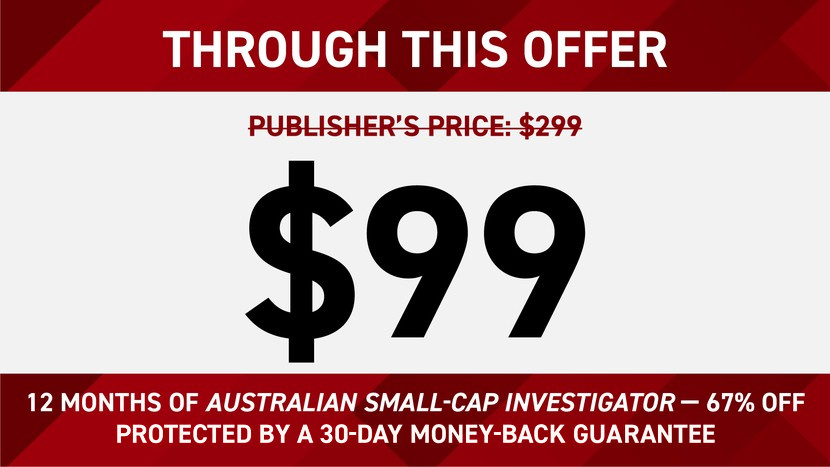
Now look, the official subscription price of Australian Small-Cap Investigator is $299 a year.

At that low price, it’s serious bang for buck.

Professional fund managers can pay more than $40,000 a year for a single Bloomberg terminal — before they’ve worked out what to do with the data!

Ongoing financial advice in Australia now costs a median $4,668 a year.

But today, I don’t even want you to pay $299.

Right now, we’re doing something that mirrors the opportunity itself.

The market is pricing good small-cap businesses well below what their progress suggests they’re worth.

I believe that’s temporary, while sentiment is down.

So, we’re pricing YOUR entry to Australian Small-Cap Investigator the same way:

...

Way below full value, for a small window, for the same reason…if you’d like to come on board for the next 12 months.

And if you do, you will do so under a watertight satisfaction money-back guarantee period, which covers you for the first month.

That means you can take the next 30 days to step inside and read everything. Look at the three companies (and my entire buy list of recommendations) with your own eyes.

If you decide the small-cap end of the market isn’t for you, tell us at any point within that time and we’ll refund every dollar. No questions asked.

And you keep every report and every piece of research I send you in that time.

One caution before
you decide

Small-caps are a high-risk and volatile corner of the market.

Positions can fall 50% or more on no news.

Some of my recommendations will not work out.

Let me say it plainly: at the big end of the market, fund managers aim to get five or six calls out of 10 right.

Small-caps flip that maths. Plenty fall by the wayside…and the rare one done right can pay for the lot.

That’s the model. Anyone who tells you otherwise is selling something.

So: never invest money you can’t afford to lose. And keep your position sizes to a level that allows you to sleep.

The clock on this:

10 January 2027

Finally…that date I flagged at the very top.

Please put it in your diary.

Last October, China gave itself the power to block exports of almost anything containing even a trace of Chinese rare earths…no matter who made it, or where.

Days later, under pressure, it agreed to pause enforcement for one year.

That pause was originally due to run out on 10 November 2026.

Then, in late September, came the clearest proof yet of how much these materials now matter.

Xi Jinping flew to Washington — his first visit to the US in 11 years — and sat down with Donald Trump at the White House. Rare earths were on the table, right alongside AI and tariffs.

And the two men agreed to extend the truce…by exactly two months.

The new deadline: 10 January 2027.

Stop and think about what that tells you…

Export controls on a handful of obscure metals have become the personal business of the two most powerful men on the planet — negotiated face to face…and even then, only pushed back by a matter of weeks.

I’m not predicting a cliff-edge on the day.

And China hasn’t gone soft during the pause, either — it’s kept hitting specific companies with targeted restrictions right through it.

Could the deadline move again? Of course — you’ve just watched it happen once.

And notice what didn’t happen when it did: the controls weren’t scrapped. China kept its grip.

The case didn’t go away. The West simply bought itself two more months to scramble for supply that doesn’t run through Beijing.

But that date is when the market’s attention comes back to exactly the materials the three companies in the Moonshot Manifest are sitting on.

And smart money doesn’t wait for the headline.

Let me be straight with you about the offer itself, too. There is no membership cap on this service. No fake countdown clock. The doors don’t slam shut at midnight.

What is real is this: the earlier you’re positioned before the market wakes up, the more of the runway is yours.

If this letter has made you nervous rather than curious — sit this one out.

That’s the right answer, too.

This market punishes people who half-believe.

But if you’ve read this far and something in you recognises what Paul Garrett saw in 1956…

…a small window, before the crowd, in the one corner of the market where ordinary investors can still genuinely get ahead of professional money…

Then this is your invitation:

Claim Your Place

Secure order page ·
30-day money-back guarantee
on your membership fee*

Your subscription renews automatically at the reduced rate of $199/year at the end of your term, unless you cancel.

You’ll be reminded before that happens, and you can cancel at any time.

Secure order page · 30-day
money-back guarantee

Sincerely,

James Woodburn

Lachlann Tierney,
Australian Small-Cap Investigator