
NATALIE WOOD:

NATALIE WOOD, HOST
Hello everyone, and welcome.
My name's NATALIE, and I'd like to welcome you to what I think is going to be a very useful next hour or so.
Now, you're here I'm assuming because you want to get better at picking the right stocks and timing your buy and sell calls.
Let me be a bit more specific about what I mean there.
Making better investment decisions means more opportunities to grow your wealth and fewer chances to lose it. But it's also about getting more clarity, greater confidence, not second guessing yourself every time a stock moves.
And the reassurance too, that feeling you get when you have a clear investment plan with actual rules behind it that's working.
Well, today you're going to watch all of this being done live by a man who's been trading markets professionally for 30 years. And you'll see that it's far more learnable than you may think.
Being a successful investor is not really about having better information. It's about how you manage yourself, your expectations, and your emotions.
Warren Buffett said it best; ‘the most important quality in an investor isn't intellect, it's temperament.’
Not being smarter or better informed, not having access to more data.
Temperament. Your emotions, your feelings, how you respond to opportunities and setbacks.
Today, you're going to
find out
what that actually
means in practice...
Now, we're not going to dive deeply into technical analysis today. There's no textbook, no jargon, no slide deck full of formulas.
Murray is going to pull up a selection of Australian listed stocks live on screen and show you exactly how he looks at them. You'll see what he sees, and you'll learn how to find out what matters in a chart and what doesn't.
Now, very quickly, we will be making you an offer later in today's session.
It's a good one. And once you understand and see what Murray's going to show you, it will make complete sense. We'll get to that very shortly.
Before then, you have a very valuable hour ahead of you, so let's focus on that.
Now, before I bring Murray in, I want to show you something.
Have a look here...
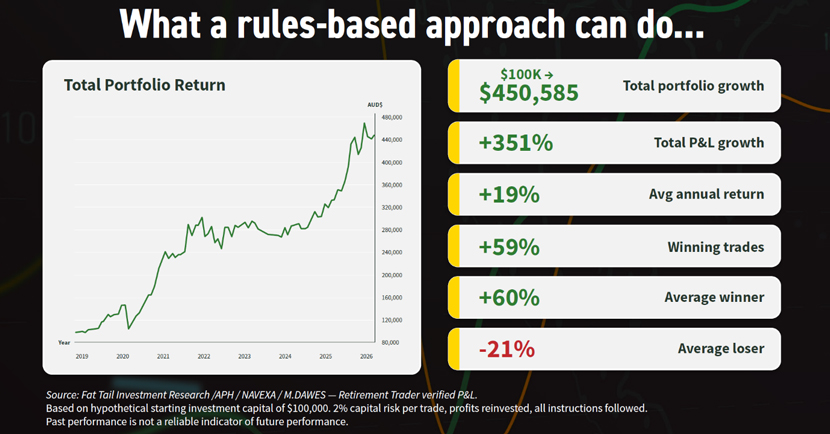
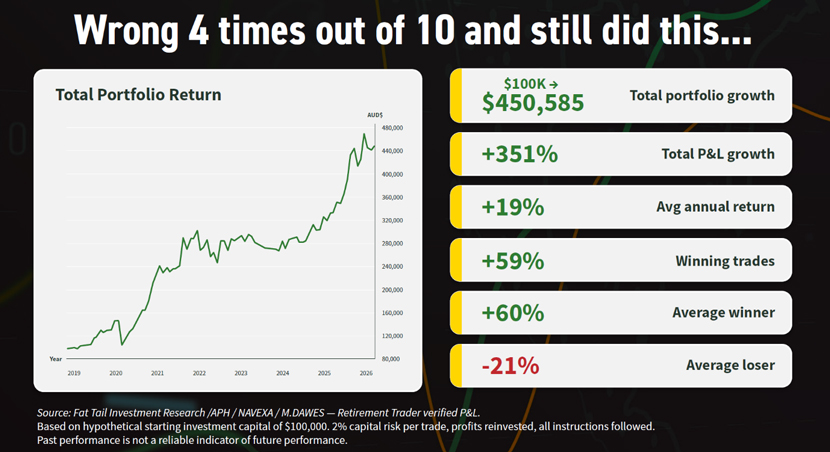
This is the trading P&L from his Retirement Trader service from its launch in November 2018 right through to the end of March 2026.
So, very quickly, this assumes that you're risking just 2% of your capital on any one trade, so it's ultra conservative.
It also assumes that you follow Murray's instructions to the letter and reinvest your profits. Had you done that, as you can see here, you could have turned a hypothetical $100,000 into over $450,000 over that time.
That's 351% total
P&L growth...
...From a conservative Australian trading strategy, in some of the most volatile market conditions we have ever seen.
Annualised, that's a 19% average yearly return every year for the last seven years.
If you can think of another conservative way to grow your wealth this well over time, I'd be very interested to hear about it.
Now of course, we're not promising that this run will continue forever, and of course not every trade Murray recommends is a winner.
But this here is what a real rules-based model can do, and today Murray is going to show you how you can apply these same rules to your investing.
So, let's meet the man himself.
MURRAY has traded financial markets professionally for 30 years.
He started on the floor of the Sydney Futures Exchange, moved into private hedge funds and for a while ran the trading capital of the Smorgon family, one of the biggest private fortunes in the country.

MURRAY DAWES,
EXPERT TRADER
These days, he hosts Fat Tail's weekly Closing Bell on YouTube, and he runs two advisory services for private investors where he puts his methodology to work on trending stocks both inside of Australia and internationally.
Muzz, welcome. Glad to have you here.
MURRAY DAWES:
Very glad to be here, Nat.
I think we're doing this
at a pretty good time
We've got Albo who’s just about to ram through all the changes to capital gains tax and negative gearing...
We've got the Aussie property market teetering at the moment, with clearance rates plunging...
So, let's face it, making money going forward is going to get that little bit harder for Aussies.
What I want to show people today is that you can actually grow your capital investing and trading in markets... and you can actually get good returns.
But not by taking wild risks!
You can actually do it in a very managed and risk averse way... and that can actually cause the high returns. That's what I want to get into today.
NATALIE WOOD:
Awesome.
So, for everyone at home, here's the promise for our session today.
Not that investing gets easier...
But that it gets clearer.
When it's clear, it stops being stressful.
When it stops being stressful, you make better decisions.
And you just saw what better decisions can produce.
Right, let's see it in action
So today Murray is going to show you something most private investors never get to see up close. How a professional trader actually makes his decisions. And it really comes down to four things.
First, stock selection.
So, let's say a sector is running hot, whether it be gold, mining, tech, whatever...
Which specific stock do you actually buy?
Well, Murray is going to show you how he narrows down a whole field to the one that's actually worth backing and why the obvious choice is often the wrong one.
Second, entry. When to buy.
Because you can pick the right stock and still get in at the wrong moment — just before a pullback or a long sideways grind.
Murray will show you what a good entry actually looks like, and also when NOT to pull the trigger.
Third, position management.
This is probably the one you neglect, and it's the one that will eventually kill your returns.
Murray will show you how to protect your downside and lock in gains as they build.
And finally, the exit.
Now this is the hardest moment of all.
Murray’s going to show you how he knows when it's time to get out — not because of a feeling or a fear, but because the chart is telling him.
Let’s start with
picking a stock...
And let's come at it in a way that it really happens: a sector's flying, and you want a piece of it.
Very quickly, there's an example I want to throw up here because this is the whole problem in one chart.
So, folks, take yourself back to the lithium boom that ran from 2016 to 2021.
Lithium was everywhere back then.
EVs were taking off, battery demand was surging, and lithium miners were flying.
Here are two of them from that exact moment.
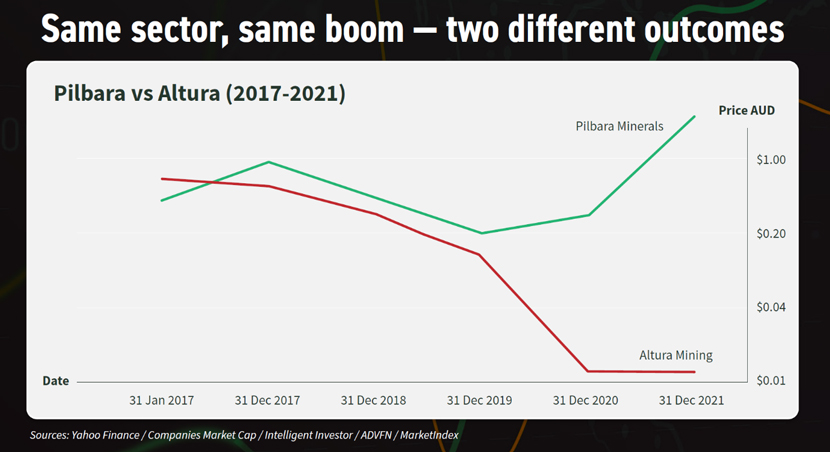
Pilbara Minerals is the green line on the chart and Altura Mining is the red one.
Now imagine it's January 2017 and you want in on lithium.
At that point, you could have bought either of these stocks...and without a process to guide you, you would have had almost nothing to go on.
But look at what happened next.
Pilbara became one of the great ASX stories of that era, going from around 30 cents to over $1 and a lot higher as the boom peaked.
Altura sadly went the other way.
In fact, in October 2020, the company went into receivership.
So Muzz, same sector, same boom. One stock made investors a fortune. The other one wiped them out.
How on earth do you
tell them apart
before you
commit your money?
MURRAY DAWES:
You can never know for SURE exactly which one's going to work out for you... but there are things you can do to put the odds in your favour. And that's what I want to take people through.
And look, I'm going to be taking you through some charts today. Now I know a lot of people are sceptical of charting. They think it's like reading tea leaves or something.
So I just want to really drive the point home that this is NOT reading tea leaves about what the future is going to be. It's more about understanding the present moment:
how the market is positioned... how other traders are positioned... and whether they're feeling euphoria or fear.
Trading on the floor, I learned over time that these things would go on. The market would keep making the same patterns, and that they were actually based on mistakes that traders make.
And so, a chart is almost a map of human emotion, really... and a map of what the insiders are actually doing. Sometimes there are big moves that happen, and you can get on them before any announcement comes out.
It’s a risk management tool as well. I use it to help me manage trades by understanding all of this; of how other traders are positioned, and where I can get in at levels that will help me.
So let’s look at sectors...
First I’ve got to figure out which sector I want to go into.
If I can find one and say, ‘this sector really is about to boom’, that puts the odds in my favour. This is a spot where I really want to hunt, because maybe it doesn't matter what my analysis of the companies is... maybe they're all going to rise.
So if I'm in a sector that is really running, that's great.
From that, you drill down into the fundamentals of each company to figure out which one stands out within that sector, and you can then go from there.
And then you want to combine the fundamentals with the technicals, which I'll show you.
All of this is just about how can I get the odds in my favour as much as possible.
And that’s what I’m going to show you right now...
So let’s bring up a chart of gold from March 2024.
This is what I was seeing at that time...
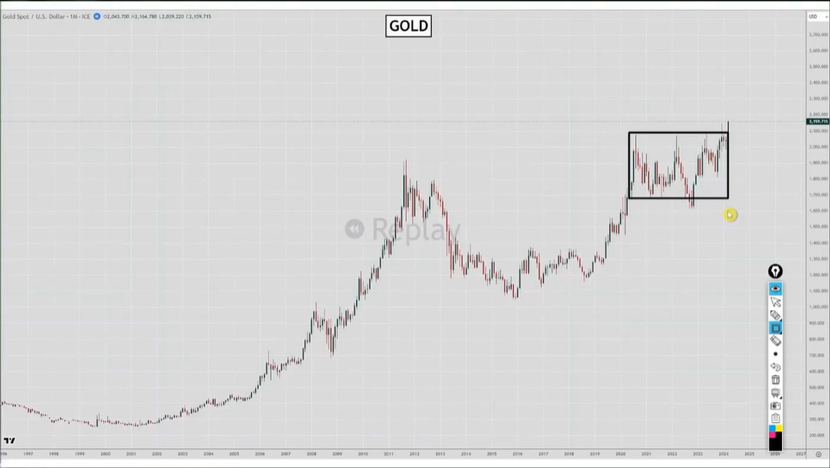
Now to set the scene, the March quarter of 2024 was the biggest ever for central bank buying of gold.
Up to that point there hadn't been much going on. But all of a sudden, this big central bank buying came in. Also, the Fed was saying that they were going to lower rates. They were talking about three cuts probably coming in 2024.
So you've got the prospect of rates coming down, which helps gold because it competes with interest rates in bonds. And you’ve got huge central bank buying happening.
Gold had been in a consolidation pattern for three years. Think of it like shaking up a Coke bottle. For three years, the market's been wondering, is gold going up or down? It had been going nowhere.
So that Coke bottle gets shaken up... and once it busts out of there, that's when it can really move.
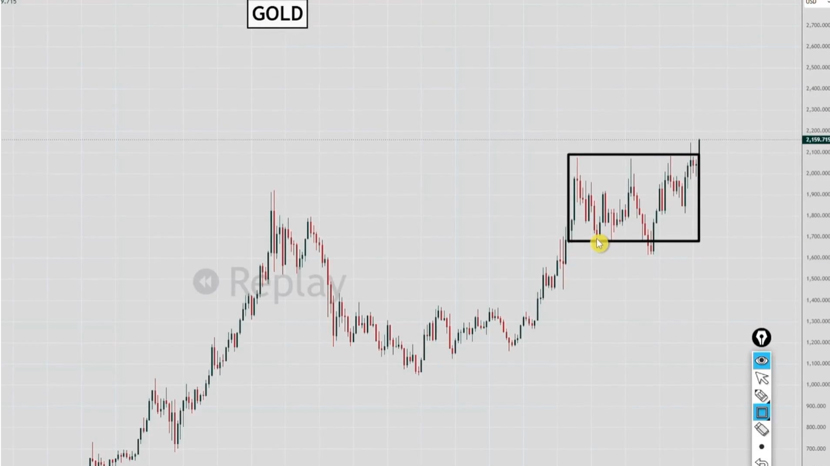
Here (chart below) we've got gold breaking out to the topside.
We've got that fundamental basis helping us, and we can see that it has been in an uptrend since 2016.
So the long term trend is up, and now gold is taking off again.
So that's a good moment for me to say, okay...
Gold looks pretty positive
here,
I want to go hunting
And that’s what I did. In March 2024, I recommended three gold stocks, and in a moment I'll show you one of them. But first I’ll show you a couple that I didn't take.
So this chart (below) is showing you the long-term trend in gold. This is just another part of the technical analysis...
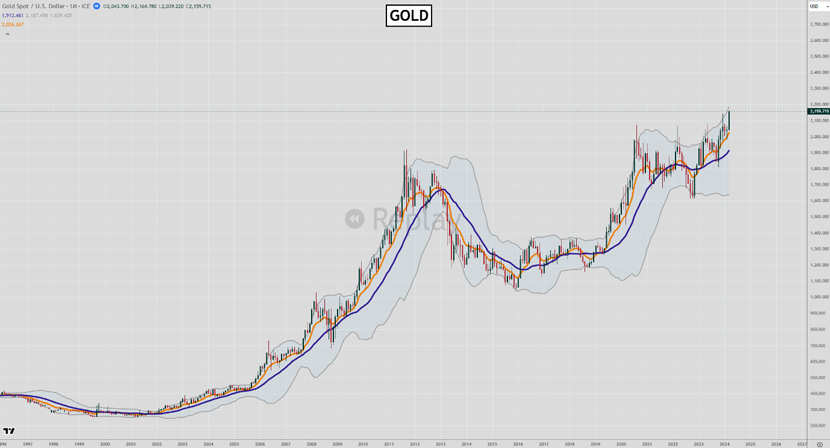
You can see the long-term trend there. It’s just turned back up. I like to see prices retesting the long-term moving averages and then turning up from there. There’s a sense of momentum shifting and turning...
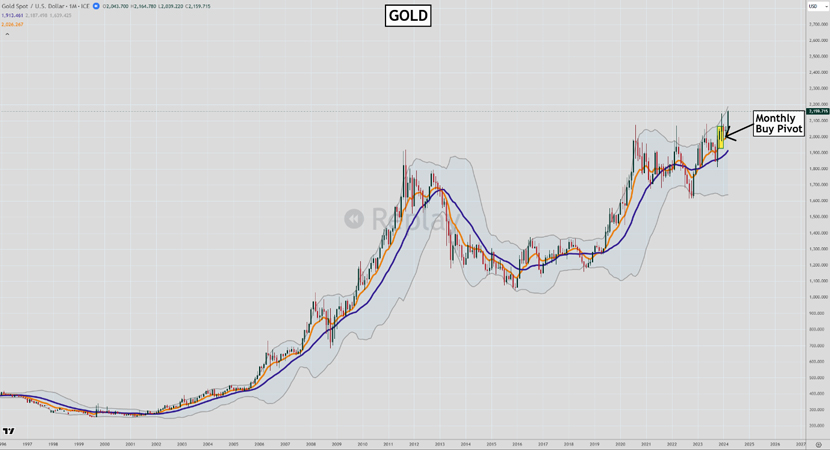
So we're combining all of those things, the fact that it's breaking out to the upside, the uptrend has just turned up... these are a few of the things I had at my disposal before looking at specific gold stocks.
And you can see here (below), that's actually what gold did, from that breakout. So you can see it was right to go with gold stocks. But did I know that gold was about to run that far?
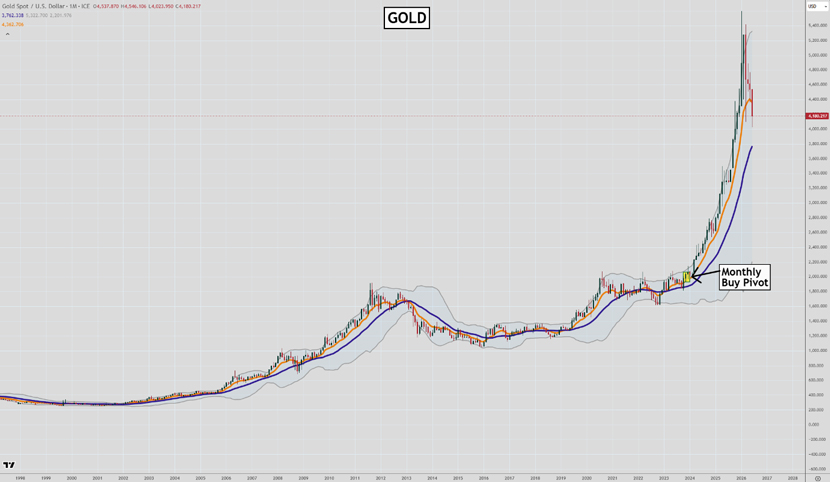
I didn't know, and I didn't need to know. All I knew was that the technicals were saying, watch out...
‘This could be a
big breakout in gold’
...and the fundamentals were backing it up.
So you don't need to know the future to trade. That's an important point.
Now on the stocks that we passed on...
This is one of them – Resolute Mining.
This chart shows that moment in March 2024 that we were talking about...
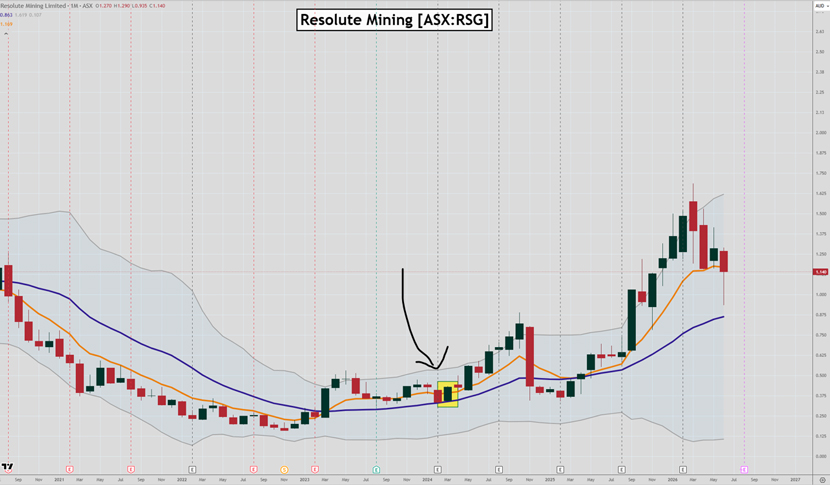
Resolute was one I considered getting into at the time.
They're based in Mali. And in 2023, the Mali Government came out and said, “your royalties are going to go from 6.5 to 10%. Instead of owning 20% of your company, we're going to own 35% of your company”.
We call that ‘sovereign risk’ — and it’s real.
The government in Mali were changing the rules as they went along.
That was one red flag. I also knew they’d had problems with their underground mine costs in the past, so that was another.
So I ended up leaving that one, and you can see here the stock price collapsed, only a few months later...
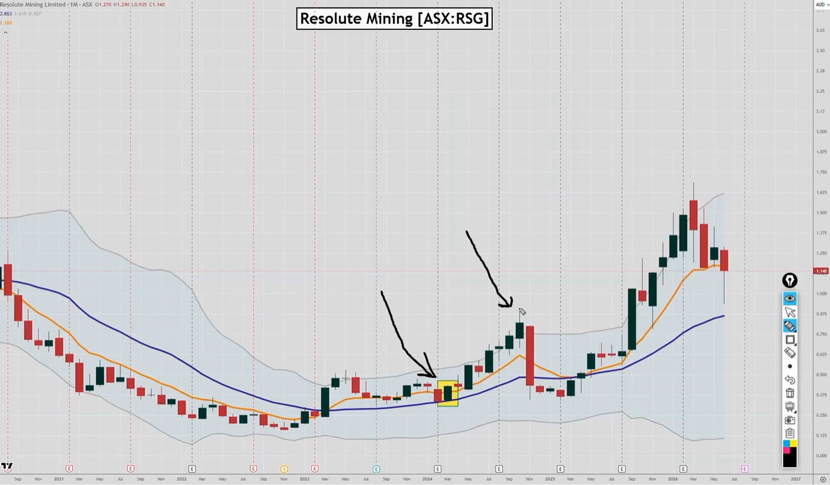
This was when the government actually kidnapped their executives and made them pay out about $160 million, stating it was for ‘unpaid taxes’. When countries are kidnapping your executives and forcing you to pay them money, that’s probably a good reason to give a stock a wide berth!
Here’s another one I passed on: Bellevue Gold...
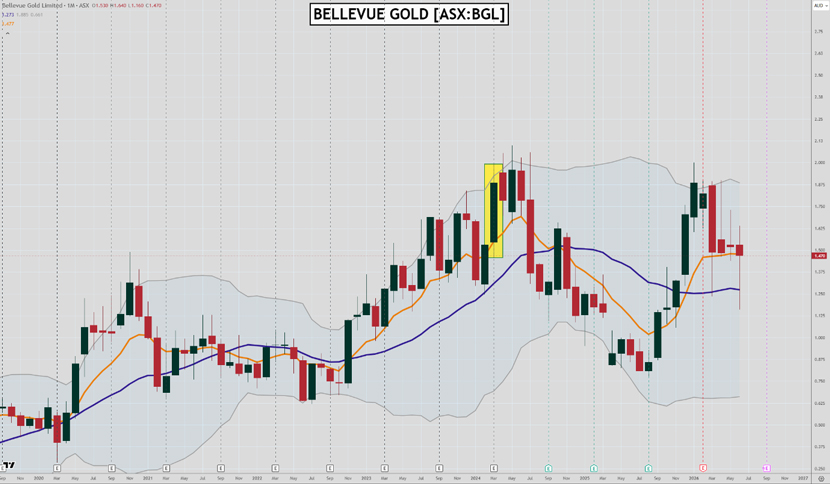
This chart here (above) is from March 2024. Now this one was looking great on its highs. At the time Bellevue were developing an underground mine and refinery.
But when you haven't got a producing mine, there's a lot of risk.
It’s a massive effort to get it up and running. You have all the data telling you what's going to happen, and they tell you what the costs are going to be and how long it's going to take. But there is a lot of risk, getting to the point of full production.
I didn't want to take on that risk.
Turns out I was right not to
Bellevue came out with a big capital raising, saying that production wasn't what they wanted — and downgraded their projections.
And look, you can see that today, their stock price is actually below where it was at before the gold price broke out.
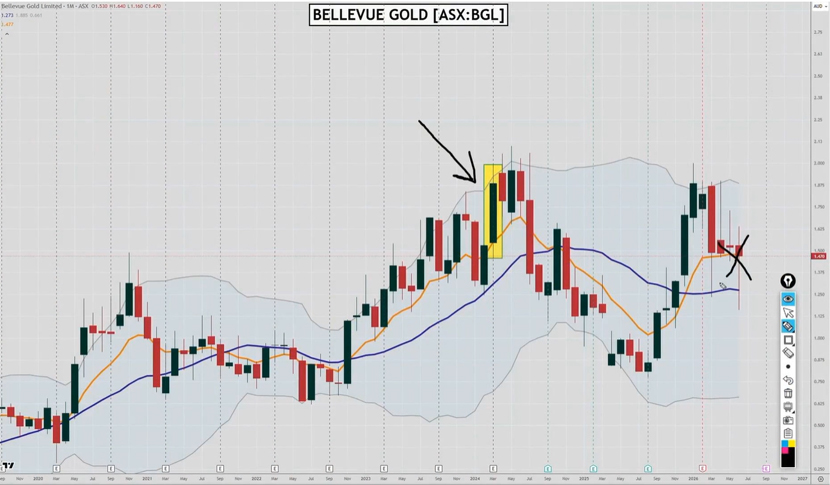
Remember, gold went absolutely ballistic, and Bellevue are still below that price.
So I was pretty happy I left that one alone.
Now let me show you the one I actually took...
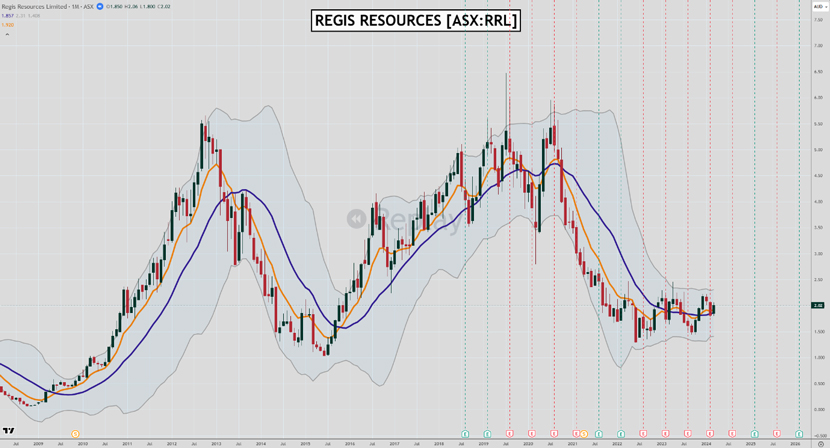
This is Regis Resources.
And it looks pretty terrible from what you can see here, right?
This is exactly what I was looking at in March 2024. The stock had sold off quite aggressively.
Why? Well, they had a big ‘hedge book’, and they were selling gold at about $1,560/oz, when the actual gold price was up at $3,000.
Regis were producing at around $2,000/oz. Not all of their production, but enough of it that the market had realised that they were not really capturing the upside in the gold price.
It meant that the stock wasn't really participating in the rally that had happened.
BUT...
Then they spent $98 million
to
buy out that hedge book
So here's a company that has had problems. They were producing over 400,000 ounces a year, which is a big operation, and their costs were coming in as expected.
Now they've gotten rid of their hedge book, so now they're fully exposed to the upside in gold.
And remember, at the time, I think the gold price is about to break out and take off.
So when I look at all those things, it's like, well, this stock really stands out as the pick of the bunch.
Then I went into the technicals to see if there was a reason for me to be thinking ‘this can turn up’.
Now, very quickly, one of the key things you'll learn today is that there's a relationship between the ‘rally’, the wave to the upside, and the ‘correction’ that often occurs afterwards.
As prices trend lower, there is a point in time after a correction where there's a higher probability prices will turn around and revisit the middle of the wave.
Let me show you...
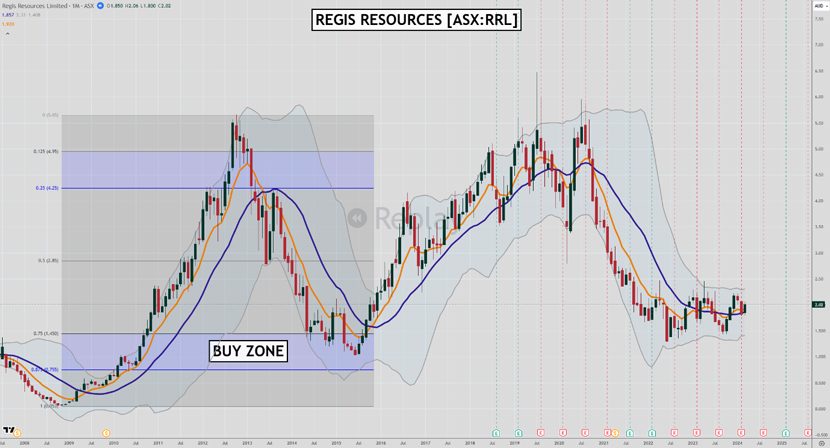
So here you can see a big rally from 2008 up into 2013, and then the price collapsed big time, sending the stock into something I call the ‘buy zone’.
This ‘buy zone’ is typically a 75% to 87% retracement of the previous rally.
That’s an area where I'm interested. Because if prices can turn up from here, there’s a high probability that the price will go back to at least the midpoint of that wave, which I’ve highlighted on the chart here in yellow.
That midpoint is what I call the point of control.
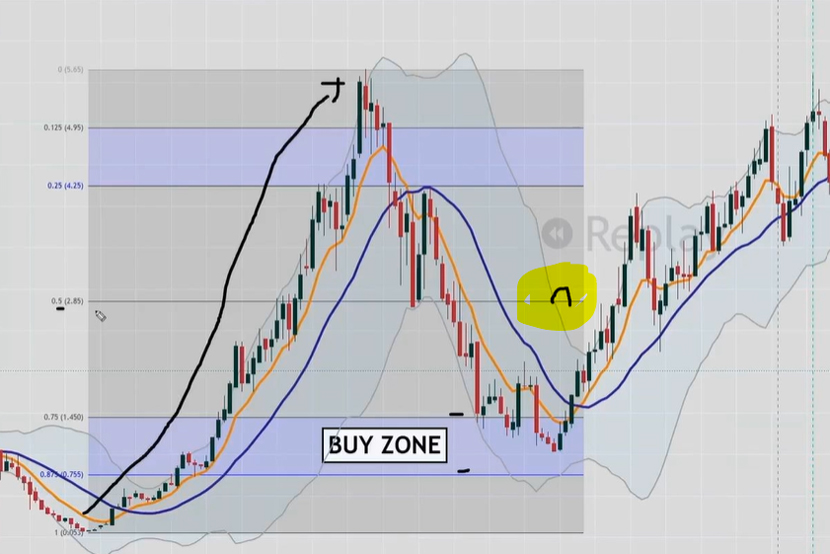
It’s like a middle ground where you know there's a high probability the price will head back there at least, even if it does fall over again.
So that's a pretty good
target
when you're trading
So that's what I was seeing at the time. We're not worrying about entry points here. We're just looking at what I was actually seeing in the price action.
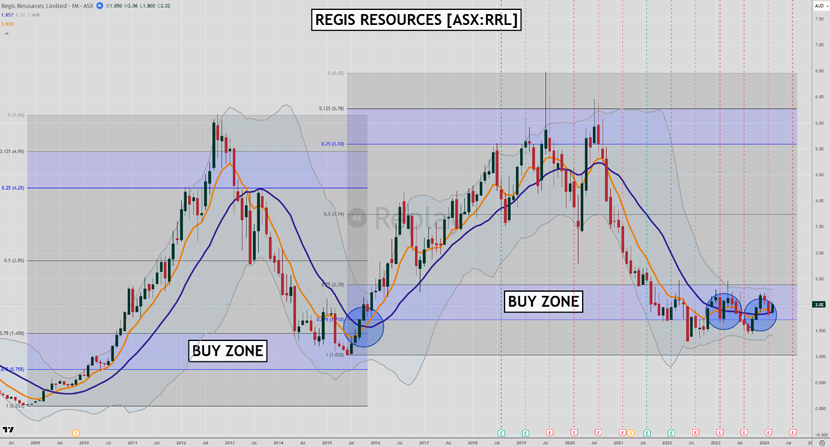
That first circle (chart above) is showing you the change in trend.
Now remember, we've looked at the fundamentals.
We think gold's going to break out.
We know the story about the hedge that's been taken off.
Regis is now exposed to the gold price.
And here we are in
that buy zone
area of
the most recent wave
The long-term trend is turning up, and for me, that's the one I’m going to go for.
We've bought it at two spots.
As soon as it really broke out, we bought it again.
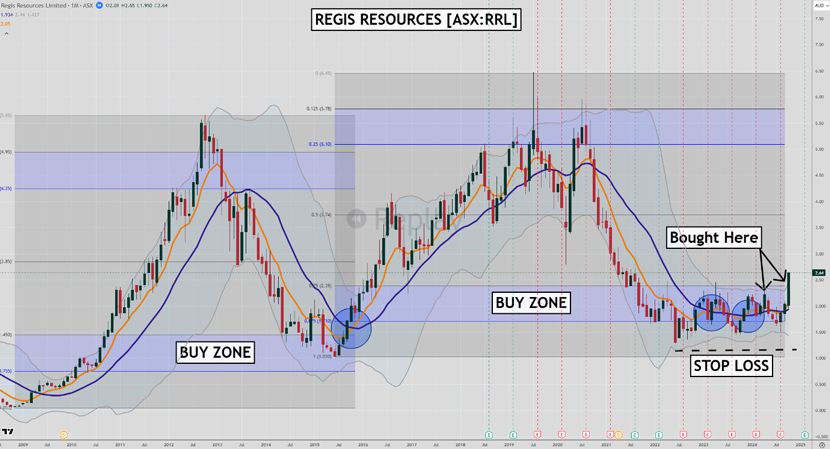
Here’s what happened next...
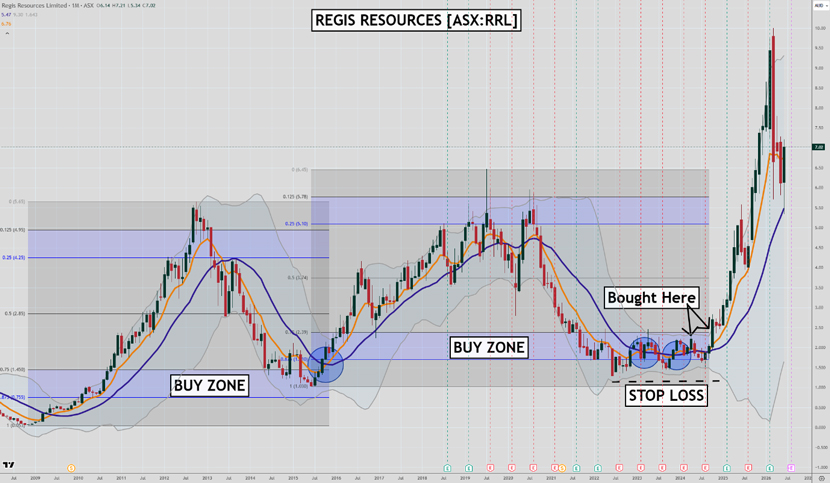
This is actually up to today, showing what actually happened in that stock.
So you can see we got in on the ground floor by using all of those ideas.
What's gold doing? What are the fundamentals at the stock level? Also the technicals as well.
I'm just trying to get as many odds as I can in my favour.
At the point of entry I still don't know whether this one will work or not.
But I do know that before I enter, I've ticked off a lot of boxes.
NATALIE WOOD:
Absolutely.
That's a very different picture to the two examples that you didn't go into.
So, going back to what you probably do at home right now, you may go with the name that you probably recognise, the one that is potentially already running...
Or a hot tip that someone mentioned at a barbecue...
...Or you've read about on a forum.
I mean, we've all
been guilty of it
Sometimes it works out okay, but a lot of the time it doesn't.
Now, quick one for you guys at home, and be honest: have you ever bought a stock just because everyone else was talking about it?
I'll admit, I've done it.
I mean, we all get caught up in the FOMO sometimes. It's hard to think rationally when a market's flying and you just want to jump right in.
And look, I get it. We don't all have Murray's charting software, and we don't have 30 years of experience telling us what to look for in a chart.
Well, that's exactly why I want to tell you about something called Murray's Trading Room...
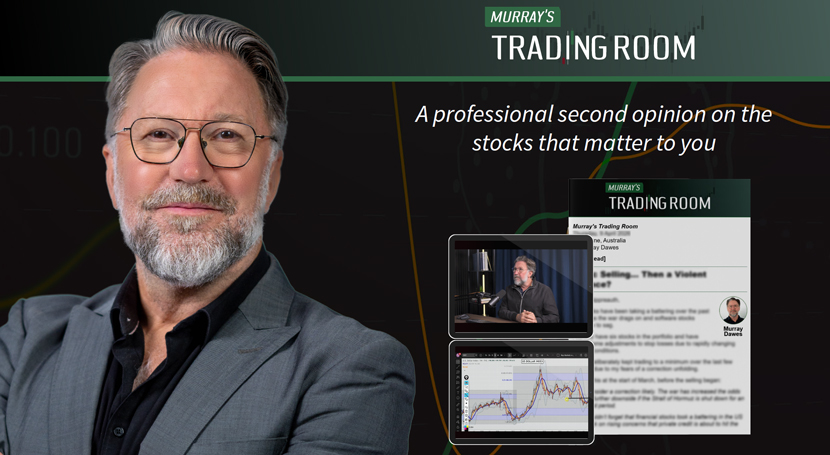
Murray's Trading Room is a live webinar Murray runs every week where he does the same kind of analysis he just did for Regis Resources, but on a stock you want to know about.
One that you're already thinking about buying... or maybe one that you already own but you're not really sure what to do about it.
You send Murray the name of the company and if he selects it for that week's session, he'll pull up the chart live on his screen and give you his professional read.
It's the same process
you're watching
today
but pointed at the stocks
that
actually matter to YOU
We’ll come back to the Trading Room a little later on.
For now, let's keep on going because picking the stock is one thing... knowing when to pull the trigger is another thing entirely. Right, Muzz?
MURRAY DAWES:
That's absolutely right, Nat.
I'm sure everyone has heard the idea that timing is everything... it really can be the difference between making or losing money.
WiseTech is an example.
At the end of 2024, it was selling for around $140 per share. Recently, it’s been as low as $30 a share.
So just from a timing perspective, you could have bought that stock at $140 back in 2024, and it's now at $30.
How long until you're making money again on that stock, if you ever will?
With inflation as well? You may never make money.
So timing is really imperative — from an emotional perspective as well. Because if you buy, and then you're sitting on a stock for two years that’s down 50%, you have to go through that mental quagmire of deciding:
- Do I get out?
- Do I hold on?
- Is it worth it?
And you typically end up dumping the stock because you're sick of it. But then when you look back you see that it’s gone up anyway!
So timing is a powerful thing to work out, and if you can do it, it stops you from making as many mistakes.
My trading model is a way of helping you make decisions, so that when you enter, you feel confident of what you're doing, and you know exactly what you're going to do next.
Let me show you by taking you through a trade we made in another gold stock — this one’s called Perseus Mining...
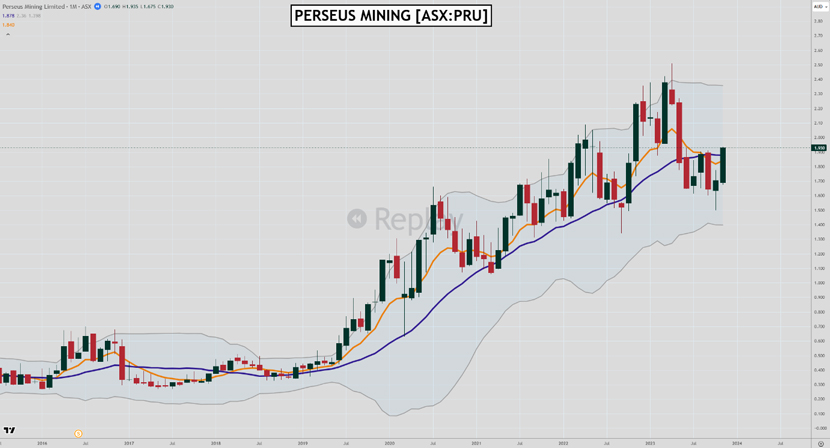
So this, again, is what I actually saw at the time when we entered the stock.
And, the first thing I want you to note, is the nice steady trend to the upside. Right?
This is from 2019. And it's been just a nice steady climb higher. The trend is good and steady, meaning the buyers are constantly stacking up and that there's value creation going on here.
So when I look at Perseus I see an interesting stock that I want to investigate further.
Now, there’s something I
want to show you here...
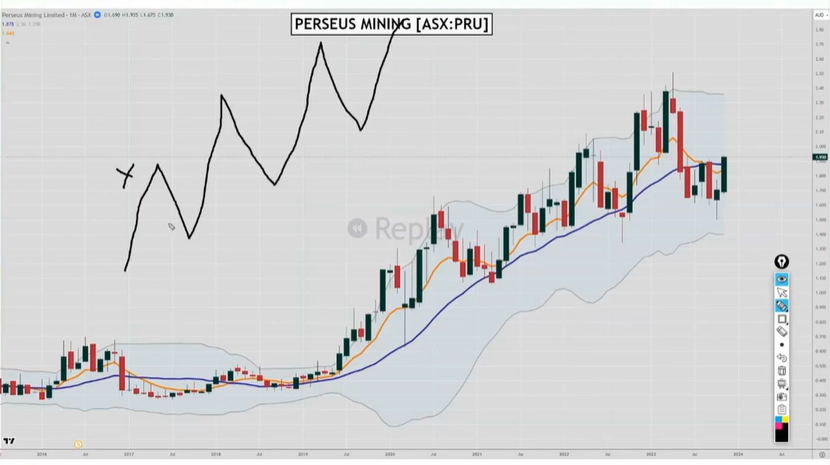
I'm sure you’ve heard of the idea that a sign of a stock in an uptrend is that it makes higher highs and higher lows as it travels.
This is what typically happens as I’ve drawn on the chart below....
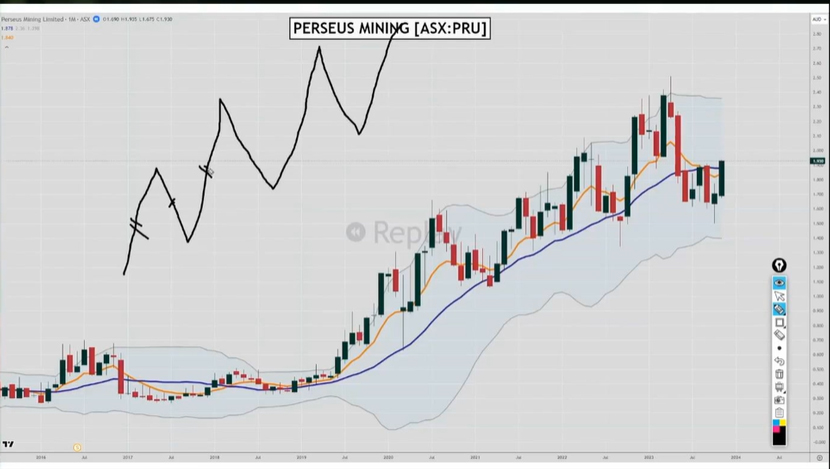
Now, most people don’t know that there is actually a relationship between each rally that occurs and the corresponding correction that occurs afterwards. And this is what helps you make calculations, which help you to decide where the best time is to be getting active in a stock.
So if we look again at Perseus (below), when do you think is a good time to buy this stock that’s trending higher?
Do you think buying here is a good time to buy it (‘X’ on the chart below)?
Or would you prefer to buy it here (highlighted ‘X’ on chart below)...
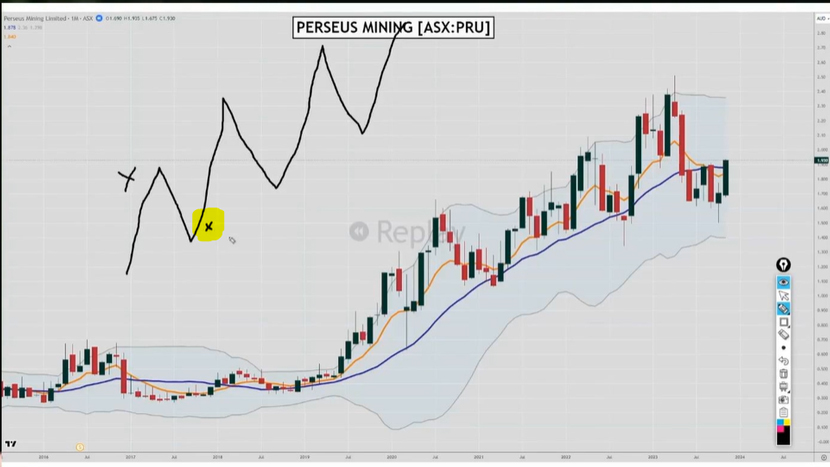
In other words, do you buy it when it's going up and it looks great, and then you're looking at it six months later and it's down 50%?
Or do you prefer to wait until the correction's over, knowing you have a rule for when prices are changing direction… and jump on it then?
My rule is:
Buy short term weakness
to own long term strength
I’ll think about the long term uptrend... and I’ll know that prices ocellate between these higher highs and higher lows. And I’ll look at the price chart and ask: ‘where are the areas that this stock could be getting ready to go again?’
That's the first lesson. It’s a simple one, but I think an interesting one to contemplate.
The second lesson? How do we know when prices change direction?
If the stock goes up one cent, does that mean it's changed direction? What about two cents? What's the rule? Because it's a sea of grey out there. Prices are flying all over the place. You need rules to help guide you.
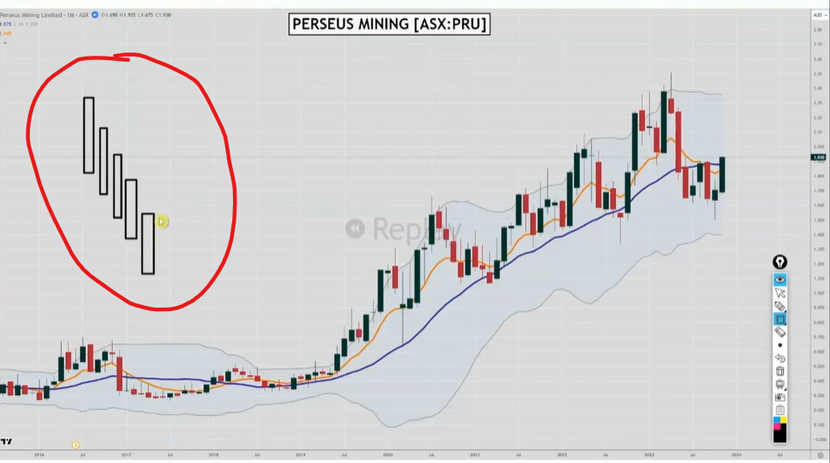
I use something called buy and sell pivots as a way of getting a sense of prices changing direction.
So imagine that these five bars (‘candles’ circled in red below) represent a month of trading. And this stock is going down, down, down. How do you know when it's changing direction?
Well, imagine if next month it closes higher than the highest point of the lowest previous candle... (as shown below). I call that a ‘buy pivot’.
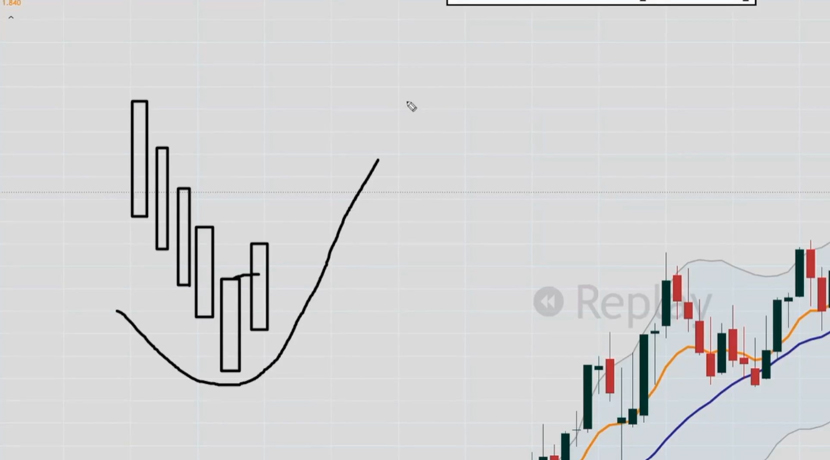
Now we’re getting a sense of prices changing direction.
Every low you've ever seen in any stock has a buy pivot at the bottom of its rally.
Now that doesn't mean that every buy pivot you see is the beginning of a huge rally. If you go out there and start buying buy pivots without any other rules, you're going to lose money.
It's about understanding where these occur.
Do that and your odds
of success go up
NATALIE WOOD:
So you're not trying to find the bottom of the move... You're trying to see when the stock changes direction?
MURRAY DAWES:
Right. By having the rule of seeing a buy pivot before I act, I’m almost forcing the market to rally a long way before it proves to you it's turning direction.
If I have that rule, it means if the stock does keep going down, I didn't buy it, did I?
I've stopped myself from making a hundred dumb trades by having that one rule.
And that's what you're trying to do: get rid of the dumb trades and concentrate on the ones where the odds are in your favour.
So now we understand how prices change direction. And we understand how trends develop. Let's have a look at what actually happened with Perseus and show you the underlying structure that people don’t often understand or see...
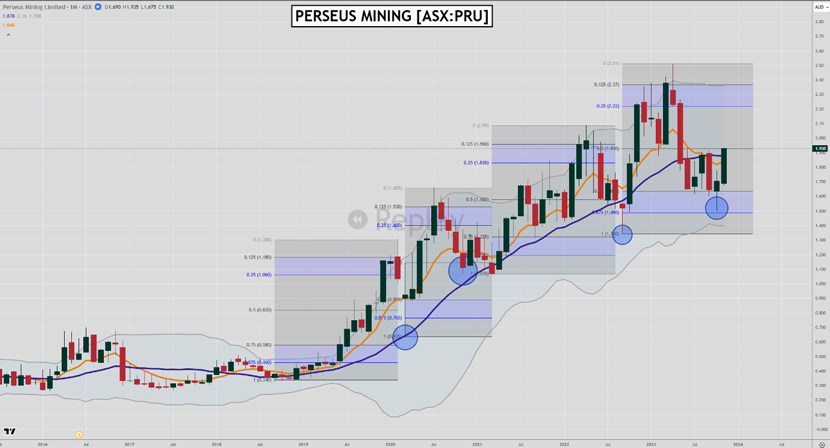
So now (above) we're seeing each wave and each correction.
This shows the range of the uptrend move.
Then you can see that buy zone area I told you about, a 75% correction of the previous move. And look — the price came all the way down there.
Then we've got the next wave.
Where did that one go to? Well it came back to the midpoint of the range, didn't it? It retested that midpoint. That's showing you the strength of the buying is really there.
And then we've got a nice big rally over that next year or so. And where does the correction come back to? Look at that. Down to the buy zone again, before taking off for the next wave.
So I'm seeing this steady move, this long trend to the upside...and I saw again a move back into the buy zone. And I'm saying, okay. Well, this is a beautiful trending stock.
I like the way gold's looking.... This stock’s actually been selling off for, seven months (circled below).
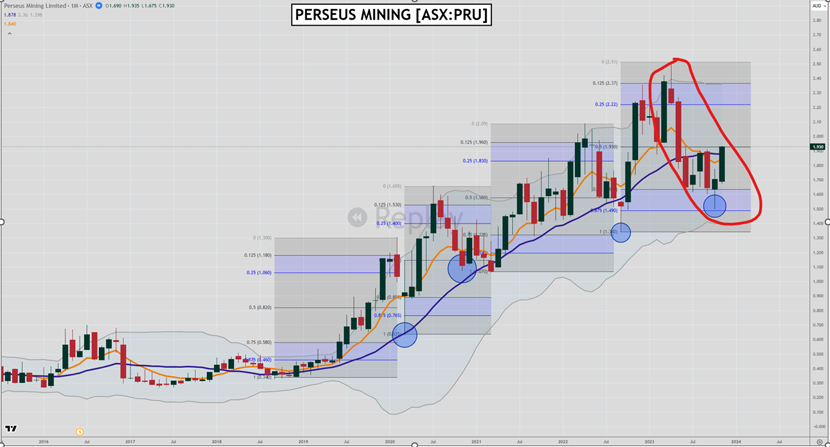
And then all of a sudden, can you see the buy pivot coming in there (below) saying, okay, maybe this thing's changing direction in the way we want...
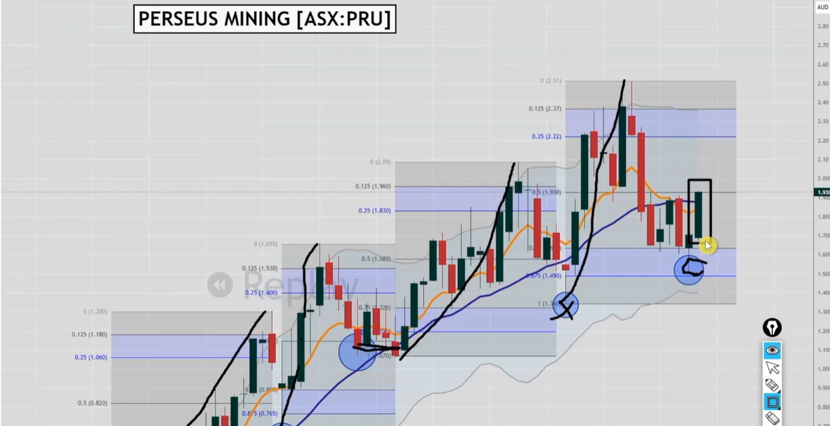
And remember, gold was looking great, and the fundamentals of this stock were good. It has ticked all the boxes.
I'm not just saying, I like this company: let's buy it. I'm saying, I'm ticking off all of these boxes before I'm allowed to buy it.
So let's just have a look at how it went from there... (see ‘Bought Here’ below...)
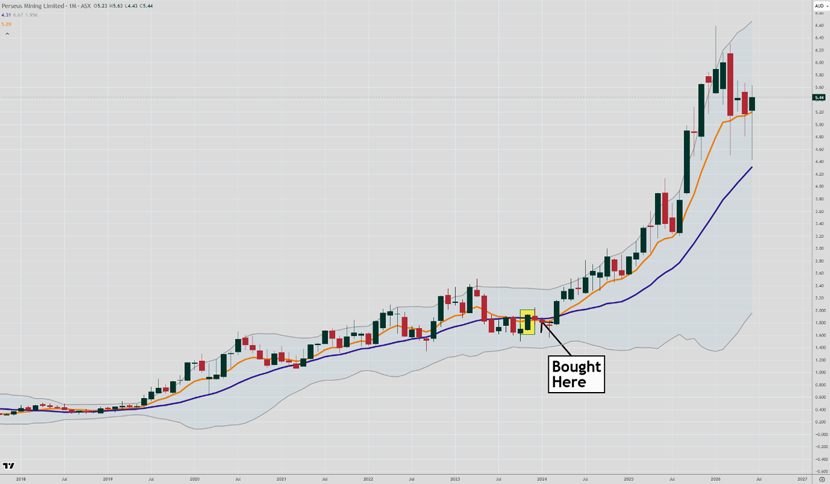
So this yellow box (above) is where we bought. And you can see that trend did continue, and this was when gold was really taking off to the upside.
Bob's your uncle!
Now of course, it all sounds simple after the fact.
But it's all about having that strong set of rules that guides your behaviour before you act... so that you're increasing your confidence, lowering your stress, meaning you can just get on with it.
NATALIE WOOD:
Yeah. That's the discipline that your model gives you, and that confidence.
I think this is the question that Murray gets more than any other in the Trading Room: ‘I like the stock, but is now the right time to buy?’
Well, you've seen how he handled it for Perseus...
He'd done the research, he knew he wanted to own it.
The exciting thing would have been just to jump in, buy it then and there.
But Murray didn't do that. He waited for the chart to confirm the moment.
This is exactly what I was talking about at the start of the show when I mentioned what Warren Buffett said about ‘temperament being more important than intellect’.
Well, this is what it actually looks like in the flesh. Not diving in because you're excited.
Waiting calmly until
the evidence says ‘go’
Muzz, that waiting... sitting on your hands when every instinct is screaming at you to buy... that's the hardest part, isn't it?
MURRAY DAWES:
Yeah, absolutely.
You do your work on a stock... You look at all the numbers, the results... You look at the future path of the company...and you get all excited.
So you decide to buy it right now... as if the market itself will realise that you've done all this amazing work... and the stock will just start rallying as soon as you've entered the position because you're such a genius!
Well, I'm afraid it doesn't work like that.
And after you've made a few mistakes doing that, where you bought something, you thought you're a genius... and then two years later, it's 50% down...
You realise that, having a model and having a set of rules that put your odds in your favour, despite the fact you don't know what the exact outcome will be, that's the way forward.
NATALIE WOOD:
Absolutely.
So no more hand hovering over the buy button. You know exactly when the moment is right, and you act.
Now, let's say you've bought a stock. Your money's on the line and the price is moving, maybe in the direction you want, or maybe in the direction you don't want.
What do you do?
Because this is a big test. When you've got real dollars on the line, you have to be able to fight your instincts and stay calm.
Muzz, how do you handle that?
MURRAY DAWES:
Look, it's really tough. I think you learn early on that our natural psychology is the opposite of what you need to be, to be a trader.
Our natural urge is to take that profit while it's there and to hold on to your losers because, just maybe, you'll be made whole again.
And then the stock
keeps falling...
...And you're waking up at 3am wondering what's going to happen, because you bought too much of the stock, and you've lost way more than you wanted to.
It's stressful, and, it's no fun.
NATALIE WOOD:
So what do you do instead? How do you keep your head when your money's on the line in a choppy market?
MURRAY DAWES:
Well, this is what I'm trying to show you today through my model of market behaviour.
Now, it's not, like I said, looking at tea leaves and saying ‘I know exactly what's going to happen’. It's about having respect for the fact that you don't know.
When you understand that, you say, right: how will I behave in the market if I don't actually know what the outcome will be? I could do a lot of work. I can show you the sector work I do... the fundamentals... I could do all that work, but still I don't know if that one's going to work.
So the way you
behave in the
market
becomes very different
You respect the model you build. You respect the decisions you make outside of the trading arena, which will help guide you, while you're in the trading arena. So when you're in the heat of the battle... and news has come out and the stock's gapping and volume's happening... you know exactly what you're going to do.
NATALIE WOOD:
I am absolutely itching to see this in action, Muzz, because this is seriously powerful stuff. Why don’t you walk us through it?
MURRAY DAWES:
Yep. Okay. So I’m going to show you how I split trades up into three sections to guide me as I'm going along.
Why do I do this?
Well, there are three things we want to achieve as traders or investors.
First. I want to make sure I survive.
Second, I want to make sure I make a little bit of money. Even if things don't pan out perfectly for me, I'd like to see my account going up a little bit.
And third...
I want to have exposure to
potentially explosive upside
I mean, why do all this unless we're going to go for a big win, right, every now and again? Because they do happen, and they can really be a kicker to your returns.
So if I can achieve those three things, I'm pretty happy.
And I achieve that by splitting the trade into three.
So I'll go into a full position, and then I'll sell a third of that position at an initial target.
What that does is creates what I call a ‘free carry’, or ‘free call option’.
And then I will hold the rest of the position knowing that I'm going to break even or make money.
At a second target in the price I'll take another bunch of profit...and from that point forward, I will either make money or make more money.
Imagine how you're feeling then. Pretty damn good!
And then the last third of the position, I'm letting it run to potentially go nuts.
And that's what I want to show you now...
NATALIE WOOD:
Let's see it.
MURRAY DAWES:
So here’s a trade I recommended in Pilbara Minerals...
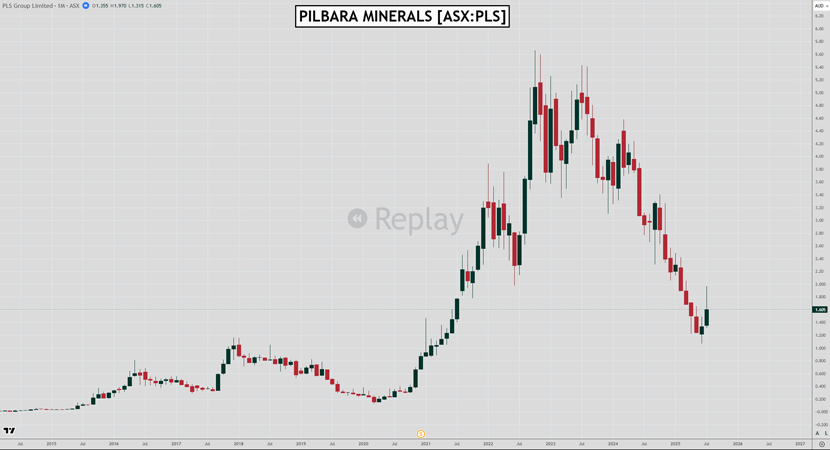
People may know this is a lithium play, and that recently we had a big correction in lithium. In fact, prices have been selling off for years.
Now remember I said that there’s a relationship between previous rallies and the corrections that occur? Well think of it as people getting shaken out of their positions... or being scared out of their positions.
The more a stock falls, the more people sell because, if you bought it two years ago... and it went up 100%... but now it's at zero... you're pretty tempted to sell, aren't you?
So, understanding that, plus what we previously said about how prices change direction, let me overlay these areas...
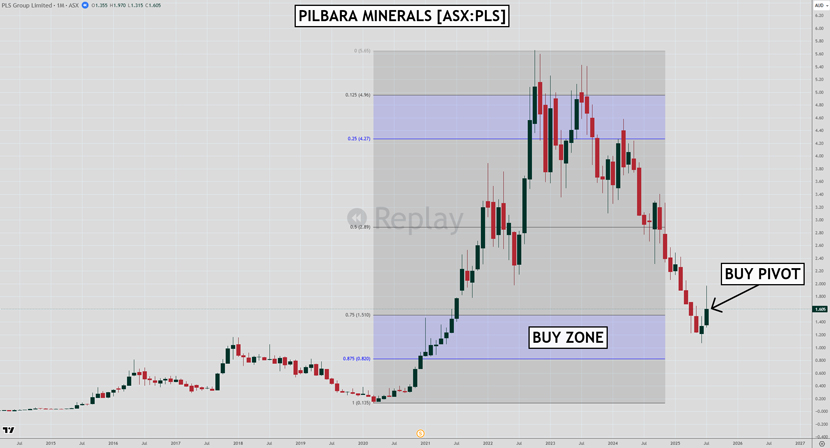
It's a pretty simple idea.
So we'd seen things start to bottom out in lithium. And Pilbara is now down in that area where I'm interested.
We've got that buy pivot that I'm talking about.
So I was pretty interested, because the long-term lithium story, I think, is still intact.
We know what drove the lithium price down was a short-term issue; oversupply, new market, China cornering things, etc... etc...
But in the next five, ten, twenty years, is lithium going to be needed?
Absolutely!
I knew long term I liked the idea.
And so when I saw this setup, it's like, okay, I want in.
But how am I going to manage the trade from start to finish?
What do I need to do?
Well, let me show you how I set up the trade, and what it looked like...
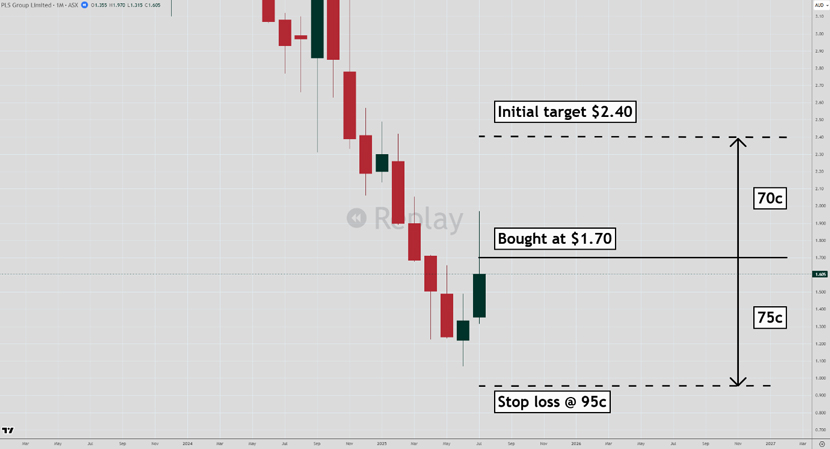
So we entered the trade at $1.70. And set our stop loss at 95 cents.
A stop loss is, of course, a price you choose where you get out no matter what. The way I look at a stop loss is, once it goes under that level, I'm wrong.
That’s the most important thing to figure out first. Rather than: how much money can I make, it's where am I wrong?
Because remember, I know that I don't know. I know this trade may not work out.
Therefore...
Where am I wrong?
That's the first question. And I want to know that I'm wrong very quickly.
So by using buy pivots, I'm getting on pretty early in the change, aren't I?
As soon as I'm seeing good momentum change... and volume start to come in at that area that I've talked about... I'm like, okay. I'm going to have a crack here because I don't need to risk too much to find out if I'm wrong.
So we set up the trade... and you can see here's the bottom of the whole range:
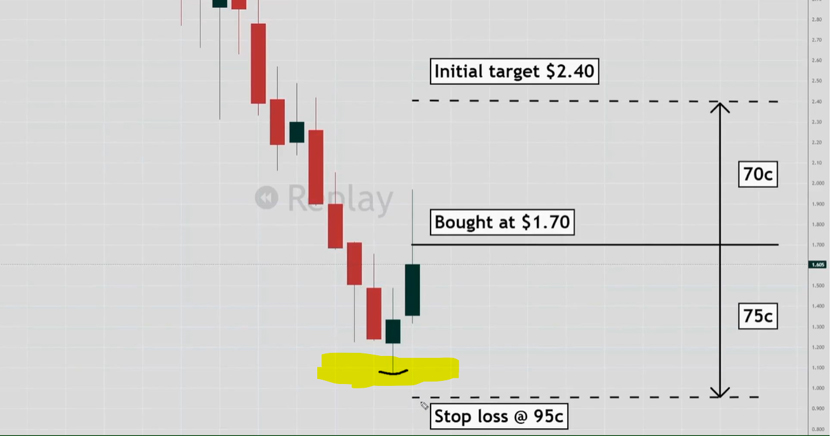
Notice that the stop loss is below that.
So what that does is it forces the market to do a lot of work to stop you out, because there's a major support level there. It's got to go down all that way, break through that support level, before it can get you out.
So that's a pretty good spot for me to say, right. I'm happy to admit I'm wrong if it's down here.
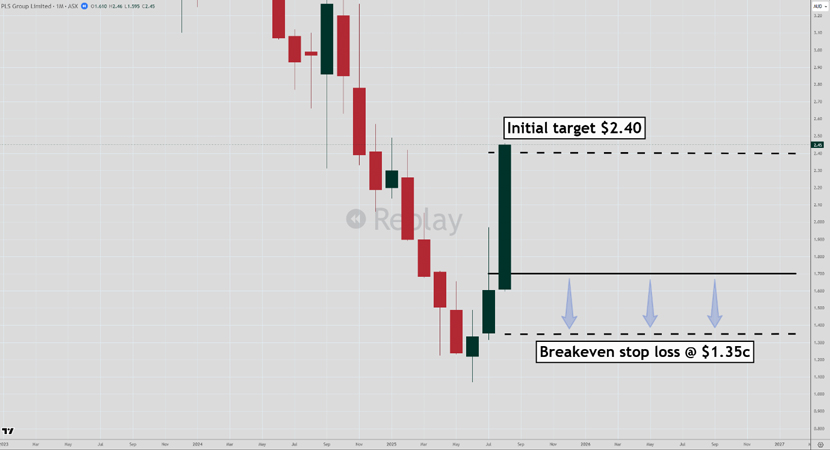
So we've got in at $1.70. Our stop loss is 95 cents. So we're risking 75 cents on the trade.
Now my initial target was up at $2.40, And that, you can see, is risking 70 cents.
That $2.40 target is actually the midpoint of a previous down wave. So I'm saying, you know, I think the odds are higher of it reaching that midpoint than it collapsing and taking me out.
So the question I'm asking of the market is a simple one.
I'm not asking: ‘is PLS going to 10 bucks?’
I'm asking: ‘are the odds higher of it hitting $2.40 or hitting 95 cents? ‘
That's the total statement I'm making about the market. It's very simple, you can write it down, and it makes sense.
So now we've set up that trade and we're in.
This is what happened next.
So a good trade. Right?
Straight away, momentum's turning, people are getting interested...
The stock hit our first profit target in less than a month.
So that means there's a month of holding the position, watching it every day, wondering, is this going to turn down and hit 95 cents... or is it going to hit $2.40?
That's only a month of this trade being remotely stressful..
Once it hit that $2.40 target, we sell a third of our position.
And what that means, is that from this point forward, we are either going to break even on the position — walk away with the money we walked in with — or make money.
Your stress levels from that
point forward PLUMMET
You no longer need to look at this stock every day.
If you know you’re either going to break even or make money, you don't really care about the outcome.
You know that your capital is safe, so you can leave the position alone and see what happens.
NATALIE WOOD:
So at this point, once you reach that initial target, you call it the ‘free carry’.
Meaning you can only break even or make money from that stock.
Right?
MURRAY DAWES:
Yes. Unless something crazy happened, the world ended and everything collapsed overnight. The chance is tiny.
So you're going to walk away with your capital intact that you had when you walked in or make money.
And that's what I call a ‘free carry’ or ‘free call option’, for people who understand those things. Once you take that profit, you’re effectively lowering your entry price.
Rather than breaking even at your entry price, your break even now is lower. By doing that, you're allowing lots of volatility to occur in the future without getting you out.
I mean, on this trade, after we took the first chunk of profit, the breakeven was down at $1.35, and the bottom of the range is down there.
Often, I'd like the breakeven to be at or below that level, but I took this on thinking ‘it's a reversal. It looks pretty good. I'm willing to give it the benefit of the doubt that it's not going to collapse from $2.40 back to $1.35...’
But once we've taken that
part profit: how great!
Our breakeven level is miles away from where it's currently trading. We're already in the money. We know it's just going to breakeven or make money now. So let's just sit back and see what happens.
So after that occurred, what happened?
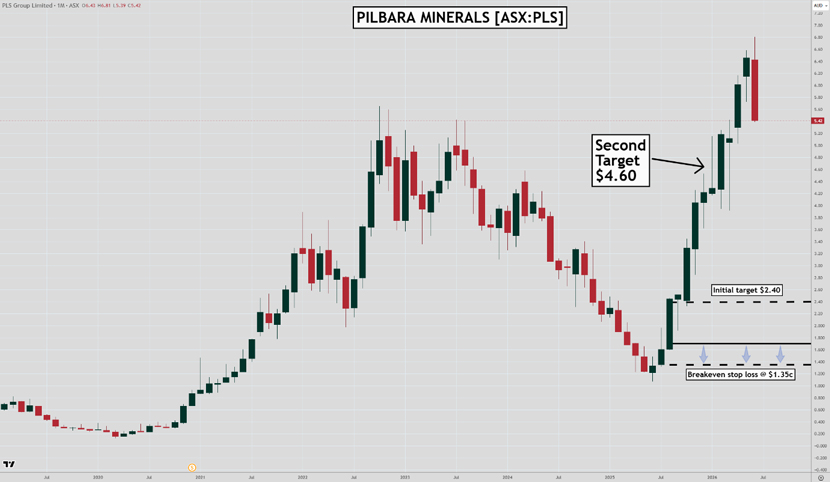
Not bad right? Again, did I know that Pilbara was about to take off to $6.80 in a matter of months? No. All I knew was that it had corrected into an area where I'm interested.
Prices had given me a signal that they were possibly turning back up. I had the midpoint as a target, and I felt there were pretty good odds that it would get there.
So we took the part profit, sat back and watched what happened...
And what happened
was a HUGE rally
How fantastic. But look – I’m no genius.
I’m just setting up a trade drawing on the knowledge I had at the time, asking: how much risk do I need to take? How can I lower the risk on this trade? Can I do it quickly?
And then sit back and let it do its thing.
And as you can see, it did rally, and so we took a second lot of profit at $4.60.
Now, after we took that profit, PLS could go bankrupt, and we'd still walk away with a win.
Not a bad position to be in, right? You're either going to make money or make more money. Your profit and loss account is going up no matter what, but you’re also exposed to explosive upside if it keeps going.
Now look, Pilbara is having a correction at the moment, but I don't mind either way. I'm in it for the long term. I like the long-term story on lithium. We've set ourselves up in a great trade.
We're either going
to make
money...
or make MORE money
So I can withstand lots of volatility and not get too stressed out.
NATALIE WOOD:
Impressive stuff.
Imagine that, folks. You go in knowing exactly what you're risking. If the stock tanks and hits your stop, you're out with a small loss you'd already made peace with before you bought in.
And if it takes off, you let it run. Step away from the screen, get on with your life, and check back later to see how you've done.
That's what investing with a professional model feels like.
And honestly, what would that mean to you?
Are you on the edge when you buy a stock, always checking your screen?
Is this something that you want to get better at?
Just for a second, imagine this being your normal; where investing stops being a series of nerve-racking gambles and starts being something you actually feel in control of.
How would you like that?
Well, that's what Murray can help you with every week in The Trading Room.
He doesn't just talk about which stocks and entry points look good. He can show you how to manage a position once you're in it, where to set your stop, when to take profit, and how it's possible to get yourself to that ‘free carry’ point.
We'll talk more about this very shortly.
But first, there's one thing that we want to cover: how to know when to sell.
This is the most important part of the entire process... AND the hardest, because this is where your emotions are screaming at you loudest. Right, Muzz?
MURRAY DAWES:
That's absolutely true.
Getting out can be tough, especially if it's going well, and you're seeing the dollar signs going up.
You think, well, if I just hold on, I might make another ten or twenty grand here. Let's just hold on...
And then the stock falls all the way back to your entry price. And you're kicking yourself every day. And then you dump it at zero, and then it bounces and takes off anyway!
The market is volatile, Nat. It'll throw you around. If you don't have some criteria to guide you along the way, you're probably going to make a mistake, and that's what we want to avoid.
So let's have a look at a trade that we ended up getting out of, I think, in the nick of time.
This is ResMed...
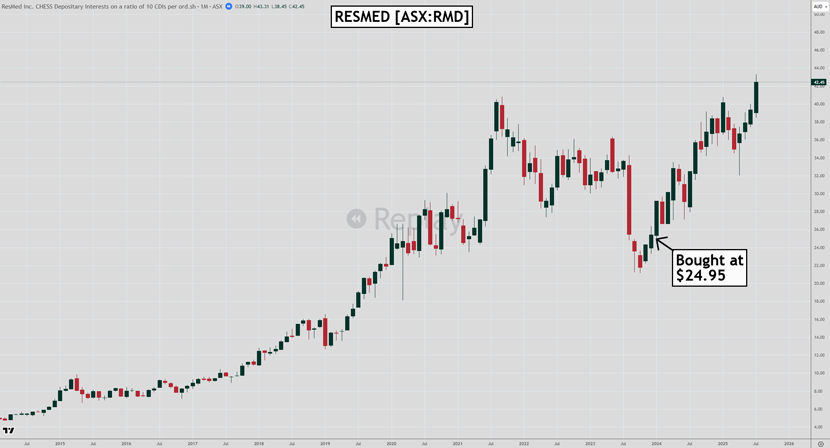
They do the sleep apnoea masks you wear to bed.
They've been growing rapidly for a long time.
But they had a period in 2023, when Ozempic was coming out and investors were fearful.
If everyone's going to lose all their weight, no one's going to suffer with sleep apnoea, and the stock crashed.
At this point I felt ResMed looked like a pretty good opportunity.
I don't think Ozempic's taking over the world straight away... and the company's still growing massively. So this seemed interesting enough for me to find an entry point.
We got into this one at about $24.95, soon after I saw the buy pivot, and momentum began turning back up.
And remember, I’m buying short term weakness to join the long-term uptrend — but all I’m doing in the first instance is targeting the stock to move back to the midpoint of the range.
Well, as luck would have it, it took off to the upside again. In fact, it bounded up to its all-time high.
So that all worked!
You know, at that point, I was thinking, ‘Great, we've got in at the ground level. We've already taken part profit. This is going to break out above 40 bucks, it's going to go to $100, I'm going to look like a genius, and this is going to be the trade of the year.’
And then... it started to not behave in a way that I liked.
Remember, I've been telling you about these ‘buy pivots’?
Well, it's the same on the top side.
A stock can be going up, up, up, up, up... and the first signs of the things actually turning down is like, okay — here’s a ‘SELL’ pivot.
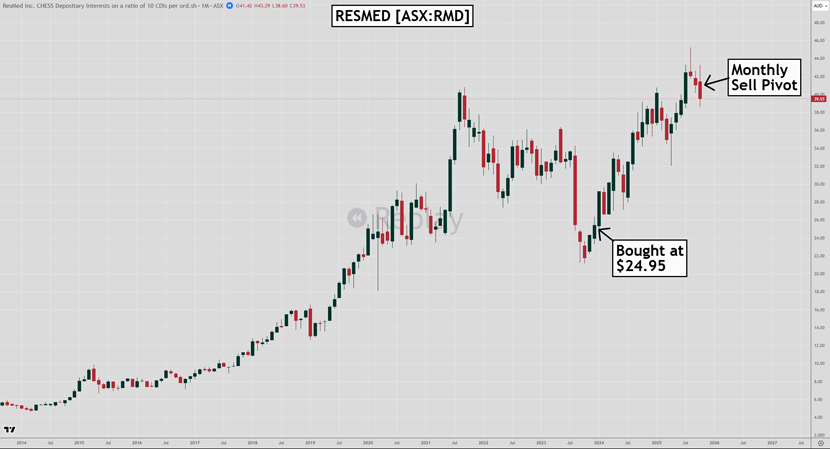
Well, let's prick our ears up here...
And, also, people may have heard of this idea of ‘double tops’. So automatically, I'm fearful... is this a double top? I don't know yet.
NATALIE WOOD:
So the ‘sell pivot’ is your first warning sign?
MURRAY DAWES:
Yes, it's a warning sign.
So I'm like, okay. Let's just keep an eye on this.
Because remember, you've got all these tensions inside you. You think it can keep going up. And then you start ignoring the negatives... because you're so caught up in the position you're in and wanting to make millions of dollars.
You’ve got to be able to stay objective and keep asking: what could be going wrong here?
One way to find out is by overlaying my moving averages... (coloured lines below)
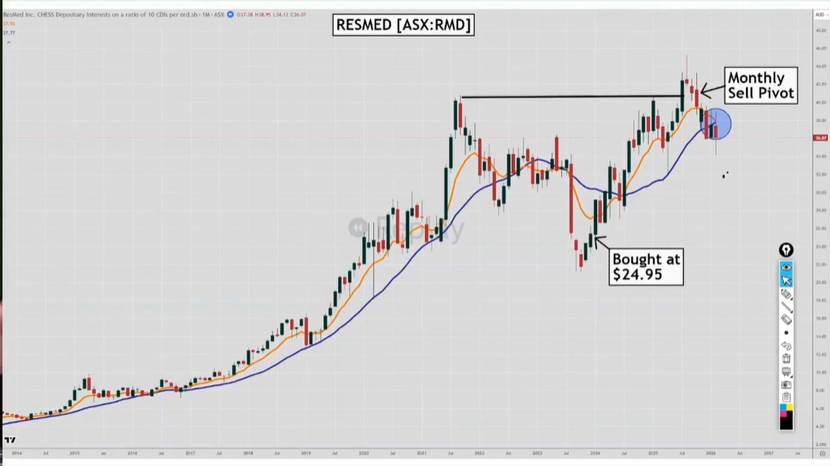
So, I use the ‘10-month exponential’ versus ‘20-month simple’ moving average. It's a bit of a different way of doing it. I just think it works better.
But you can see here with ResMed, this has been in a long-term uptrend all this time. And now we’re seeing the first moment since 2014 when it turned into a downtrend.
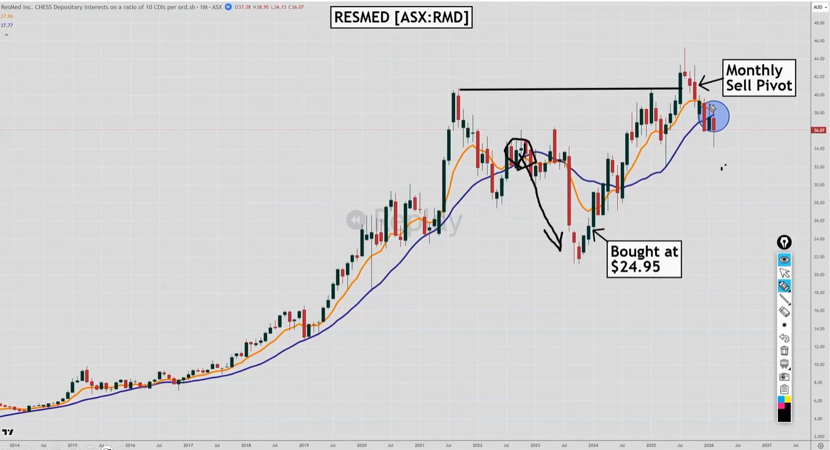
Well, the stock did sell off.... and continued selling after that monthly sell pivot.
It was weakening off, and you can see (below) that the long-term trend is about to shift. So now I'm in a long-term downtrend. That may not work out well for me!
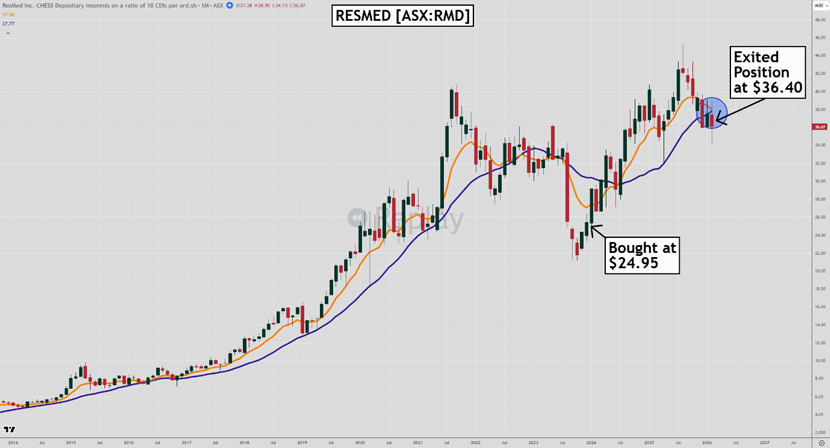
So we exited the position, the whole lot. And that was not what I planned to do. I wanted to hold it till it got to $100.
And look, I felt nervous selling out of it, but I was just following that set of rules that were saying you've got enough warnings here that something's going on.
Let's bank the profit and you can always get back in if you want.
So we exited the position there at $36.40, all fine and good.
Now... just to show you what happened next...
ResMed collapsed!
I had no idea it was going to collapse like this...
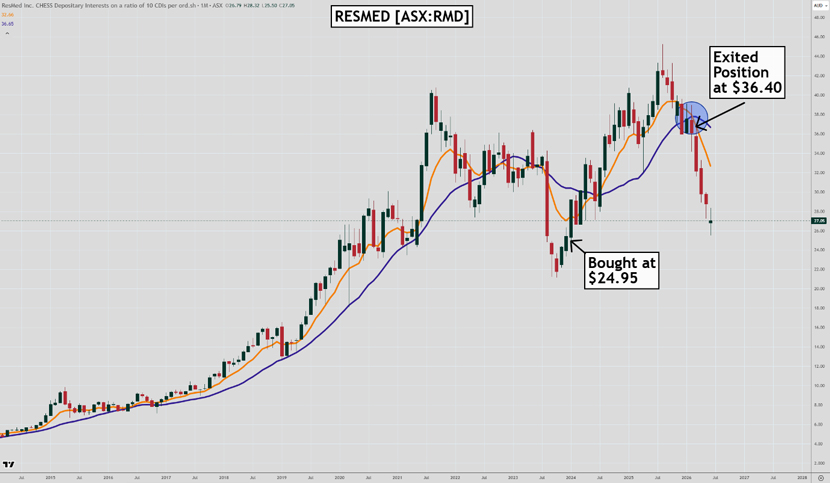
And the fact is, it retreated almost back to where we bought it.
So if you’re an investor who says, ‘oh, I just buy a stock and hold it forever’, that’s all well and good...
Three years later, that stock’s gone up massively, crashed, and now it's back at your entry price.
How are you feeling?
You're feeling like a short-term trader doing the same thing. It's just happened at a different time scale.
So not acting, not taking profits, not managing your risk, not putting yourself on the front foot... all of a sudden, you're under pressure again because the market’s so volatile.
You've always got to be
thinking in this way
So, in the end, it was just a bunch of rules that I've developed over thirty years that helped us have a have a great trade and capture most of that uptrend.
And you know what? Now we can actually re-enter the position.
We’ve already banked all of that profit and can move on from there without stress!
NATALIE WOOD:
Absolutely.
So there it is. Four decisions. Stock, entry, management, exit.
In every single one of them, Murray has made a clear rules-based decision.
No guesswork and no gut feel.
Now Murray didn't get this from some rare gift he was born with.
What he has got is a process built over 30 years of trading that takes all of the emotion out of the decision making.
And while it doesn't help him make profit on every stock, it certainly helps him to work the odds in his favour.
Muzz, going back to your Retirement Trader numbers, how often are you actually right?
MURRAY DAWES:
Well, I get six out of ten trades right. So that is four out of ten wrong.
Now, people who maybe don't have much experience in trading may say, oh my God — that's a lot to get wrong.
It's actually a very
high strike rate...
Because I’ve made a lot more on our winners than I’ve lost on our losers...
An average of 60% gains on the winners and 21% losses on the losers.
Which means you’re actually making three times as much on your winning stocks than you're losing on your losers.
What does that look like?
Well, imagine you're risking $2,000 on each trade you make.
Okay. So we got four losses. So we've lost $8,000. Ouch. Right?
But you also have six wins making $6,000 each... because you're making three times as much on each win.
So you've made $36,000 on the six wins.
And lost $8,000 on the four losses.
Meaning you've walked away with $28,000 in gains from those ten trades.
Imagine doing that
over time...
That’s why our overall P&L performance is so good, and it's why the average return is 19% per year over seven years.
Now of course you have phases where it doesn't work. You have periods when the market's terrible and we back off and don't do much.
But when the market's trending... and you're attacking... and managing it properly, all of a sudden, things can really start to flow.
NATALIE WOOD:
So Murray's been wrong four out of ten times and has still grown a hypothetical $100,000 trading account by 350% over seven years.
Again, we're not claiming this is going to continue forever.
Your money is at risk every time you invest.
But can you see what we're getting at here?
You don't have to be a genius
to be a successful investor
You don't have to pick winners every single time.
You just need a process and the discipline to follow it.
The best part?
You've just watched it. It isn't rocket science. It's learnable.
So... how would you like Murray to run the same process over the stocks that you're thinking about... or the ones that are already sitting in your portfolio that you're not sure what to do with?
Well, the good news is you CAN... by joining Murray inside his weekly Trading Room.
Muzz, tell us a bit more about it...
MURRAY DAWES:
So every Wednesday I host a live webinar where I analyse several of the stocks that members bring to me.
What I’m offering
members is a
‘professional
second opinion’
Just like I've done today.
So if there’s a trade that’s open that you’re worried about, or another company that you’re looking at, thinking: ‘what's the right way to go about this?’ — send it to me.
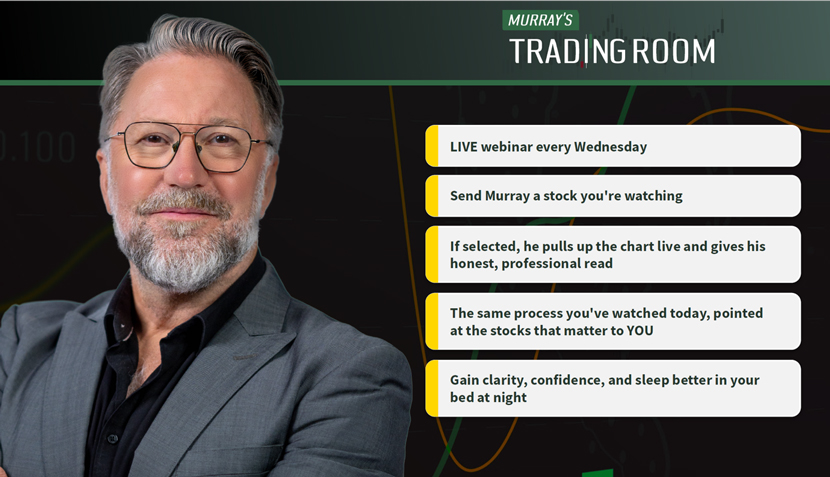
I set up the Trading Room because I figured that there's an opportunity to gather a group of like-minded people, every week, where everyone can throw in their ideas.
I go through and rank them. I'll even show what I think are the best prospects of the lot. I vet them, show members how to go about trading, how to manage the risk, and then single out the ones that are really interesting.
So not only are you getting a trader's knowledge of how to think about markets, how to trade and how to manage risk, you’re also getting new ideas thrown in.
NATALIE WOOD:
The one bit that stands out to me in particular is the confidence that members get... and the lower stress levels.
That’s the thing people say about Murray more than anything else.
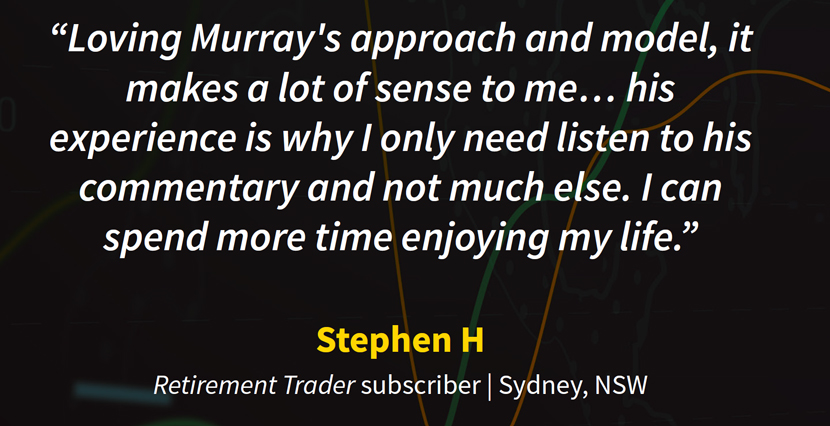
Thousands of investors right now across Australia follow Murray's work, and they write to us all the time.
In fact, this one came in from a Retirement Trader subscriber, Steven, in Sydney, and it really stuck with me:
I love that:
‘More time enjoying my life’
That's what it's really all about, isn't it, Muzz?
MURRAY DAWES:
Absolutely. Look. I've been there before, as a trader, putting everything on the line, waking up with the stress, almost running on adrenaline. And, really, it's unnecessary. You don't need to do it.
Trade smarter, not harder.
And you know, you can actually shoot after higher returns as a result of managing your risk effectively.
After a while of using the model that guides me, I noticed that my returns were getting better. And that came from me saying, ‘right, I'll just trust that model.’
Believe me, I'd much rather be on the golf course than sitting in front of the screen watching thousands of moving numbers.
Once you build that model and trust it, life just becomes much easier and more enjoyable.
NATALIE WOOD:
So every Wednesday, Murray opens The Trading Room live.
If you have a stock you're thinking of buying or one you already hold and you’re not really sure what to do about, send Murray the name.
He may not be able to get to every stock, but if yours is selected for that week's session he'll pull up the chart on screen, look at all the levels and give you his honest read on whether it looks like a good buy, the timing, the potential risks, what the opportunity is, and more.
It's the exact same process you've just watched today, just pointed at the stocks you care about.
So here is what you get as a member:
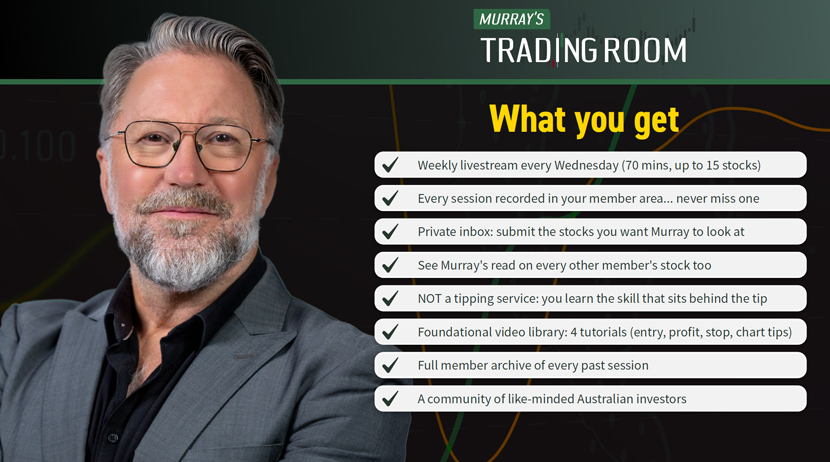
First, there's the livestream every Wednesday.
It usually goes for about an hour. And Murray will often work through as many as 15 stocks in that session.
If you can't make it live, no worries. Every session's recorded and available in your member area. So you never have to miss a thing.
Next, you get a private inbox that gives you access to Murray. That's where you'll submit the stocks that you want them to look at, just send him the name and a brief description of what you'd like to know.
And here's something
I think you'll really like...
You don't only get the chance to have your stocks looked at; you get to see Murray's analysis on all the other stocks in The Trading Room too. So every week you're getting a whole education in how a professional thinks.
Now, this is a lot different to most other advisories. Murray is not going to hand you a list of stocks to buy. The Trading Room isn't a tipping service.
But then, a stock tip only helps you once. What Murray's teaching you is what sits behind the tip, the ability to look at any stock, any sector, any time, and know what you're looking at yourself.
That's a skill you get to keep for life. Tips run out. This doesn't.
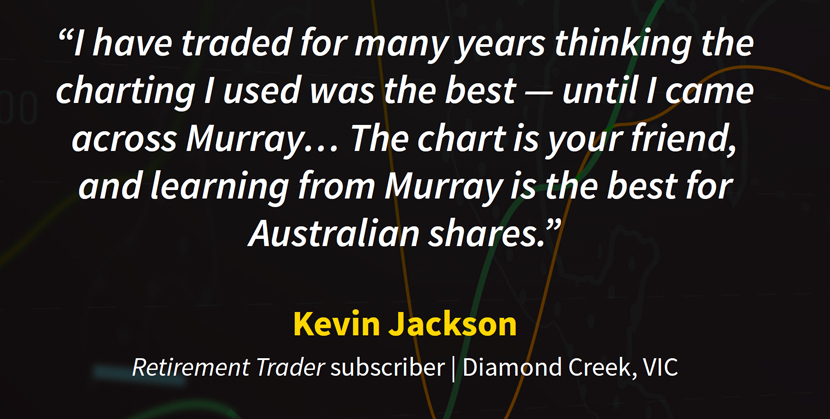
It's like Kevin, a Retirement Trader subscriber from Diamond Creek in Vic, says:
Next, you'll get immediate access to Murray's foundational trading video library.
You get four tutorials on the essentials; finding an entry, taking profit, setting a stop loss, and how to read a chart like a pro. Watch them at your own pace whenever you like.
Plus, you get the full member archive of every past Trading Room session, which is pretty useful when you want to revisit a particular stock or idea.
Above all, you'll become part of an online community of like-minded Australian investors who are on the same journey as you, learning to make better decisions with their money and helping each other along the way.
Now, one more quick thing before we talk about what it costs to get access to Murray's Trading Room...
There's a reason we've
launched this in 2026
And that's because a service like this matters way more than it might have a year ago.
The truth is, the financial environment is getting harder for ordinary investors to succeed in.
Markets move faster than they ever have before. Algorithms now drive somewhere between 70 and 80% of all global trading. We're talking about AI agents that can make and execute decisions in milliseconds.
So by the time you've read a piece of news, thought about what it means, and made the decision to act on it, the move has already happened and you've missed it.
That's just one headwind.
Another, I'm sure you've heard, is coming in July 2027 when the 50% capital gains tax discount you may have relied on before is being wound back to be replaced by a minimum 30% tax on gains.
This means that if you want to invest for long term growth in Australia, your after-tax return is going to be lower than it is today.
So stock selection, what you actually buy, will suddenly become much more important...
But timing, knowing when to get into a stock and when to get out, is going to become absolutely crucial.
That's why we're launching Murray's Trading Room now, to make it easier for you to make better, sharper investment calls in an increasingly tough market environment.
And we're making
it accessible too
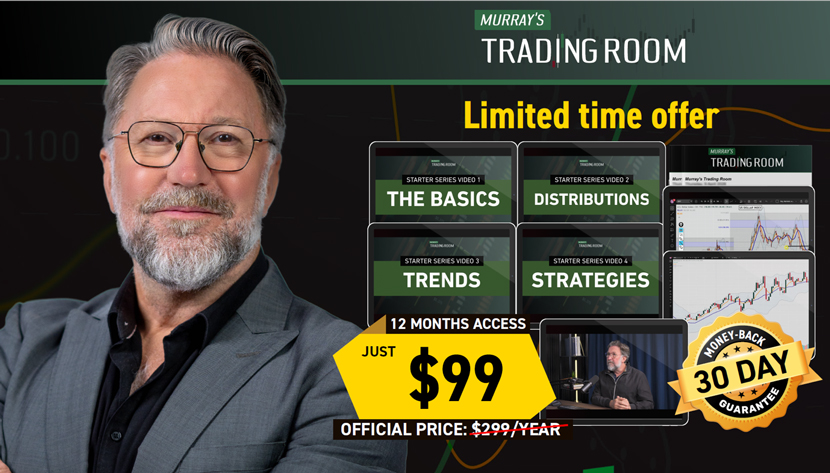
A full annual membership to Murray's Trading Room costs just $299, which is peanuts, frankly, when you consider the value of having a professional trader weigh in on your stock choices.
However, for a limited time, you can join Murray's Trading Room for just $99 for your first full year.
That's a saving of $200.
If you want to claim it, click the button below and we'll help to get you set up.
Now, I want you to feel completely comfortable about your decision today, so there are a couple of other benefits that I'd like to tell you about...
First, if you decide to stick with your membership in 12 months' time, you won't pay the full price for your renewal.
You'll pay just $199, saving $100 on the official rate.
And we'll lock that price in for you every year that your membership remains open.
And second, if you decide Murray's Trading Room isn't for you for any reason at all, call us in the next 30 days and we'll refund your membership fee in full, no questions asked.
So have a think about what that actually means...
You can join right now, sit in on a couple of the next few live sessions with Murray, send in a stock or two, and watch the whole video library.
And if you decide it's not for you, you can get your $99 joining fee back.
What do you think?
Well, let me just tell you that this is a limited time offer. Once it expires, the price jumps back up to $299.
Click on the button below to get started right away.
Muzz, anything you want to add?
MURRAY DAWES:
What I want people to think about is that we are building a community of people with ideas.
So not only are you getting ridiculously cheap access to the bulk of my trading methodology — something that has taken me a long time to build — you're also joining a group of people all working together.
I'll be analysing all the best ideas, educating you along the way, and you may end up possibly getting a great idea or two for free.
Just imagine you get one stock over the whole year... something I think is worth investigating. So you buy it.
What if you make thousands of dollars from it?
$99 will seem pretty cheap then. Plus you’re getting access to all the trading education. So there are huge benefits to getting involved.
If you've got a stock that you're in, you're wondering what to do with...
...Or you've got one that you're really excited about that you want to get on...
This is your opportunity
It really can be the difference between making and losing money.
And not only that, it's also about lowering your stress levels. Trading is a very stressful game if you don't know what you're doing. Markets are volatile. None of us like that feeling of going up and down all the time.
I can teach you a process to not only help you learn how to make money, but how to lower stress. You can actually shoot for high returns but do it in a way that doesn't give you a heart attack! That’s really what this has been about today.
So, really, 99 bucks? It’s cheap as chips!
There’s a button below. Click on that. Get started. It's a no brainer.
NATALIE WOOD:
I think that is the perfect place to leave it.
Muzz, thank you so much for your time and everything you've shared today. I've personally learned a ton of stuff, and I know that everyone watching would have too.
MURRAY DAWES:
There's never been a better
time to get involved
Albo's about to stitch us all up, change all the rules, and make it harder to make money. And I can show you how to do it; how to create good returns without stressing out all the time.
Manage the risk really well and results will take care of themselves.
99 bucks. Click on the button below and I'll see you in there...
NATALIE WOOD:
Thanks, Muzz.
Folks, we're almost done.
Here's what I'd love for you to take away from our time together today...
You don't have to pick a stock on a whim, or a hot tip and then cross your fingers and hope.
There's another way to do this.
You can invest with confidence... with rules behind your decisions... without second guessing yourself every single time the price moves.
Knowing that you can sleep easy at night, whatever the market's doing.
And that's not a fantasy.
You’ve seen it today. It's a skill and it's learnable.
A way of finding the right stock in a trend before it's peaked... buying it when the timing's right... managing it so the worst case keeps getting better the longer it runs your way... and then getting out cleanly with a strong result.
That's a completely different
game to
the one most
investors are playing
And as of today, it's available to you.
The offer is live, $99 for your first full year of Murray's Trading Room, $200 off but only for a limited time — after that, the price goes back up.
So, if today’s got you thinking: ‘I want that kind of read on MY stocks,’ click the button below. It takes two minutes and your access starts straight away.
That's it from us.
Thank you so much for being here today.
From Murray and me, take care of yourself, and we hope to see you on the inside.
Sincerely,

NATALIE
Fat Tail Investment Research


 All figures accurate as at 16/04/2024. Please download and read our