
— JAMES ‘WOODY’
WOODBURN — PUBLISHER —

James Woodburn

James Woodburn

What do all stocks that rise hundreds — sometimes thousands — of percent have in common?

The answer is one word.

MOMENTUM.

Small moves build into bigger moves.

A trickle becomes a river...

...and sometimes, if you catch it early enough, a FLOOD.

Now imagine this:

At the click of a mouse...

...you could scan the entire ASX...

...and spot those trickles of momentum BEFORE the broader market catches on.

Prepare to meet ATLAS.

Charlie and his team are almost ready to fire this up.

Our usual setup at Fat Tail HQ by the South Melbourne markets doesn't quite have the horsepower for a live demo like this...

...so today, we're coming to you from a specialist studio in Collingwood.

And in just a few moments... you're going to see something very few retail investors have ever seen before.

A deep dive inside a system we've been quietly building for a long time here at Fat Tail.

But the REAL leap has come in just the last 12 months.

As we've thrown a specialist team — and a new generation of AI capability — at this project.

ATLAS is the result.

A next-generation trading engine designed to turn the ASX into a live, ranked opportunity map.

Meaning instead of drowning in thousands of tickers...

...you can narrow the market down to the strongest emerging momentum opportunities in seconds.

One click.

One ranked view.

One instant snapshot of where money is ACTUALLY flowing right now.

Over the past year, we've effectively turned part of our research operation into a live AI lab.

Quants, coders, traders — all focused on one problem:

Can we build an AI system capable of outpacing this market?

Not a chatbot.

Not some repackaged American software platform.

But a genuine, Australian-built AI trading engine designed for one purpose:

Finding momentum on the
ASX
before the crowd does

That's exactly what Charlie and the team have built.

And in a moment, he's going to walk you through it live.

Because what you're about to see goes well beyond a traditional research service.

ATLAS is designed to solve one of the biggest problems modern investors now face:

Too many stocks. Too much noise. Too much information moving too fast.

Right now, there are between 1,500 and 1,600 small to mid-cap stocks listed on the ASX.

ATLAS is built to continuously scan that universe...

...track where momentum is building...

...and rank the stocks showing the strongest combination of money flow, trend strength and market pressure right now.

The prime movers.

The names the market is beginning to cluster around.

And instead of spending hours buried in charts, announcements and financial headlines...

ATLAS can do this for you... IN SECONDS.

Continuously scanning...

Continuously ranking...

Continuously adapting.

Now words are cheap. You need to see this thing in action.

So, let's launch ATLAS right now, and explore the engine in its first-ever demo.

Ladies and gentlemen,
meet ATLAS...

— Charlie Ormond
— Editor & ATLAS Architect —

James Woodburn

Charlie Ormond

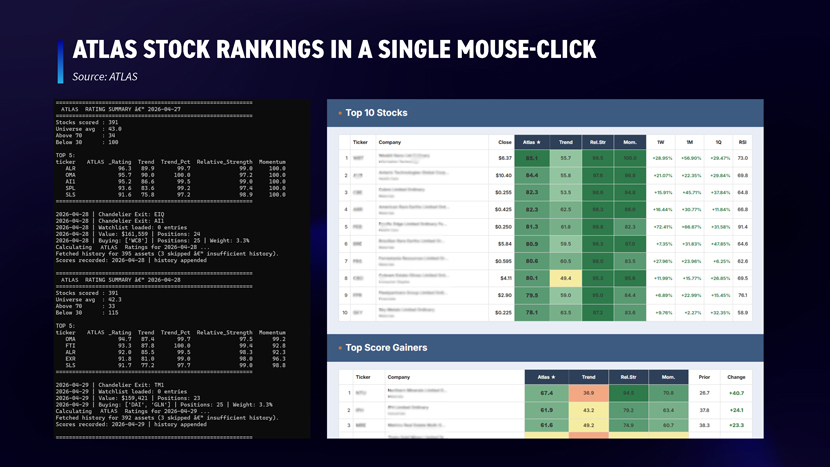
To start, I want to show you something.

Right now, you're looking at ATLAS running live. It's scanning the entire ASX small-cap universe.

Every price move.

Every shift in momentum.

Every trend strengthening...or breaking down...across hundreds of companies simultaneously.

...

And by the time we finish this presentation...

...it will have ranked them all.

Not on hunches. Not on opinions.

But on a quantitative system applying the same process...the same logic...and the same discipline...

...EVERY SINGLE TIME.

In a moment, I'll explain how it works. Why we built it specifically for today's market.

And how ATLAS can instantly narrow thousands of stocks down to the names showing the strongest momentum right now.

The goal is clarity.

A cleaner view of where money is moving, without spending your life buried in charts and headlines.

And by the end of today you'll see exactly what stocks ATLAS is flagging right now...and the criteria it's using to rank them.

But first, I wanted you to see it running.

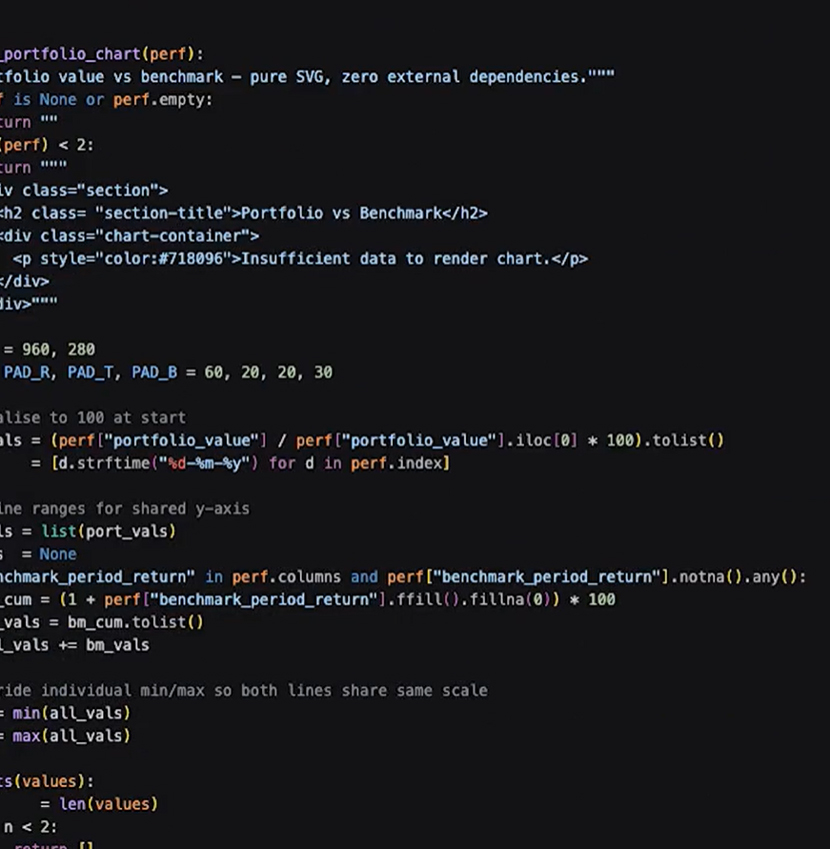
I know this just looks like lines of code on a screen...but this is what real AI systems actually look like underneath the hood.

Every AI platform you use today has something like this happening in the background.

You just never normally see it.

And that's important.

Because what you're about to see is not a polished concept video...or a flashy pitch about some future technology.

This is live.

It's real.

And it's running right now while we talk...

Scanning...sorting...ranking.

Identifying momentum trade
opportunities
with a simple
1–100 ATLAS rating

And those ratings matter.

Because as you'll see throughout today's presentation...

...when ATLAS gives you a very high rating...

...it's often identifying stocks entering powerful momentum phases.

Take a few names you probably already know.

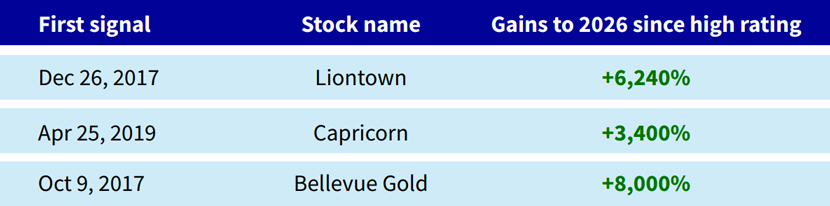
Liontown Resources.

Capricorn Metals.

Bellevue Gold.

...

Hypothetical results derived from simulated back-testing and not indicative of future performance.

In ATLAS's historical back-tests, those stocks all triggered extremely high ratings before their major runs began.

Liontown, for example, first triggered a high-90s ATLAS rating in late 2017.

From there, the stock went on to climb more than 6,000% until this year.

Capricorn Metals delivered a gain of more than 3,400% up until 2026 — after first being flagged in historical simulations in 2019.

And Bellevue Gold rose more than 8,000% between 2017 and 2026.

Now...

The prime word there is BACKTEST.

Back-testing has real and inherent limitations.

Simulated results are hypothetical.

They can't fully account for live-market chaos, slippage, psychology or unexpected events.

And past performance — simulated or otherwise — never guarantees future results.

The true test comes when a system moves from historical simulation...into the live market.

That's what today is about.

ATLAS is not a flawless oracle that predicts every move.

It's a disciplined system designed to cut through noise...and spotlight where momentum appears to be building...earlier.

And more systematically.

We're not trying to predict the future.

We're trying to identify where money and momentum are already flowing...before most investors fully recognise it.

And by the end of today's presentation...

...you'll see exactly the kinds of stocks ATLAS is flagging in the live market right now.

Why ATLAS is a godsend

in this market

Look, you've seen the news. You've seen the markets. Things are CRAZY.

You wake up and your portfolio suddenly looks very different.

Not because of company news.

But because something happened overnight in a shipping lane...a parliament...or a conflict zone on the other side of the world.

One tweet. One drone strike. One surprise policy change.

And instantly, money moves…

Most private investors don't lose money because they're stupid.

You lose because you're LATE. You're busy. You have a life.

Or quite literally, you were asleep while the market started repricing!

That's the environment ATLAS was built for.

Take what happened earlier this year when tensions around the Strait of Hormuz suddenly escalated.

Friday night, Australian time, reports emerged about a major disruption to a third of the world's oil supply.

By Sunday evening, oil futures were already moving.

By Monday morning in Sydney, energy stocks were gapping higher.

Shipping companies were repricing.

And second-order effects were rippling into fertiliser, agriculture, even food and retail-related sectors.

If you spent the weekend glued to headlines, you might have caught it.

If you didn't, you walked into Monday morning already behind the move.

Now here's what's interesting.

When we simulated ATLAS over that time, it had already started buying energy stocks BEFORE hostilities officially began.

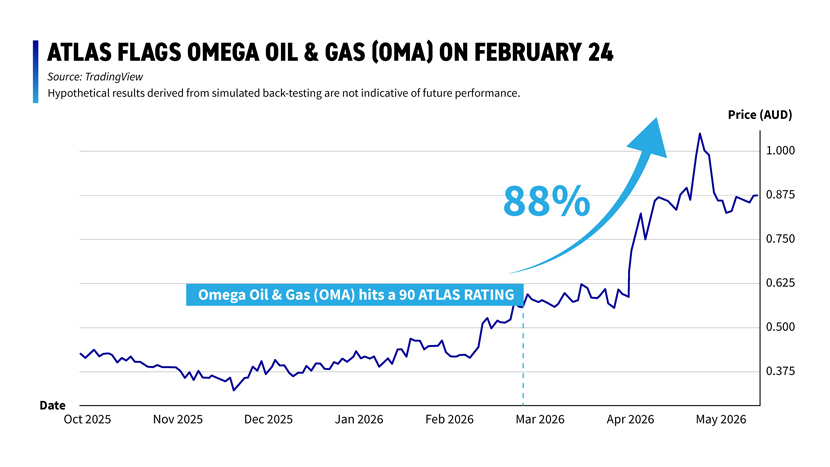
On February 24th — four days before the conflict escalated — ATLAS flagged Omega Oil & Gas.

...

And honestly looking at this chart, I probably don't need to tell you where the conflict started.

Two months later, that position was up 88%.

Now again...

That's a back-tested example. Back-tests are hypothetical.

They're useful for studying historical behaviour — not predicting future certainty.

And past simulated performance never guarantees future outcomes.

But the point is this:

ATLAS is built to detect where
money and
momentum appear to
be moving...often
before the
broader market fully catches up.

And in today's market, that matters.

Because the sheer amount of information hitting markets right now is staggering...

  • Central banks moving rates in different directions.
  • AI reshaping entire sectors almost overnight.
  • Trade wars redrawing critical mineral supply chains.
  • Geopolitical shocks repricing energy markets in hours.
  • And all of it moving faster than at any point in market history.

The reality is, the modern market moves too fast for most people to process properly in real time.

News cycles that once took days to play out now unfold in hours.

Money rotates between sectors faster than most people can update a watchlist.

And that changes the game.

Because the old approach...

Find a good stock, do your research, buy it, hold it...

There's nothing inherently wrong with that approach.

But in markets moving this quickly...it's SLOW.

And slow increasingly means you're buying AFTER momentum has already started...

...and reacting AFTER conditions have already changed.

That's why the edge today ISN'T prediction.

Nobody can predict the next geopolitical event...the next supply shock...or the next market panic.

The edge is POSITIONING.

Identifying momentum as it begins building.

Tracking where capital is flowing in real time.

And responding systematically...instead of emotionally.

Because no human can realistically track every stock...every sector...every rotation...and every momentum shift simultaneously.

Not consistently.

Not without missing something.

You need a precision tool to do that work.

That tool is ATLAS.

The origin of ATLAS

This didn't start as a tech project.

Or an urge to jump on the AI bandwagon.

In fact...

Fat Tail was experimenting with machine-assisted trading years before ChatGPT showed up.

So in many ways, we were early.

But over the last year...something changed.

The technology caught up with the ambition.

What began as rough and experimental – has evolved into something far more powerful.

That evolution is ATLAS.

And at its core, ATLAS was built to solve a problem investors keep telling us about again and again.

Information overload.

There's more data than ever.

Research reports. Breaking news. Broker notes. Sector flows. Announcements.

All coming at you 24/7.

But knowing what matters...what doesn't...and how to turn all that noise into clear, actionable insight?

That's harder than ever.

So, here in Melbourne, at Fat Tail Investment Research, we tackled that problem head-on.

The remit was simple:

Build a systematic way to see
where
momentum is actually
forming on the ASX.

For me, this also drew on work I'd done years earlier with Microsoft...back when deep machine learning was still the domain of specialists.

And well before ChatGPT rewired the world's understanding of AI.

Back then, I helped craft hands-on machine learning courses.

So, when the new generation of AI capability arrived, we asked a simple question:

"How do we make this genuinely useful for Australian investors?"

And I think ATLAS is our answer.

But let me be clear about what this is — and what this isn't.

  • ATLAS is not a large language model (LLM).
  • It's not ChatGPT picking stocks.
  • And it's not some off-the-shelf American platform with an 'ASX' sticker slapped on it.

ATLAS is purpose-built.

Built here. Built for this market.

Built to rank ASX momentum using AI tools and infrastructure that simply weren't available 18 months ago.

And the name matters.

An atlas maps terrain.

That's what this system does.

It maps the momentum landscape of the ASX.

Where trends are forming. Which sectors are leading. And which ones are losing steam.

It doesn't predict the future.

It reads the present...faster and better than any human can.

Let me give you another example from our historical simulations...

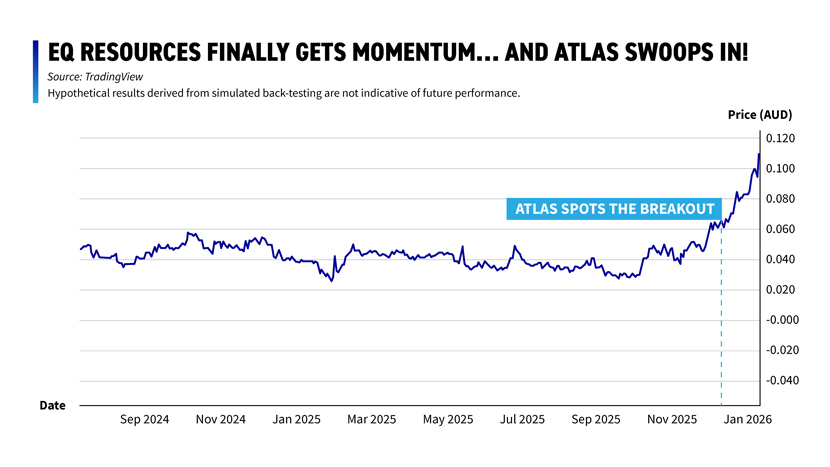
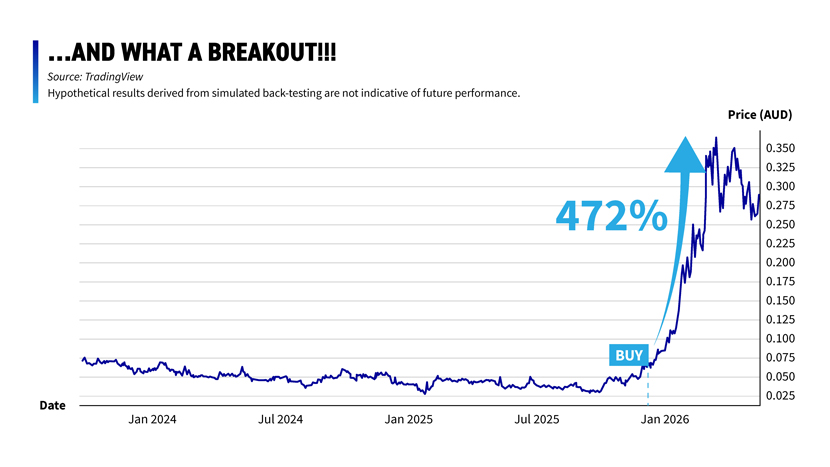
In early December 2025, ATLAS flagged a tiny tungsten miner:

EQ Resources — ASX:EQR.

For most of 2025, the stock traded sideways.

Then it began to break out.

...

And ATLAS caught the shift.

The system gave EQR a rating of 91.1 at entry.

From there, the stock moved from 6.6 cents...to 10 cents...and then 17 cents by late January.

Eventually, it went on to produce a much larger move.

...

And that's the power of momentum in small-cap stocks.

When the right stock starts
moving
and the trend keeps
building...
the gains can
compound very quickly.

Now, of course, this is still a back-tested example.

And any developer can tweak parameters to make historical results look impressive.

That's the classic trap.

Which is exactly why back-tested results never promise future performance.

They're useful. But they're not the real test.

The real test is live market conditions.

And that's where we are now.

ATLAS is processing the live market right now.

Updating its rankings as you watch this.

It doesn't execute trades automatically. That's deliberate.

The final decision still sits with you.

But the analysis...the scoring...the ranking...that's happening right now.

So, the real question is:

How does ATLAS turn all that market chaos into clear signals you can actually use?

Let's lift the bonnet... and show you the engine that powers it.

The three pillars

ATLAS distils every small to mid-cap ASX stock into one crystal-clear number:

The ATLAS Star Rating —
scored between 1 and 100.

And the higher the score...

...the stronger the combination of trend, relative strength and momentum appears to be.

If the stock score is, for example, above 90...

That's a stock you should seriously consider buying soon.

Here’s the Three Pillars that fuel that score:

  1. Trend
  2. Relative Strength
  3. Momentum

Each carries equal weight.

Let's start with:

Pillar One

Trend

Is the market voting 'yes' on this stock?

Is the price trading above rising moving averages?

And are those moving averages themselves accelerating higher?

Because when you're trading with the trend...it's like swimming with a powerful current behind you.

When the trend disappears, you're fighting the tide.

So 'Trend' forms the first third of the ATLAS rating.

Pillar Two

Relative Strength

This is where ATLAS asks:

Is this stock merely rising with the market...or is it actually outperforming?

You see...true leaders tend to separate themselves early.

They climb when indexes stall. They hold up better during pullbacks. And they attract capital while weaker stocks fade.

That relative outperformance forms the second pillar of the system.

Then comes Pillar Three:

Pillar Three

Momentum

And this is the really important one.

Because a stock can still be trending higher...even while the move itself might be losing energy.

What we're looking for is acceleration.

A move gaining force.

ATLAS measures momentum across multiple mathematical layers and timeframes simultaneously.

Think of it like two snowballs rolling downhill.

Both are moving. But one starts gathering size, speed and force much faster than the other.

That's what ATLAS is trying to identify.

Not just movement...but accelerating movement.

It measures where momentum sits right now...how quickly it's changing...and whether conditions are strengthening or weakening beneath the surface.

That layered approach is critical.

Because momentum can shift very quickly in small-cap stocks.

So those three pillars — Trend, Relative Strength, Momentum — get combined into a single ATLAS Star Rating number between 1 and 100.

A stock scoring above 90 is typically showing strong trend, strong relative performance and accelerating momentum simultaneously.

A stock scoring below 20 is generally showing very little strength at all.

Now of course...

This is not a crystal ball. The system doesn't predict the future.

Trading will always be probabilistic.

Sometimes setups work. Sometimes they fail.

The goal is to stack the odds more heavily in your favour.

And approach the market with greater discipline and consistency.

That's what ATLAS is designed to help with.

And importantly...you don't need to calculate any of this yourself.

  • You don't need to understand quantitative analysis.
  • You don't need to manually track moving-average slopes or momentum formulas.
  • You don't need to scan thousands of charts.

ATLAS does the heavy lifting every day.

What you see is the output:

  • A ranked list.
  • A clear score.

And a top trade from me each week from ATLAS's output.

Now, this is where things start getting interesting...

Because we're opening ATLAS up to a small group of early users in the live market.

So, the obvious question becomes:

Is ATLAS a tool YOU
can easily use?

If you can read a score out of a hundred...

...and follow a clear buy or sell instruction...

...you can use ATLAS.

That's the point.

The entire goal was to take extraordinary market complexity...

...and compress it into something practical, usable and fast.

Now, having said that...

There IS one thing that will probably exclude some people from becoming ATLAS first-users.

If you're uncomfortable with speculative small-cap investing...this probably isn't for you.

Because ATLAS is designed to go where momentum is ACTUALLY forming in this market.

And more often than not, that's in smaller, faster-moving companies.

These stocks are high risk and can move aggressively in both directions.

They can be volatile. They can be thinly traded.

And at times, they can be psychologically difficult to hold.

ATLAS is not designed as a 'set and forget', capital-preservation-only strategy. And it certainly doesn't get it right every time.

And if the idea of a stock swinging sharply in a bad week would genuinely keep you up at night...then this probably isn't for you.

But on the other hand...

If you're a small-cap investor and know the risks...

...and you want a new, AI-powered edge...

...then ATLAS may become an incredibly powerful tool FOR YOU.

ATLAS results so far...

Now — the obvious question:

Does it actually work?

Let me show you.

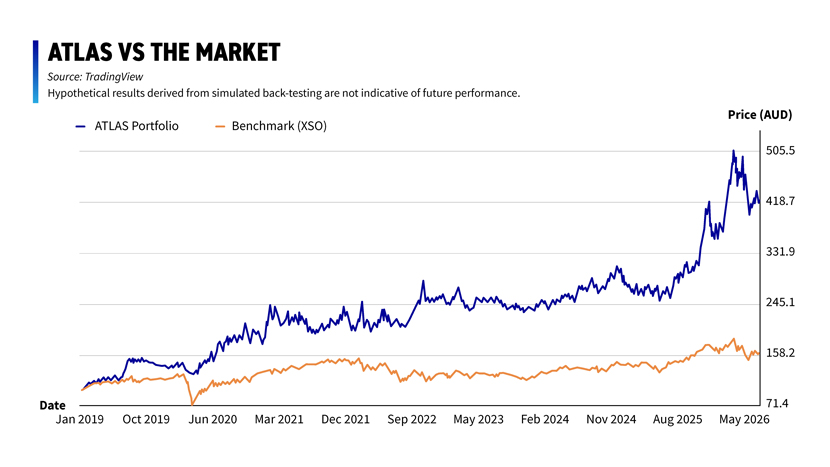
Here is ATLAS outperforming the market relative to the index since 2019.

...

But let’s look at a more recent example.

...

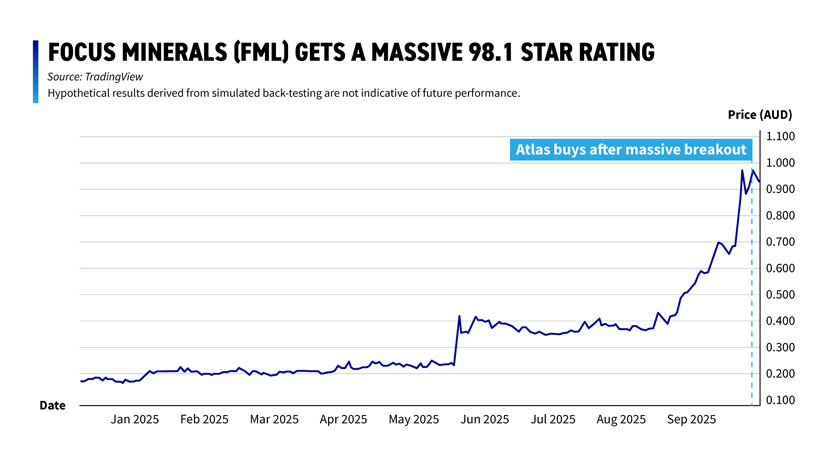
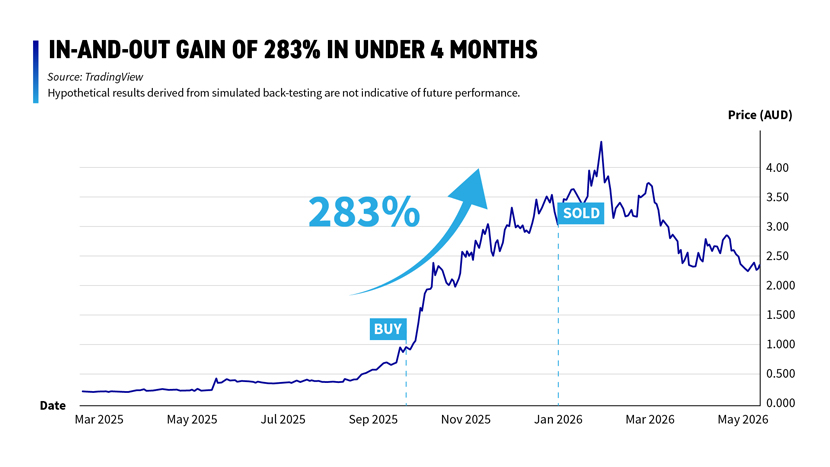
In September last year, ATLAS assigned a little-known gold explorer a Star Rating of 98.1.

That's an extremely high score.

During the early stages of that move, the ASX issued the company what traders call a 'speeding ticket'.

A formal query asking the company to explain the sudden surge in share price and trading volume.

'Is there something the market should know?' they asked.

The company said no.

But clearly... something was changing.

The market could feel it.

And ATLAS detected it.

...

Gold was entering a powerful bull phase...

...and this tiny explorer was beginning to attract serious momentum.

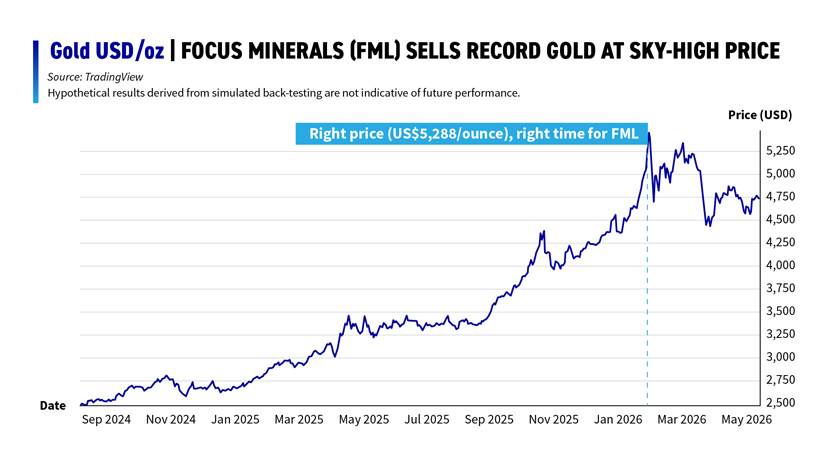
Over the next quarter, the company delivered RECORD gold production.

AT THE EXACT TIME gold pushed to all-time highs.

The stock moved from around $1...to $3...and then beyond.

...

In ATLAS's historical simulations, that translated into a gain of 283% by January this year.

But I want you to pay attention to something important here:

The exit.

We're not showing you some fantasy 'perfect trade'.

ATLAS exited as momentum began deteriorating.

Did it miss the final part of the move?

Yes.

You can see that on the chart. But it also preserved the bulk of the gains.

And as you can see, the stock then rolled over.

And that matters.

Because successful trading isn't about perfectly capturing every last cent.

It’s about identifying strong
trends and
protecting capital
when conditions change.

Now let's look at something much tougher:

COVID.

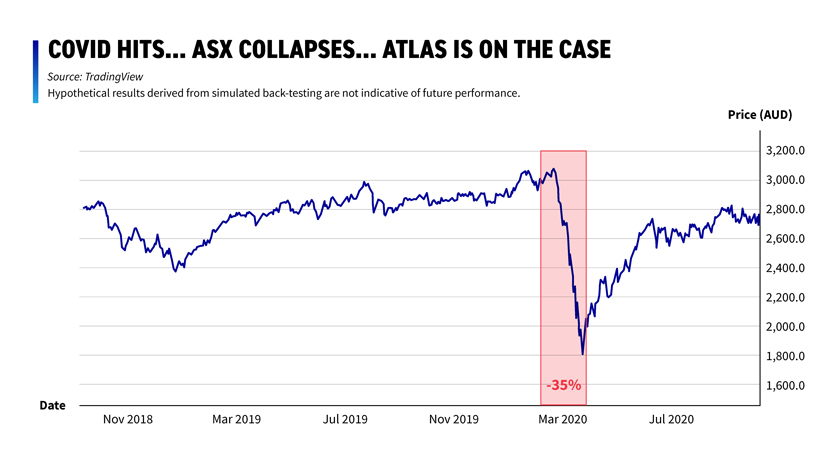
An extraordinary period for markets...and for us all...and especially brutal for ASX small caps.

...

As the scale of the pandemic became clear, ASX small caps collapsed 30%.

Eleven years of gains erased, almost overnight.

But in back-testing...

...ATLAS had already HALVED the portfolio...BEFORE the bottom hit.

THREE WEEKS before the low.

As a result, its maximum drawdown during that period was MUCH lower than the broader market.

But what's even more interesting is what happened next.

Because the real story isn't just about the losses ATLAS avoided.

It also started detecting where momentum was rotating to as the world changed.

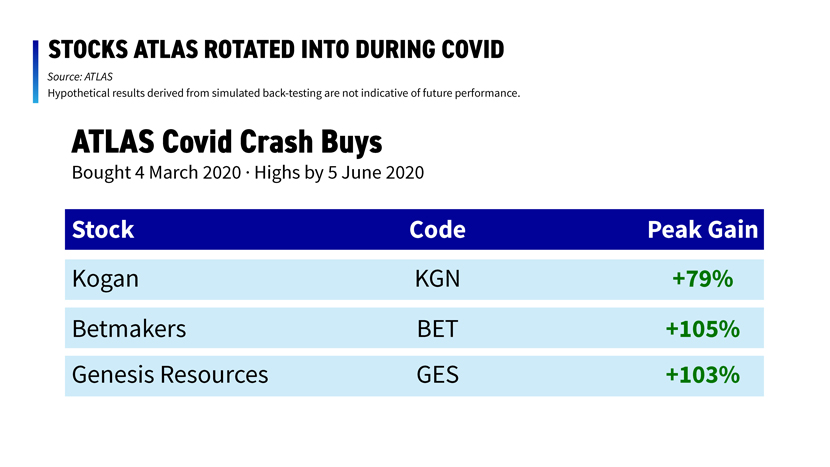
Here's one example.

...

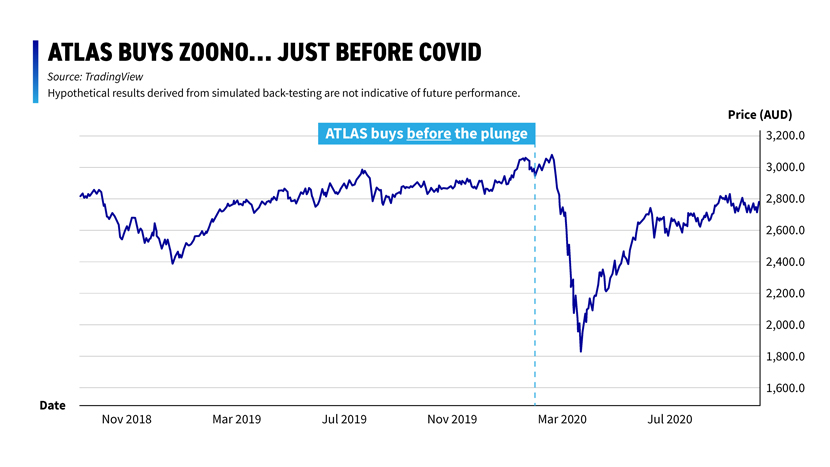
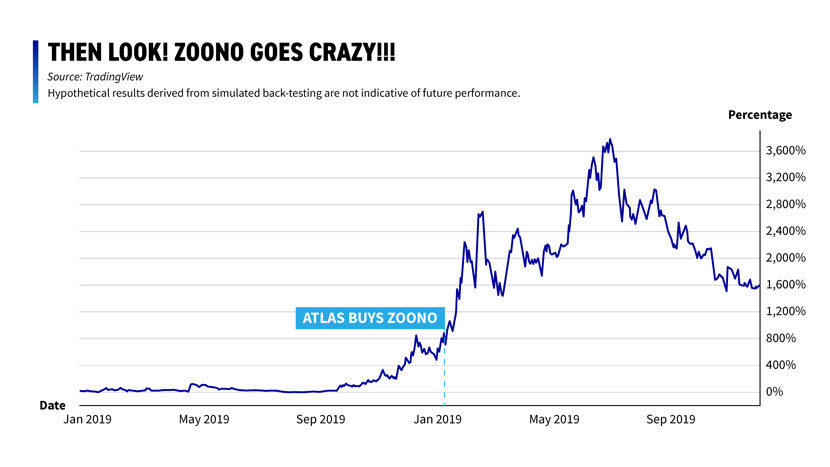
Just before the crash intensified, the ATLAS simulation flagged Zoono Group — a small company specialising in anti-microbial products.

ATLAS didn't 'understand' COVID.

It didn't predict a pandemic.

It simply detected unusual momentum and relative strength building beneath the surface.

...

And during the COVID period...the stock exploded higher.

That's what systems like this can potentially offer:

  • A clearer view through the noise.
  • Toward where capital and momentum are moving next.

...

During COVID, that meant rapid rotation into healthcare...defensive names...and online retail.

And importantly, as the broader market was still collapsing...

...

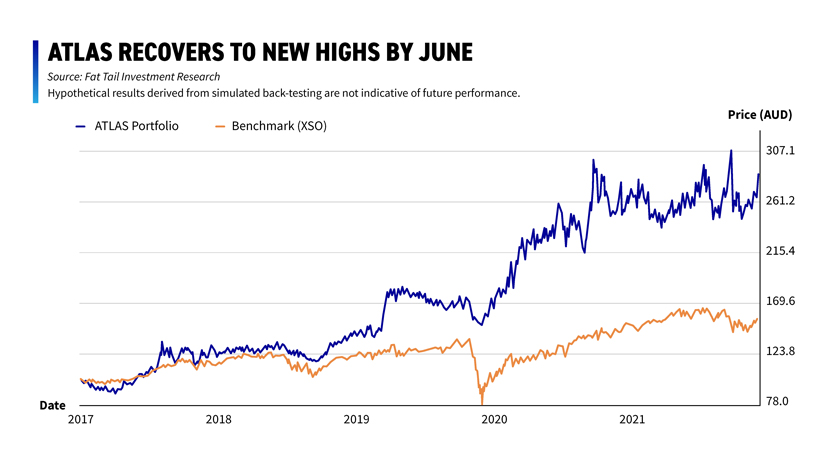
ATLAS had already begun shifting back onto the offensive by early March.

By June, ATLAS simulations had already recovered to new all-time highs... far outstripping the benchmark.

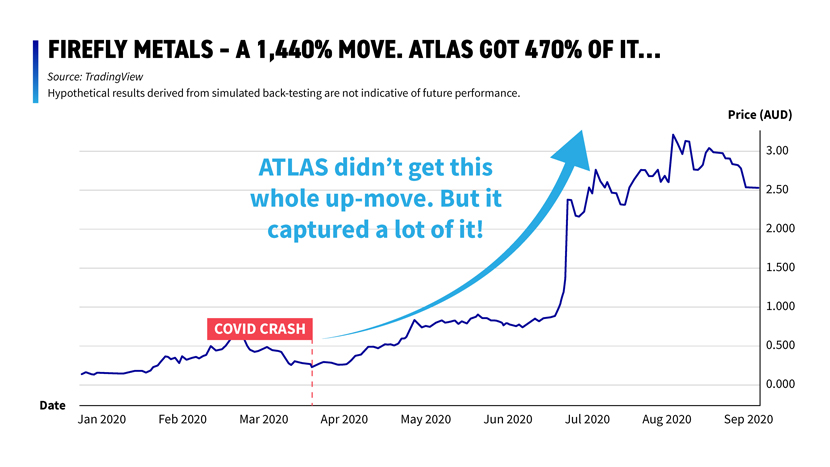
And among the stocks it continued holding with conviction through the volatility...

...were names like Firefly Metals, which later surged more than 470% in four months.

...

Nobody predicted COVID.

And ATLAS certainly wouldn't be able to 'know' a pandemic was coming.

But what it can detect...

...is deterioration in trend structure...

...weakening momentum...

...and shifting relative strength.

And it acted on that signal faster than you could say Wuhan.

That’s not prediction.
That’s
systematic risk management.

And that brings me to another important feature built into ATLAS:

Its capital protection system.

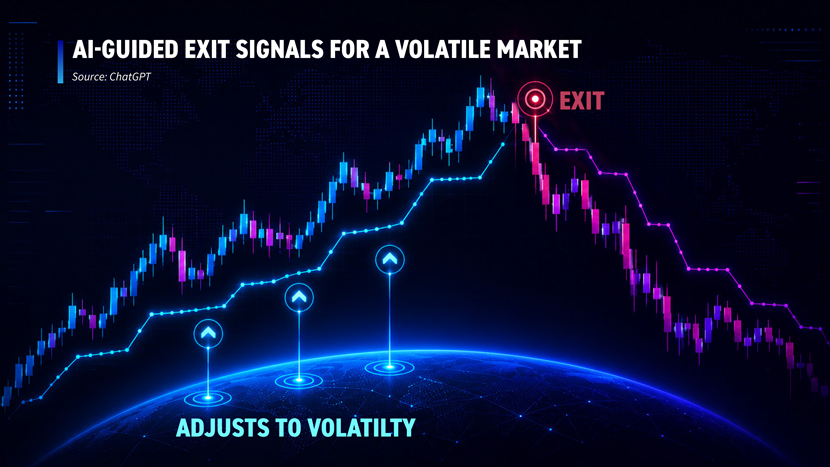
Specifically, something called a Chandelier Exit.

Simply put:

It tells you when to GET OUT.

A dynamic stop-loss that adjusts according to volatility.

When volatility spikes... the stop gives the position room to breathe.

When things are calm, it tightens.

So ATLAS doesn't just help identify trends.

It spots when trends break...and gets you out.

Now, at the risk of repeating myself...

Back-tests are not guarantees. They're hypothetical simulations.

They're extremely useful for building, refining and stress-testing systems.

But live markets are always messier than historical models.

That's why this next phase matters...

Opening ATLAS to
founding members

What happens next...is the live market phase.

Now we're opening ATLAS to an early group of founding members as the system begins operating continuously in real-world conditions.

This is not a 'beta test'.

As I said, the core engine has already been built and validated extensively behind the scenes.

What happens now is the real-world deployment.

And the investors who join us EARLY will get first-access to those rankings, signals and trade opportunities as they emerge.

At its simplest...

You could spend five minutes a week reviewing the latest ATLAS rankings and my top momentum setups currently appearing in the market.

That alone could dramatically change the way you view opportunity flow on the ASX.

But for more active traders...the system also opens a much deeper layer of exploration.

Because once you can see where momentum is clustering...

...you start spotting opportunities most investors never even notice.

And importantly...

ATLAS isn't just built around entries.

Risk management is deeply embedded into the framework as well.

Every trade is monitored for weakening momentum and deteriorating trend conditions.

And every recommendation comes with my analysis layered over the AI output.

So you're not being handed a black box and wished 'good luck'.

You're getting:

  • A disciplined quantitative framework.
  • Human oversight and interpretation.
  • Access at a stage very few investors will ever experience.

Before broader rollout. Before wider adoption.

While the system is still operating with a small founding cohort.

And that early-access phase comes with some significant perks and privileges, which I'll outline for you now...

What you’ll get starting
today

if you join ATLAS

Log in, and you get a pool of fully ranked ASX stocks.

...

Each scored 1–100 by the ATLAS Three Pillars.

  • No guesswork.
  • No chart marathons.
  • No opinion clashes.

Just PURE DATA CLARITY on what's moving NOW.

A live momentum map of the ASX, focused on the small- and mid-cap sectors.

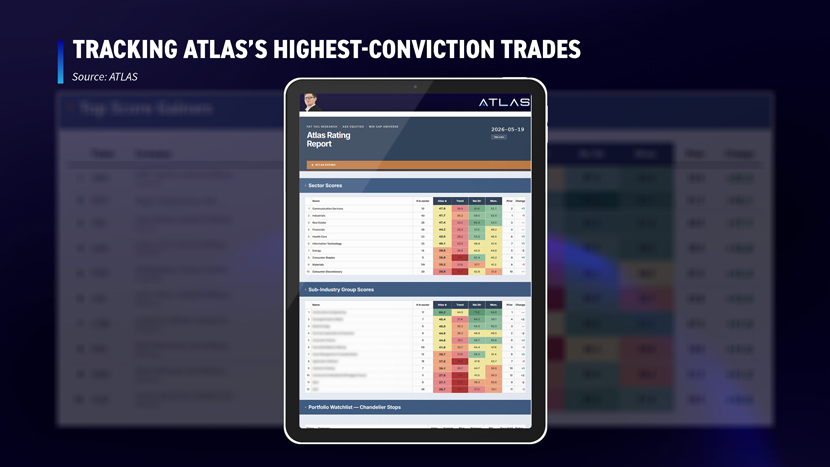
Your access includes:

  • Top-ranked momentum stocks in the market
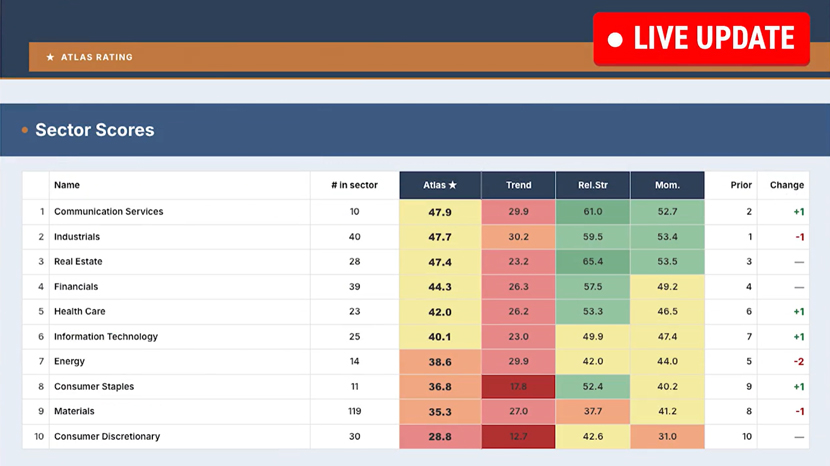
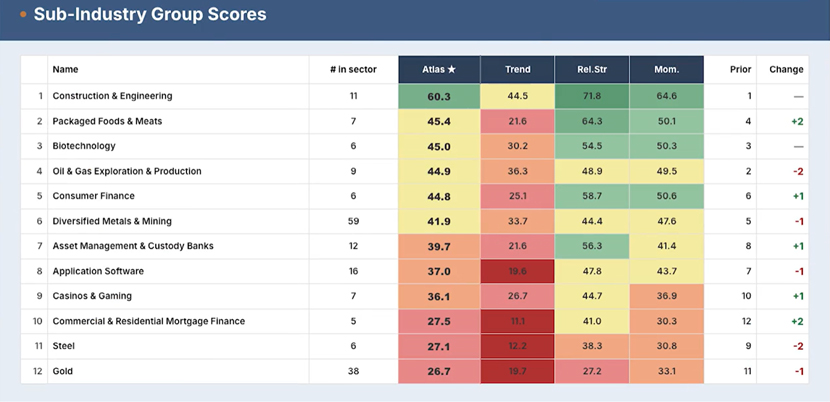
  • Sector heatmaps tracking capital rotation
  • Subsector analysis showing where leadership is emerging
  • Weekly rankings as market conditions evolve

Behind the scenes, ATLAS continuously processes trend, strength and momentum data across the market in SECONDS.

Turning information overload into FOCUS.

Then there’s:

...

Each week, I'll narrow the output down to one standout trade setup I believe deserves your attention.

ATLAS does the heavy lifting.

I apply human judgment, context and interpretation.

Each weekly setup comes with:

  • Why the stock is ranking highly now
  • The key ATLAS signals behind the move
  • Suggested entry levels
  • Risks worth watching
  • Upcoming catalysts and momentum drivers

One focused idea. Zero noise.

And then from here, we scale it up...

...

ATLAS's top ideas in a high-conviction portfolio. With a maximum of 30 holdings.

These are a pool of stocks that continue to appear at the top of ATLAS's Star Rating System.

ATLAS tells you when to EXIT as well as enter.

...

The Chandelier Exit system tracks trend decay.

I monitor and issue CLEAR EXIT GUIDANCE.

Now, while ATLAS is extremely powerful...it's also designed to be simple to use.

You literally get the results you're after with one mouse click.

That said, there are a few things you need to know to get it humming for you straight away.

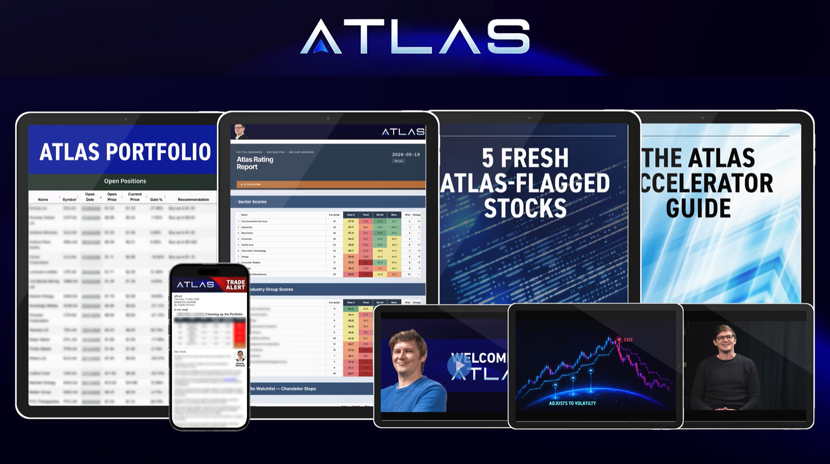
I've mapped out exactly what you need in a series of onboarding resources you can access straight away.

These include:

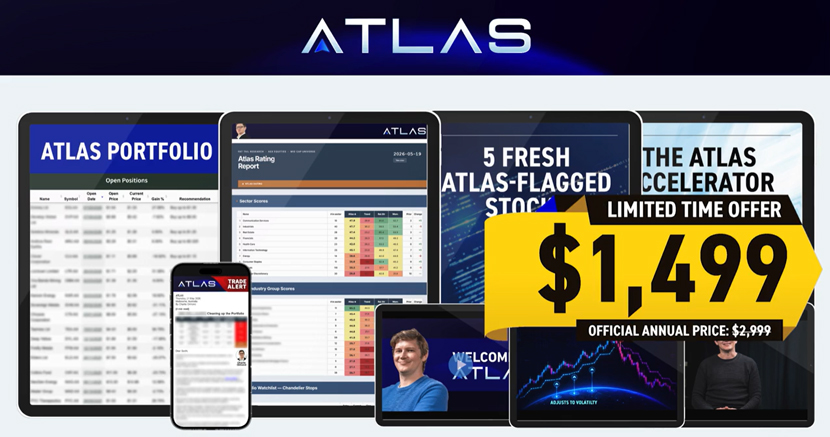
  • My ATLAS Accelerator Guide — which shows you how to get maximum potential from the engine quickly.
  • A starter guide titled 5 Fresh ATLAS-Flagged Stocks. You'll have these within minutes of joining and can choose whether or not to jump in.
  • A 5-minute video walkthrough to get you into ATLAS — log in, scan, trade. And you're away.

So from day one, you'll know exactly how to start using ATLAS effectively.

That's the full ATLAS arsenal.

...

A relentless live AI engine scanning
the market continuously for you...


...combined with human interpretation
and risk management.

Thanks for spending this time with us.

And if you'd like to become one of our founding members...

...I'll hand you back to Woody.

50% discount. And a special

founding member commitment...

— JAMES ‘WOODY’
WOODBURN — PUBLISHER —

James Woodburn

James Woodburn

I hope Charlie's demonstration gave you a genuine sense of what we've been building here.

Even if you ultimately decide not to become one of our first ATLAS users!

Now as you'd expect, access to ATLAS is paid.

But for this initial founding-member intake, we've deliberately stripped the price right back.

And I'll keep this brief...

...because by now, you probably already know whether ATLAS feels right for you or not.

As you've just seen...

ATLAS is not a conventional research service.

It's a purpose-built momentum ranking engine designed specifically for ASX small caps.

The kind of infrastructure institutional trading firms spend enormous amounts developing internally.

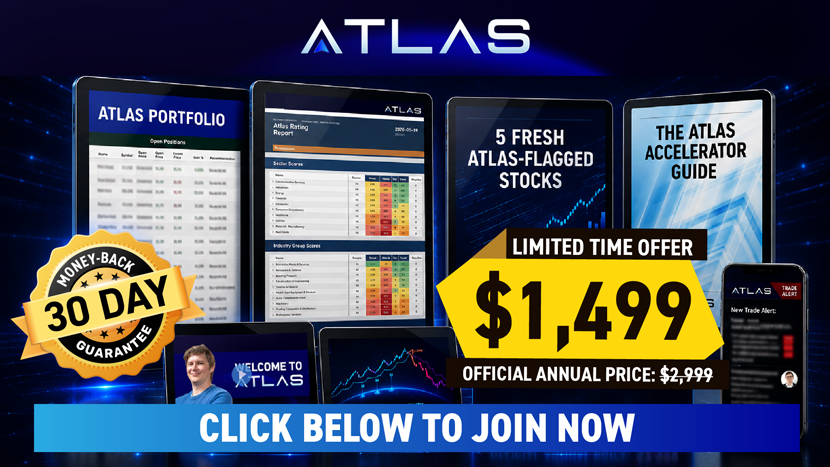
When ATLAS eventually rolls out more broadly, the standard annual membership will be $2,999 per year.

But for this initial founding-member intake...

...the first year is $1,499.

A straight 50% reduction.

...

And importantly:

That founding-member pricing remains locked in for as long as you remain an active member.

...

Why are we doing that?

Because this first cohort matters enormously to us.

You'll be using ATLAS during its first true live-market deployment phase.

Your feedback...your observations...and your real-world experience using the system...

...will help shape where ATLAS evolves from here.

We think that early participation

deserves to be recognised.

The second thing you'll receive is this:
You are fully protected for the first 30 days.

If ATLAS doesn't resonate with you...

...if the system's output doesn't click...

...or if you simply decide it's not the right fit...

...just let us know within 30 days and we'll refund your founding-member fee in full.

No hassle. Use the dashboard. Review the rankings. Follow the weekly setups.

Track the portfolio. Stress-test the system as much as you like.

Then make your decision.

Fair enough?

And finally...

To be crystal clear:

We are NOT guaranteeing profits. We are NOT promising market-beating returns.

And no trading system wins all the time.

Markets are wild. And unpredictable.

Especially in the kind of small-cap environment ATLAS is designed to operate in.

But because this is a brand-new live market deployment...

...and because as a founding member you are effectively participating in that first real-world phase with us...

...I wanted to build in an additional layer of reassurance.

So, here’s our ULTIMATE

founding-member commitment:

...

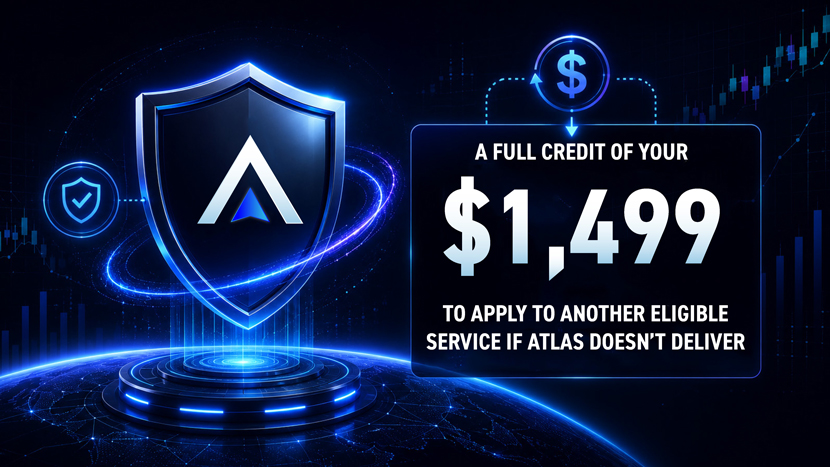
After your first 12 months, if you genuinely feel ATLAS trailed the broader ASX...JUST TELL US.

You'll be able to apply for a full and unconditional $1,499 credit toward any other Fat Tail service.

We won't even ask you to prove ATLAS underperformed.

We'll simply take your good-faith word on it and apply the credit.

Because ultimately we believe the system will speak for itself over time.

Again:

Founding-member pricing.

Two bulletproof reassurance backstops.

An unmatched edge.

The scan is complete.

The rankings are live.

Remember the opening scan Charlie showed you?

...

That scan is complete.

...

...

The first rankings are ready.

The system's live.

And the founding-membership intake is officially open.

Ideally 500 founding memberships.

If you want one, click the JOIN NOW link below.

...

You have knocked the ball out of the park recently!

– DR

I call Callum's trades “money in the bank” because of the high probability that most of his recommendations will appreciate and often quickly.

– Wel G

Probably the best advice around when it comes to investing in small caps.

– Moss